All dishes / 西欧
Pizza Margherita Period BOrigin theory DVerified
Some fields (dish name, region and gates) are shown from the Japanese-edition data.
Did Queen Margherita really inspire the pizza named after her? The story that the Naples pizzaiolo Raffaele Esposito invented the Margherita in 1889 and named it for the visiting queen is a later invention. A pizza of the very same form — tomato, mozzarella, and basil — was already described in print in 1866, more than twenty years before the royal tale is set.
Verification highlight popular claim → verdict → evidence
The popular legend that pizzaiolo Raffaele Esposito created and named this pizza for Queen Margherita in 1889 is not supported by the evidence: the one surviving letter documenting the story shows signs of forgery, and the same tomato-mozzarella-basil pizza already appears in print in Francesco De Bourcard's 'Usi e costumi di Napoli' (1866), well before the supposed naming. The pizza's form therefore predates 1889; the true origin of the name 'Margherita' remains undetermined.
The three gates
- Ingredient-supply gate
- Tomato, a New World crop
- Cooking-technique gate
- Urban wood-fired ovens and the restaurant trade
- Venue gate
- eating houses / common people
Overview
Where the Margherita actually came from
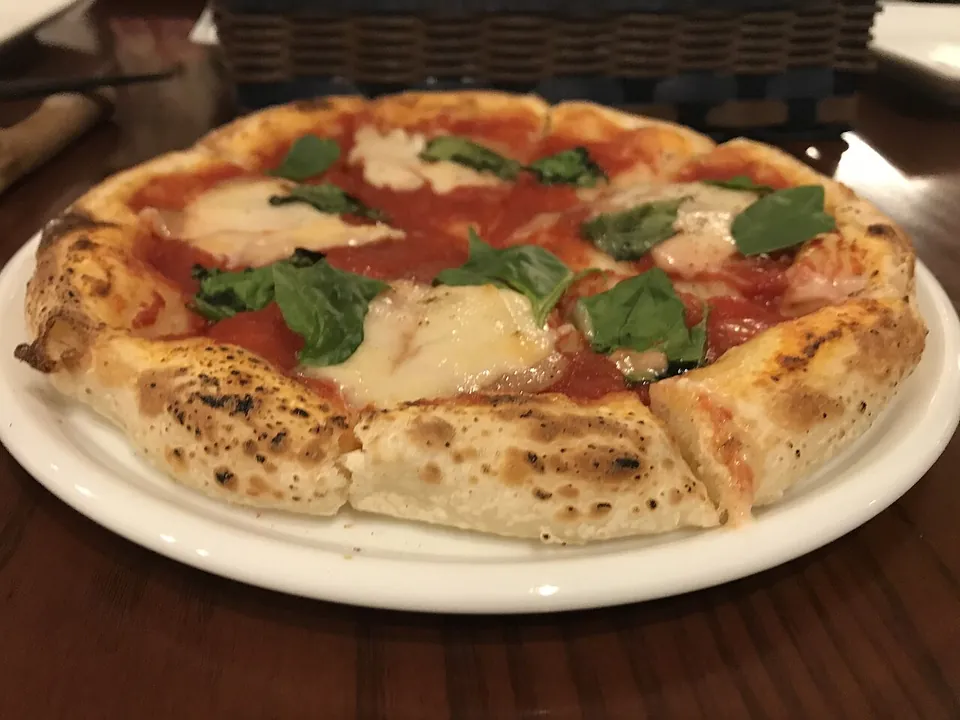
The Margherita is a Neapolitan pizza in three colors: red tomato, white mozzarella, and a few leaves of green basil on a thin round of dough, baked crisp and eaten hot in the street. The tomato at its heart reached Naples late. It crossed from the New World to Europe in the sixteenth century and was long kept at arm's length there as an ornament or a suspected poison, spreading as an everyday food in the city's kitchens only over the course of the eighteenth century.
The pizza we now call Margherita — tomato, mozzarella, and basil — took root in the streets of Naples over the course of the nineteenth century. Wood-fired ovens lined the corners, the habit of eating out grew, and pizzerias, shops devoted to the trade, began handing customers pizza straight from the oven. It was through this street life of the city that the dish settled in as everyday food for ordinary people.
Across the nineteenth and twentieth centuries, Neapolitan emigrants carried this pizza across the sea to America. There it changed into a local style with thick dough and a generous load of cheese, and American pizza branched off as a separate line.
How we know
The familiar version goes like this. In 1889, when Queen Margherita visited Naples, the pizzaiolo Raffaele Esposito is said to have made her a pizza in the three colors of the Italian flag — red tomato, white mozzarella, green basil — and to have named it in her honor.
The tale falls apart on its own timeline. More than two decades before the supposed royal presentation, Francesco De Bourcard's "Usi e costumi di Napoli" (Vol. II, 1866) already describes a Neapolitan pizza topped with mozzarella and basil. The form existed well before the name later pinned to it.
The single piece of physical evidence ever offered for the anecdote — a thank-you letter from the royal household — is dogged by doubts that will not go away. The study by Nowak ("Folklore, Fakelore, History," Food, Culture & Society, 2014), summarized by Scott's Pizza Tours, notes that the seal and the signature (Galli Camillo) do not line up, and that the purported sender's name, "Esposito Brandi," clashes with the dates. And the Geneva Gazette of 25 July 1880 had already reported the queen eating pizza in Naples — before Esposito's shop even opened in 1883. On the sequence of events alone, the 1889 naming cannot stand. National Geographic has carried these points to a wide readership.
So the dish itself — tomato, mozzarella, and basil on a Neapolitan pizza — was real and on the streets of Naples well before 1889. Where the name "Margherita" actually came from, the sources still do not say. The queen's anecdote has been set aside; the true origin of the name remains an open question.
The full set of origin theories and the detailed verification log — traceable all the way to their sources — are available on the Japanese edition.
See the full origin theories and verification log (Japanese) →
Related dishes
Cross-links Sister dishes & same-name dishes (separate lineage)
Shares the key ingredient
- Pasta al pomodoroSouthern ItalyB
- ShakshukaMiddle East / North AfricaC
- Jollof riceWest AfricaC
- Butter chickenDelhi (India)C
- Khao SoiB
- GazpachoAndalusia (Spain)C
- LecsóHungaryC
- Chana masalaNorth India (Punjab)C
- RatatouilleProvence, France (Nice)C
- Thieboudienne (ceebu jën)SenegalC
- ChakalakaSouth AfricaC
- KedjenouIvory CoastB
- Caprese saladCapri (Italy)C
- SaloonaPersian Gulf (Bahrain and Kuwait)C
- Shan khauk hswè (Shan noodles)Myanmar (Shan State)C
- FrancesinhaPorto (Portugal)D
- ChakhokhbiliGeorgia (Caucasus)C
- KachumberGujarat (Western India)C
- SalmorejoAndalusia (Spain)C
- Greek salad (horiatiki)GreeceC
- Shopska saladBalkans (Bulgaria)B
- Melanzane alla parmigianaItalyC
Similar dishes Overlapping ingredient, period or region
More debunked origins
Other famous dishes whose popular origin story doesn't survive the sources.