All dishes / 北米
Fortune cookie Period BOrigin theory CVerified
Some fields (dish name, region and gates) are shown from the Japanese-edition data.
Are fortune cookies really Chinese? No. The cookie handed to you at the close of a Chinese meal has no tradition in China at all. Its trail runs back to the tsujiura senbei of nineteenth-century Kyoto and to Japanese immigrant confectioners in early-twentieth-century California.
Verification highlight popular claim → verdict → evidence
Popular claim: the fortune cookie is a Chinese invention. Verdict: refuted -- it has no tradition in mainland China and instead traces to Kyoto's tsujiura senbei (fortune-telling cracker), documented in an 1878 Japanese illustrated book, decades before any American version. Japanese immigrants in early-20th-century California (including Makoto Hagiwara's Japanese Tea Garden) sweetened and popularized it for American customers; production later shifted toward Chinese-run restaurants, especially after Japanese Americans were interned during World War II, which helped cement the misconception. The exact inventor (Hagiwara vs. David Jung vs. Seiichi Kito) remains disputed even after a 1983 mock trial. Key source: research by Yasuko Nakamachi.
The three gates
- Ingredient-supply gate
- Wheat, sugar, and eggs were all readily available, so ingredients were not the limiting factor. The limiting factor was technique and setting, namely the baking mold and the supply networks of immigrant neighborhoods.
- Cooking-technique gate
- A baked disc is folded while warm to enclose a paper fortune inside, a shaping technique derived from Kyoto's tsujiura senbei (fortune-telling crackers).
- Venue gate
- Served at restaurants and confectioneries in Japanese and Chinese immigrant neighborhoods on the US West Coast.
Overview
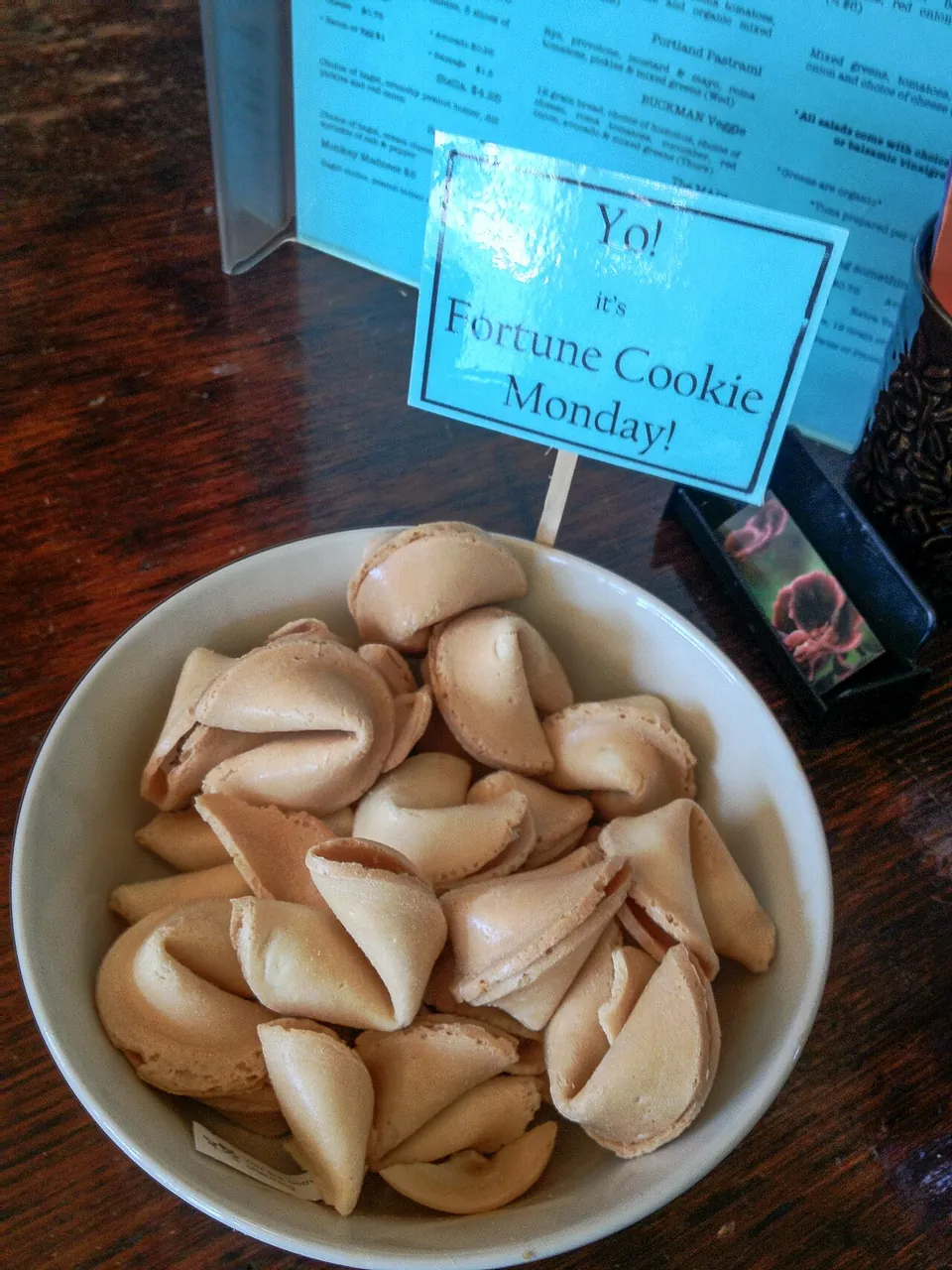
A fortune cookie is a thin baked wafer, folded in half while still hot so that a slip of paper with a printed fortune sits sealed inside. The dough is ordinary enough—wheat flour, sugar, egg. What set the cookie apart was the knack of folding the hot wafer around the paper over a baking iron, practiced in the confectioneries and restaurants of the Japanese and Chinese immigrant districts along the California coast in the early twentieth century.
Its ancestor is the tsujiura senbei of Kyoto: a senbei with a fortune slip folded inside, sold along shrine approaches. An illustrated book printed in Osaka in 1878 already shows a confectioner's apprentice baking tsujiura senbei—roughly thirty years before any American claim to the cookie. Japanese confectioners who crossed to the United States sweetened the senbei to local taste and turned it into a shopfront treat. One of the earliest American traces is a record of the sweet being served around 1914 at Makoto Hagiwara's Japanese Tea Garden in San Francisco.
Then the makers changed. Around the Second World War, as Japanese immigrants were forced into internment, the making of the cookie passed from Japanese to Chinese hands. After the war it spread as a fixture of Chinese restaurants—and that is how a Japanese-American sweet came to be read as a Chinese one.
How we know
Almost everyone assumes the fortune cookie was born in China; the sight of it arriving at the end of a Chinese meal is simply too familiar. Yet mainland China has no tradition of the cookie, and the China-origin belief has been set aside by scholarship.
The folklorist Yasuko Nakamachi spent years following the thread and found the prototype in the tsujiura senbei of Kyoto. The decisive piece was that 1878 Osaka book, Moshiogusa Kinsei Kidan, in which a senbei-shop apprentice is drawn baking tsujiura senbei. A fortune slip folded into a senbei was plainly present in nineteenth-century Japan—well before the 1900s and 1910s from which the American side dates the cookie. The Japanese lineage is corroborated by several independent reports that overlap, among them HISTORY, CNN, KQED, National Geographic, and the reporting of Jennifer 8. Lee. It was Japanese immigrants in San Francisco who carried the form across and sweetened it, and this Japanese-American origin is now the established view. The Chinese association is a later misreading, born when the makers changed during and after the war.
One question stays open: who first devised the American cookie. Makoto Hagiwara of San Francisco, David Jung of Los Angeles (Hong Kong Noodle Company, 1918), and Seiichi Kito, also of Los Angeles, each has a claim. A "Court of Historical Review" held in San Francisco in 1983 ruled in Hagiwara's favor, but Los Angeles never accepted the verdict. The broad frame—a Japanese-American origin—has firmed up; the credit for any single inventor remains unsettled.
The full set of origin theories and the detailed verification log — traceable all the way to their sources — are available on the Japanese edition.
See the full origin theories and verification log (Japanese) →
Related dishes
Shares the key ingredient
- PierogiPolandC
- EmpanadaRío de la Plata (Argentina)C
- BliniRussiaB
- PirozhkiRussiaB
- CheburekiCrimea (Crimean Tatar)C
- BelyashiVolga-Ural (Tatar / Bashkir)C
- JalebiNorthern IndiaB
- StroopwafelGouda (Netherlands)C
- LamingtonQueensland (Australia)C
- ChimichangaTucson, Arizona (USA)C
- BuuzMongoliaB
- YantıkCrimea (Crimean Tatar)C
- VarenykyUkraineC
- MandaziEast Africa (Swahili Coast)C
- LángosHungaryC
- Daoxiaomian (knife-cut noodles)Shanxi (China)C
- KhuushuurMongoliaB
- Dobos torteHungaryB
- SambusaEast Africa (Swahili Coast)B
- SarburmaCrimea (Crimean Tatars)B
- ThenthukTibet / NepalB
- ShumaiGuangzhou (China)B
- Jiaozi (gyoza)ChinaC
- Hohhot shaomaiHohhot (China)B
- OliebollenNetherlandsC
- MarquesitaYucatán (Mexico)D
- Halwa puriLahore (Pakistan)D
- Roti prataSingaporeB
- SopaipillaNew Mexico (USA)C
- CoyotaSonora (Northern Mexico)C
- RunzaMidwestern United StatesB
- BanshMongoliaC
- Kashyk-ash (къашыкъ-аш, Crimean Tatar spoon-dumpling soup)Crimea (Crimean Tatar)C
- KulebyakaRussiaB
- Spring roll (Chinese)ChinaC
- ChuchvaraUzbekistan (Samarkand / Fergana)C
- DamperAustraliaC
- SamsaCentral AsiaC
- HalushkyUkraineC
- BanitsaBalkans (Bulgaria)C
- Har gowGuangzhou (China)C
Similar dishes Overlapping ingredient, period or region
More debunked origins
Other famous dishes whose popular origin story doesn't survive the sources.