All dishes / 西欧
Francesinha Period COrigin theory DVerified
Some fields (dish name, region and gates) are shown from the Japanese-edition data.
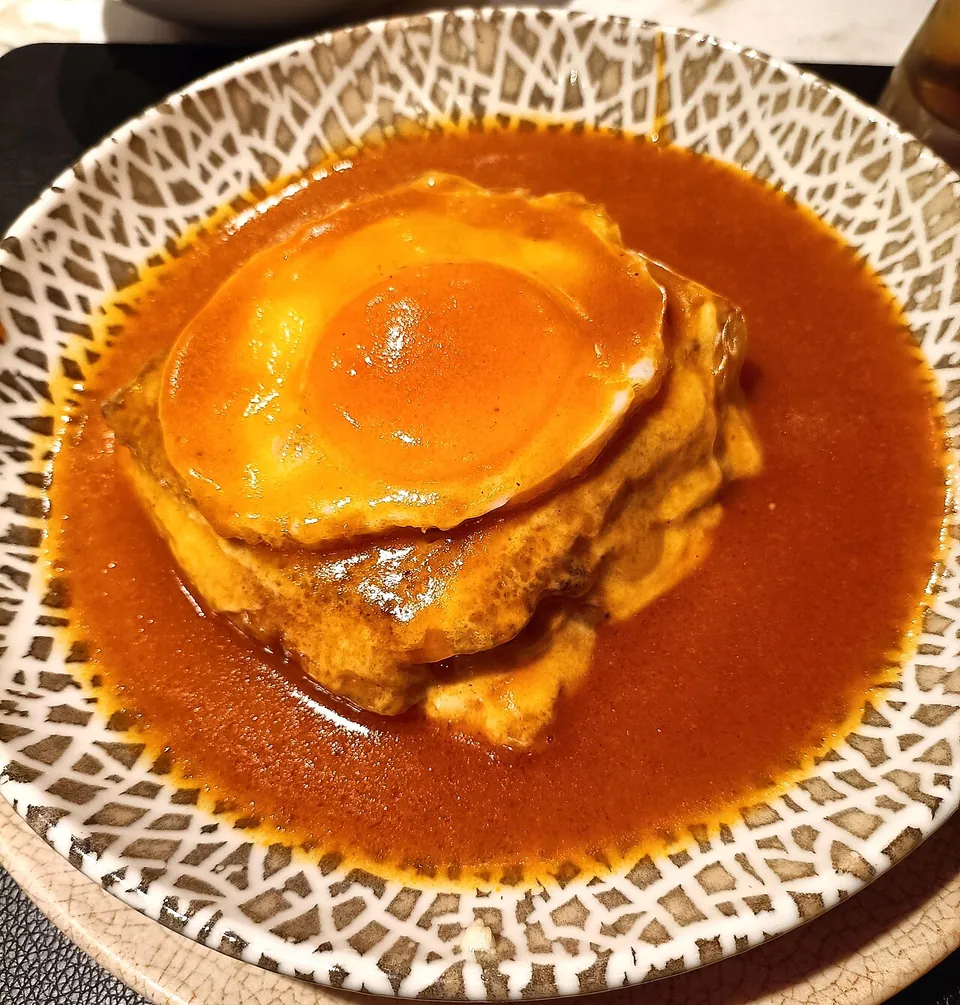
Porto's heavy hot sandwich, the francesinha. The famous origin tale - that in 1953 a returning emigrant, Daniel da Silva, single-handedly devised it at the cafe A Regaleira - has no dated contemporary record, and its details shift with every retelling. It is a story tidied up after the fact.
Verification highlight popular claim → verdict → evidence
The standard story credits Daniel David da Silva with single-handedly inventing the dish in 1953 at Porto's A Regaleira, naming it after a French woman who found it too spicy. No dated 1950s newspaper, advertisement, or document supports this; it rests only on family oral history and later retelling, with inconsistent details across versions. The dish is better understood as a Porto adaptation of the French croque-monsieur that only gradually became a symbol of local tradition over the following decades. Main sources: Manuel Teles Fernandes's 2020 study and a Público newspaper investigation.
The three gates
- Ingredient-supply gate
- Bread, meat, and cheese were already available locally; the tomato sauce depends on the New World tomato having arrived first.
- Cooking-technique gate
- Layered ingredients are baked until the cheese melts, then covered with a hot sauce.
- Venue gate
- Served at cafés and restaurants in the city of Porto, as everyday food eaten out.
Overview
The francesinha is a Porto specialty: bread toasted crisp, layered with pork, sausage, and ham, capped with melted cheese, and drowned in a hot sauce sharpened with tomato and beer. It crosses the French croque-monsieur and croque-madame with the cheese-sauce idea of Welsh rarebit, swapping in the meats and cheeses of northern Portugal and the tomato that took root from the New World. The name francesinha means "little French girl," keeping its French-sandwich lineage right there in the name.
This dish was born not in the home kitchen but in the cafes and restaurants of the city. Stacking the fillings, melting cheese over them, and pouring hot sauce over the plate before the customer - this presentation only works where there is a commercial kitchen to fire it to order and send it out steaming, plate and all. The materials themselves had long been on the land. Bread, pork, and cheese have sustained the everyday tables of northern Portugal, and the tomato in the sauce has been in these fields ever since it crossed the sea and took root in the sixteenth century. Into a place where the local materials were already at hand came the street kitchens that assembled them and served them hot, and the francesinha took shape. The cafes and restaurants that spread across mid-twentieth-century Porto were the stage on which this dish was born.
There are several dated footholds. Cafe Santiago has served it since 1959, and that window of the 1950s in Porto is backed by more than one independent line of testimony. A French-style hot sandwich, on the street kitchens of this city, gradually took on meat and cheese and sauce and turned into the thing called francesinha - that much is a firm outline.
How we know
The francesinha comes with a well-made origin story. Daniel David da Silva, an emigrant who had lived in France and Belgium, returned in 1953 to the shop A Regaleira on Porto's Rua do Bonjardim and adapted the croque-monsieur he had learned in France into a local dish. A French woman who came to the shop found it "spicy," and so it was named francesinha, "little French girl" - or so the telling goes.
But no record from the time writes this story down. No newspaper article, no advertisement, no document bearing a 1950s date survives; the only support is oral lore in the shop's family and a version that spread in later years. And the details told do not agree. The year is given as 1952, or 1953, or "around 1950"; the name of the shopkeeper at the time does not match across sources; even the route by which da Silva returned to Porto wavers. The naming anecdote has itself always been recounted as a legend. Beyond A Regaleira, several shops around Porto post signs reading "here the francesinha was born," and there is no material proof that any one person created it alone. An enthusiasts' fraternity was founded in 2000, and as the telling spread online in recent years, the pedigree of "tradition" was arranged after the fact. In a 2020 study, the scholar Manuel Teles Fernandes reads this origin tale as a story constructed later.
What is certain is the plainer, larger story. The francesinha was not conjured overnight by a single genius; within the mass dining of mid-twentieth-century Porto, a French-style hot sandwich gradually gathered the local meats and cheeses and the tomato-and-beer sauce, and over roughly half a century grew into a dish that stands for northern Portugal. As for who made it first, the A Regaleira claim is the strongest but lacks material proof, and rival shops keep pressing their own case, so the question remains unsettled to this day. The famous inventor's tale was tidied up afterward to paper over exactly that lack of an answer.
The full set of origin theories and the detailed verification log — traceable all the way to their sources — are available on the Japanese edition.
See the full origin theories and verification log (Japanese) →
Related dishes
Shares the key ingredient
- Pasta al pomodoroSouthern ItalyB
- Pizza MargheritaNaples (Italy)D
- ShakshukaMiddle East / North AfricaC
- Jollof riceWest AfricaC
- Butter chickenDelhi (India)C
- Khao SoiB
- GazpachoAndalusia (Spain)C
- LecsóHungaryC
- Chana masalaNorth India (Punjab)C
- RatatouilleProvence, France (Nice)C
- Thieboudienne (ceebu jën)SenegalC
- ChakalakaSouth AfricaC
- KedjenouIvory CoastB
- Caprese saladCapri (Italy)C
- SaloonaPersian Gulf (Bahrain and Kuwait)C
- Shan khauk hswè (Shan noodles)Myanmar (Shan State)C
- American pizzaUnited StatesC
- ChakhokhbiliGeorgia (Caucasus)C
- KachumberGujarat (Western India)C
- SalmorejoAndalusia (Spain)C
- Greek salad (horiatiki)GreeceC
- Shopska saladBalkans (Bulgaria)B
- Melanzane alla parmigianaItalyC