All dishes / 西欧
Carbonara Period BOrigin theory BVerified
Some fields (dish name, region and gates) are shown from the Japanese-edition data.
Where did carbonara really come from? Not from the charcoal-burners of the mountains, and not from one cook's wartime dinner in 1944. The egg-and-guanciale pasta took shape after the Second World War: its oldest surviving recipe was printed in Chicago in 1952, and the early record leads to the trattorias of Trastevere and the supply lines of occupied Rome, not to the mountains its name evokes.
Verification highlight popular claim → verdict → evidence
Popular claim: carbonara is named for, and was invented by, charcoal burners (carbonai) working in the mountains, or was invented in 1944 by chef Renato Gualandi at a dinner in Riccione. Verdict: both refuted -- the earliest printed mentions (1939, 1950) place the dish in Roman trattorias, not among charcoal burners, and the carbonaro reference is a naming metaphor rather than an origin story; Gualandi's claim, made only in 1991, is unsupported by any contemporary record. The dish most likely took shape in postwar Rome (1944 onward), when Allied ration ingredients -- eggs, bacon, cheese -- met local pasta. Key sources: Luca Cesari; La Stampa (26 July 1950); De Koerier (23 August 1939).
The three gates
- Ingredient-supply gate
- Eggs, guanciale, and Pecorino Romano had all been native to Lazio since antiquity, so they did not limit carbonara's emergence in 1944. What limited it was postwar supply in Rome - the flow of cured pork products, powdered eggs, and cheese, including through Allied rations during the occupation - where an American/British-style pairing of egg and bacon met local pasta.
- Cooking-technique gate
- A pasta technique that emulsifies egg yolk using residual heat - no special technique limited the dish.
- Venue gate
- Roman trattorias.
Overview
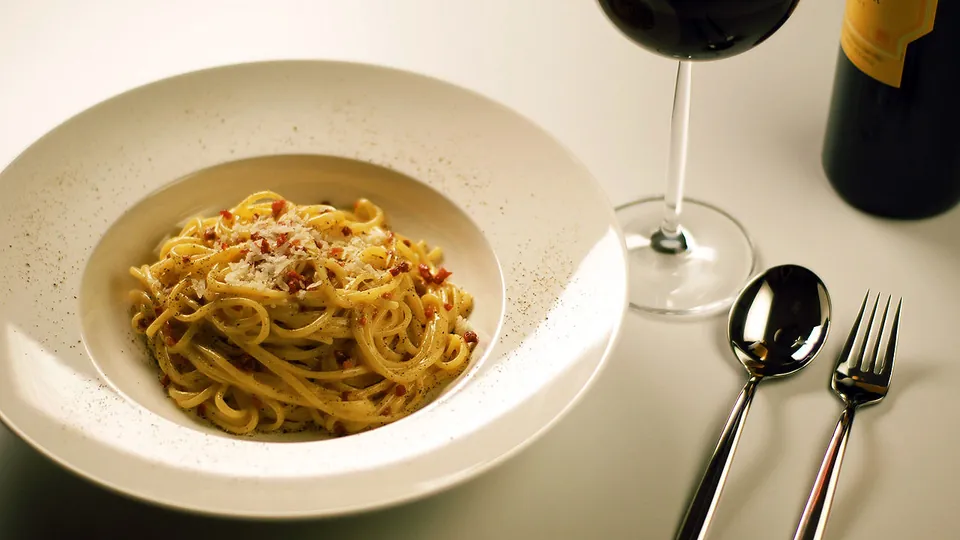
Carbonara is a Roman pasta of egg, guanciale (cured pork cheek), Pecorino Romano (sheep's-milk cheese), and black pepper. Every one of these has been on Roman tables since antiquity; all are local to Latium. Yet the dish itself does not surface until after the Second World War, in the Rome of the late 1940s and 1950s. The ingredients are old; the dish is new, and that gap is the whole story.
Having ingredients on hand and having them reliably is not the same thing. Through the war, Roman tables were bare, and neither eggs nor cured pork could be had at will. When Rome was liberated in 1944 and supplies began moving again under the occupation, eggs, guanciale, and the bacon and powdered egg the Allied forces brought with them circulated through the city. Pairing egg with bacon belonged more to Anglo-American cooking than to the Italian tables of the day, and it was that combination, joined to Rome's own pasta, out of which carbonara rose.
The method asks for no special tool or skill: the residual heat of just-drained pasta binds beaten egg into a glossy cream, something any home cook or corner trattoria could manage. The dish spread fast through postwar Rome, and the paper trail tracks that rise. The name runs ahead of the trail: it is already in print on 23 August 1939, in a Rome column carried by the Batavia daily De Koerier in the Dutch East Indies, which gives spaghetti alla carbonara as the specialty of a Trastevere trattoria without a word about what went into it. The oldest Italian appearance of the name yet found comes in the Turin daily La Stampa on 26 July 1950, where an American officer is said to have spent years hunting for the dish at a Trastevere eatery. The oldest surviving recipe follows in a 1952 Chicago cookbook, Patricia Bronté's Vittles and Vice; the first Italian recipe appears in La Cucina Italiana in 1954. Within a decade, carbonara had taken root as one of Rome's signature pastas.
How we know
Carbonara comes wrapped in two famous origin stories, and neither survives contact with the record.
The first says it was the food of the carbonari, the charcoal-burners who worked long stretches in the mountains, and that the name proves it. The charcoal-burner is indeed old company for this pasta: the earliest known printing of the name, in a Rome column of 23 August 1939, glosses spaghetti alla carbonara as "strings such as the charcoal-burner's wife makes them". But that is an image attached to a name, not a report of where the dish was born. The same column sets the plate in a trattoria on piazza Santa Maria in Trastevere, in the middle of Rome, and says nothing of any mountain camp. No contemporary record puts the dish in the hands of charcoal-burners, and egg with bacon was not the fare of Italian mountain villages but an Anglo-American pairing. The origin of a word is not the origin of a dish.
The second credits Renato Gualandi, a Bologna cook, with inventing it in September 1944 at Riccione, for a dinner of Allied officers made from US rations. But the name was in print five years before that dinner, and in the wrong city: the 1939 column has it in Rome, as the specialty of a Trastevere trattoria kept by one Alfredo. Gualandi first claimed to be the inventor only in 1991, roughly half a century after the fact, and no earlier record carries the tale; the oldest mentions name neither him nor Riccione. A single self-attribution, made fifty years later, is the very shape of an origin legend.
Set against the legends, the documents fall into one narrow window. The oldest print appearance of the name is that 1939 column, in the Batavia daily De Koerier, published in the Dutch East Indies and preserved as a scanned page in the digitized newspapers of the Dutch royal library. Its Rome correspondent sets two trattorias on the same square against each other, Umberto's risotto with prawns against Alfredo's spaghetti alla carbonara, and gives neither ingredients nor method, so it fixes when the name existed, not when the egg-based plate did; no earlier printing of the name turns up anywhere in the Dutch-language press. Next comes the Turin daily La Stampa on 26 July 1950, the oldest Italian mention yet found, which records an American officer searching for spaghetti alla carbonara at Da Cesaretto in Trastevere, a page that survives as a scan in the paper's Turin archive. The oldest surviving recipe is the 1952 Chicago cookbook Vittles and Vice; the first Italian one comes in La Cucina Italiana in 1954. Newspaper, cookbook, and food historians, among them Alan Davidson, Luca Cesari, and Eleonora Cozzella, all point to the same postwar years, and the historian Alberto Grandi, shown the 1939 find, read it as a complication in the travels of the name rather than a change of origin, with the Americans still at the centre.
So the charcoal-burner tale and the lone-inventor story are both later legends, unrecorded in any contemporary source. The name was already in print before the war, but the plate itself could only have come together after it, when the Anglo-American pairing of egg and bacon, moving on the supply lines of occupied Rome, met the city's own pasta.
The full set of origin theories and the detailed verification log — traceable all the way to their sources — are available on the Japanese edition.
See the full origin theories and verification log (Japanese) →
Related dishes
Shares the key ingredient
More debunked origins
Other famous dishes whose popular origin story doesn't survive the sources.