All dishes / 北米
California roll Period BOrigin theory CVerified
Some fields (dish name, region and gates) are shown from the Japanese-edition data.
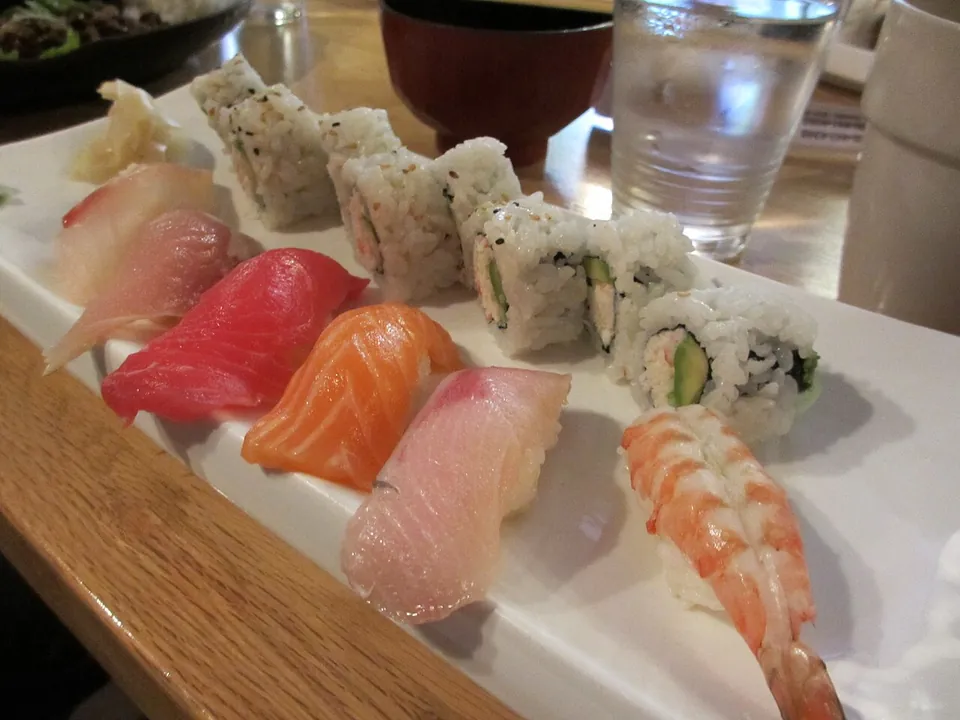
The California roll is widely taken for a piece of old, authentic Japanese sushi. It is nothing of the kind: this inside-out roll of avocado and imitation crab was invented in North America in the mid-twentieth century, most likely by sushi chefs in 1960s Los Angeles, and made for American diners wary of raw fish. Who first rolled one is genuinely disputed, but that it was born on the American side of the Pacific is not.
Verification highlight popular claim → verdict → evidence
Popular legend credits a single inventor, but the attribution is disputed. The strongest-backed account is Ichiro Mashita of Tokyo Kaikan in LA's Little Tokyo, whose assistant gave firsthand testimony of a 1964 avocado-crab-cucumber test roll; food historians see the roll as something that evolved within the LA sushi scene rather than a single stroke of genius. A rival claim that Hidekazu Tojo of Vancouver invented it alone in the late 1970s comes later and is contradicted by the evidence. Key source: Trevor Corson, The Story of Sushi.
The three gates
- Ingredient-supply gate
- Avocado, native to the New World, was cultivated and distributed in California; nori and rice were naturalized through Japanese immigrant communities
- Cooking-technique gate
- The uramaki (inside-out roll) sushi technique
- Venue gate
- Japanese-run sushi restaurants in Los Angeles, devised for American customers who disliked raw fish
Overview
The California roll is an inside-out sushi roll: the nori is tucked inside and the filling is avocado and imitation crab, with no raw fish at all. The rice and nori change places, so that the rice wraps the seaweed rather than the other way around, and the whole shape was worked out for American diners who were unused to sushi.
By the middle of the twentieth century the makings were easy to come by in Los Angeles. Avocado is a New World crop, and commercial groves had spread across California since the 1910s, so it was an everyday item on the shelf. Rice and nori had become familiar too, brought into daily use by the city's Japanese immigrant community. The dish turns on a simple substitution: the soft, rich texture of avocado standing in for the fattiness of tuna.
The distinctive form came out of the sushi bars themselves. Faced with local customers who shied away from raw fish, chefs turned the roll inside out, hiding the black seaweed and giving each piece a gentler, more approachable look. From that reworking of the roll's shape the California roll took its identity: a sushi remade to meet the diner halfway.
How we know
The California roll comes trailing a long argument over who invented it. Several people have each claimed the credit, and their accounts contradict one another. Trevor Corson, who spent months reporting on the sushi culture of Los Angeles for his food history The Story of Sushi, describes the roll not as the work of a single hand but as something that grew up inside the restaurants of that city.
The account with the most support today centers on Ichiro Mashita, a chef at Tokyo Kaikan in the Little Tokyo district of Los Angeles. He is said to have used avocado in place of fatty tuna and rolled it inside-out with crab and cucumber. His assistant, Teruo Imaizumi, gave firsthand testimony describing a trial version of avocado, crab, cucumber, and ginger in 1964.
Other threads run differently. In 1979 the Associated Press reported that Ken Seusa, a chef at a sushi bar near Hollywood, was the inventor, and with no rival claim for years this was treated for a time as settled. The name itself first reached print on 25 November 1979, in the Los Angeles Times, which tells us when the roll was already well established rather than when it was born. A separate claim came from Hidekazu Tojo of Vancouver, who said he had devised the inside-out roll in the late 1970s and named it for crab and avocado; but his version comes later than the Los Angeles accounts, and no contemporary record supports handing the invention to any one person.
So the honest answer to the question of who invented the California roll is that no single name can carry it. The most any record will bear out is a picture of several Los Angeles chefs, each trying to please customers wary of raw fish, arriving at much the same inside-out roll at much the same time.
The full set of origin theories and the detailed verification log — traceable all the way to their sources — are available on the Japanese edition.
See the full origin theories and verification log (Japanese) →
Related dishes
Similar dishes Overlapping ingredient, period or region
More debunked origins
Other famous dishes whose popular origin story doesn't survive the sources.