All dishes / 西欧
Gazpacho Period BOrigin theory CVerified
Some fields (dish name, region and gates) are shown from the Japanese-edition data.
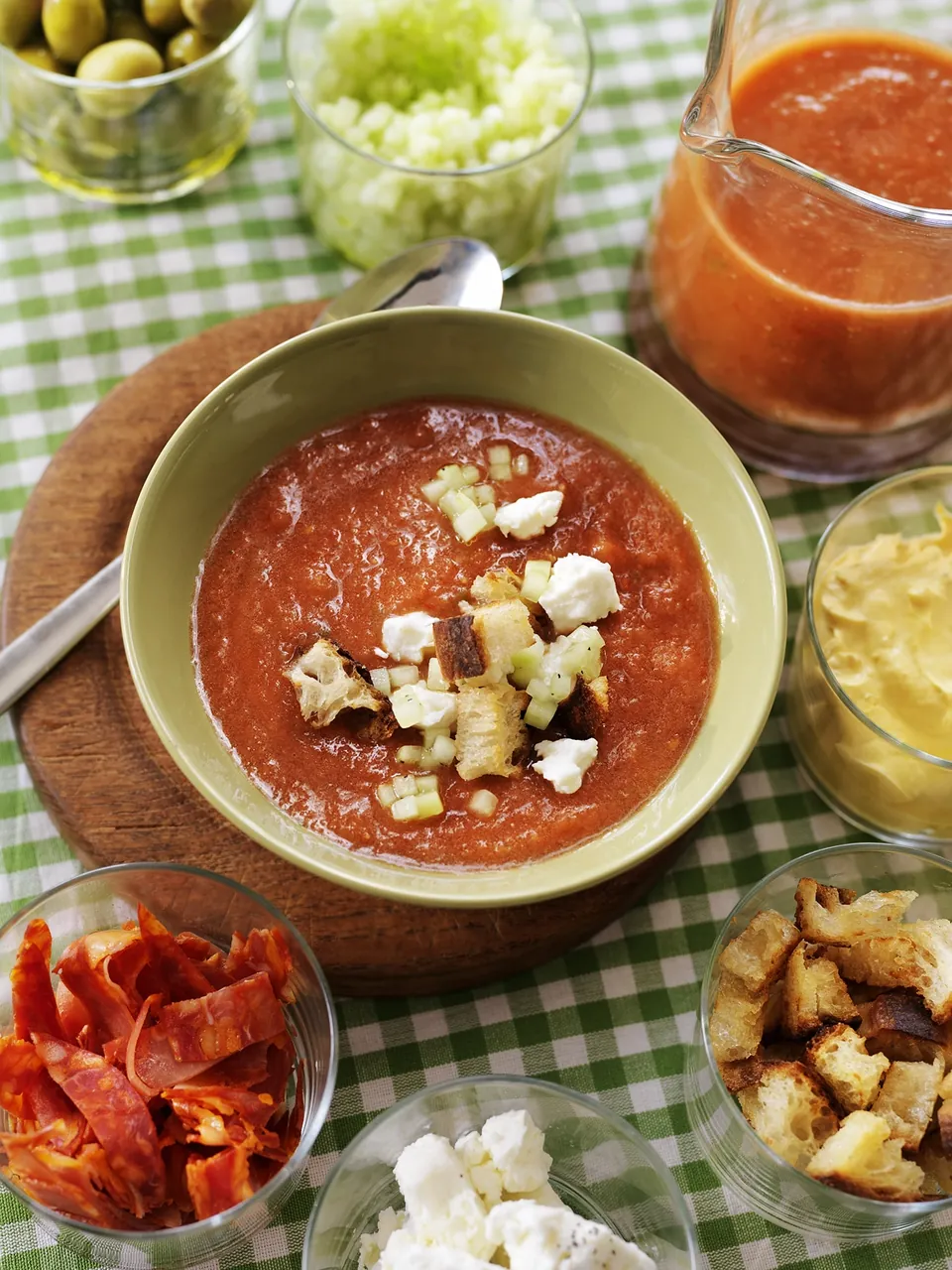
Gazpacho, the cold soup of Andalusia. Its vivid red is not something carried down from antiquity. The tomato is a New World crop; it settled into Spanish kitchens only by the mid-eighteenth century, and red gazpacho appears in print only in the nineteenth. Before that, gazpacho was a pale, cold bread pottage with no tomato at all.
Verification highlight popular claim → verdict → evidence
Gazpacho passes easily for an ancient Spanish tradition, and the story most often told has the word coming from an Arabic term for soaked bread, and the soup from Moorish al-Andalus. The etymology will not bear the weight: it spread only in the nineteenth century and has never named the Arabic word it is supposed to come from, while the derivations philologists actually put forward, Latin caccabaceus and caspa and the Mozarabic suffix -acho, are not Arabic at all (Etymonline). How old the pale, tomato-less bread pottage may be is still argued, between a Roman line, for which Apicius gives a cold dish of Alexandrian bread steeped in vinegar-water, and the food culture of al-Andalus, where ajoblanco stands as a sister dish. The red is another matter, and it is dated. Juan de la Mata's Arte de reposteria of 1747, the first gazpacho written down in Spain, has bread, anchovy bones, garlic, vinegar and olive oil, and no tomato; the first red one in print is the Gaspacha of Mary Randolph's The Virginia House-Wife, 1824.
The three gates
- Ingredient-supply gate
- The tomato is a New World crop, and in Spain it turns up in the record between 1592 and 1608: Gregorio de los Rios listed the red-ripening kinds in his Agricultura de jardines of 1592 and wrote that they were good for sauces, and the account book of a Seville hospital entered purchases of tomatoes in the summer of 1608. Red gazpacho can be no older than that. The fruit became ordinary in Spanish cooking, and the soup turned red, only in the nineteenth century, in print by 1824. Its earlier form was a cold bread pottage of the Middle Ages with no tomato in it.
- Cooking-technique gate
- Grinding raw vegetables and working them into a smooth emulsion, in a mortar and, in modern kitchens, a blender.
- Venue gate
- Everyday food of ordinary people, made in the households of a local community.
Overview
Gazpacho is an Andalusian cold soup of raw vegetables ground together with water and oil worked in. The red of the tomato feels self-evident today, but the dish has an older shape: a cold bread pottage of bread, garlic, olive oil, vinegar, and water, ground and mixed, with no tomato. It was a plain food that let people working in a hot land fill themselves without wasting stale bread.
That older form survives in the record. The first gazpacho written down in Spain is the capón de galera in Arte de repostería, published in 1747 by Juan de la Mata, a confectioner of the Madrid royal household. It combined bread, anchovy bones, garlic, vinegar, sugar, salt, and olive oil. There is no tomato in it. This one book tells us that the gazpacho of the mid-eighteenth century was not yet red.
What turned this cold bread pottage red was the tomato, come from the New World. When tomatoes reached Spain in the sixteenth century, their use as food was already known. In his Agricultura de jardines of 1592, Gregorio de los Ríos listed the kinds grown in Spain that ripen red and wrote that they were good for sauces, and in the summer of 1608 a Seville hospital bought four pounds of tomatoes on 20 July and two more on 17 August. The purchases stop there, though; tomatoes took their ordinary place on the Spanish table only in the mid-eighteenth century, and gazpacho appears in print in its red form only in the nineteenth. Mary Randolph's The Virginia House-Wife, published in America in 1824, carries a recipe titled "Gaspacha—Spanish" that layers tomatoes into a red gazpacho. This is the first tomato gazpacho ever put into print.
So two eras lie stacked in gazpacho. Under it is the old cold bread pottage, made from stale bread and everyday seasonings. Over it sits the tomato from the New World, changing its color and its taste. Grown as the daily food of Andalusian farms and laborers, the soup spread in time to the cities and then across all of Spain.
How we know
Gazpacho tends to carry the plain impression of "an ancient Spanish tradition." The most widely circulated version holds that the word gazpacho comes from an Arabic term for "soaked bread" and reaches back to Moorish food culture. But this etymological received wisdom lacks a foundation.
By the etymological dictionary Etymonline and by linguistic study, the "gazpacho = Arabic soaked bread" account is something that spread only in the nineteenth century, and it has never once identified the Arabic word it supposedly derives from. The candidates scholars actually put forward—Latin caccabaceus and caspa, the Mozarabic suffix -acho—are all rather non-Arabic. In other words, the Arabic-etymology story cannot serve as proof of an Arab origin.
Even so, how far back the pre-tomato cold bread pottage reaches is not yet settled. One view has the Romans bringing a cold soup of bread, olive oil, vinegar, and water. Another ties it to the food culture of al-Andalus under Moorish rule, and points to ajoblanco, a white soup thickened with almonds, as a sister dish. The etymological support has collapsed, but this cultural continuity itself remains. Both views grant that the older layer is genuinely old, and they stand opposed—Roman origin against Arab origin—still side by side.
The thing to keep from mixing here is two questions. Whether the old pottage reaches back to Rome or derives from the Arabs, and the fact that red gazpacho came into being in the nineteenth century, are separate matters. Two books tell the second story. De la Mata's of 1747 has only a gazpacho without tomato; Randolph's of 1824 records a red one. However old the older layer may be, that today's tomato-red gazpacho came into being between these two years, together with the New World tomato, does not move.
The full set of origin theories and the detailed verification log — traceable all the way to their sources — are available on the Japanese edition.
See the full origin theories and verification log (Japanese) →
Related dishes
Lineage Family, predecessor, variants
Shares the key ingredient
- Pasta al pomodoroSouthern ItalyB
- Pizza MargheritaNaples (Italy)D
- ShakshukaMiddle East / North AfricaC
- Jollof riceWest AfricaC
- Butter chickenDelhi (India)C
- Khao SoiB
- LecsóHungaryC
- Chana masalaNorth India (Punjab)C
- RatatouilleProvence, France (Nice)C
- Thieboudienne (ceebu jën)SenegalC
- ChakalakaSouth AfricaC
- KedjenouIvory CoastB
- Caprese saladCapri (Italy)C
- SaloonaPersian Gulf (Bahrain and Kuwait)C
- Shan khauk hswè (Shan noodles)Myanmar (Shan State)C
- American pizzaUnited StatesC
- FrancesinhaPorto (Portugal)D
- ChakhokhbiliGeorgia (Caucasus)C
- KachumberGujarat (Western India)C
- SalmorejoAndalusia (Spain)C
- Greek salad (horiatiki)GreeceC
- Shopska saladBalkans (Bulgaria)B
- Melanzane alla parmigianaItalyC