All dishes / サブサハラ・アフリカ
Jollof rice Period AOrigin theory CVerified
Some fields (dish name, region and gates) are shown from the Japanese-edition data.
"Today's red jollof was born in the medieval Wolof empire," the story often goes. But the tomato that gives it its red does not reach West Africa until the nineteenth century—a dish whose antiquity has been confused with the age of an empire and a name.
Verification highlight popular claim → verdict → evidence
The dating is solid, since tomato and chili are New World crops that only reached West Africa in the 19th century, fixing the earliest possible date for the current form. The origin itself remains disputed: Senegal's Wolof thieboudienne is the strongest academic candidate, alongside theories emphasizing Mali Empire/Djula trade dispersal and colonial-era modernization; the popular Ghana-vs-Nigeria 'Jollof Wars' is a cultural rivalry, not a scholarly origin claim. A widespread myth tracing the tomato-based dish to the medieval Wolof Empire is refuted, since tomatoes had not yet arrived.
The three gates
- Ingredient-supply gate
- Tomato and chili are New World crops; their spread to West Africa dates to the 19th century.
- Cooking-technique gate
- New World crops arriving via Atlantic trade, combined with indigenous rice cultivation.
- Venue gate
- A Wolof rice dish that became a national dish across West African countries.
Overview
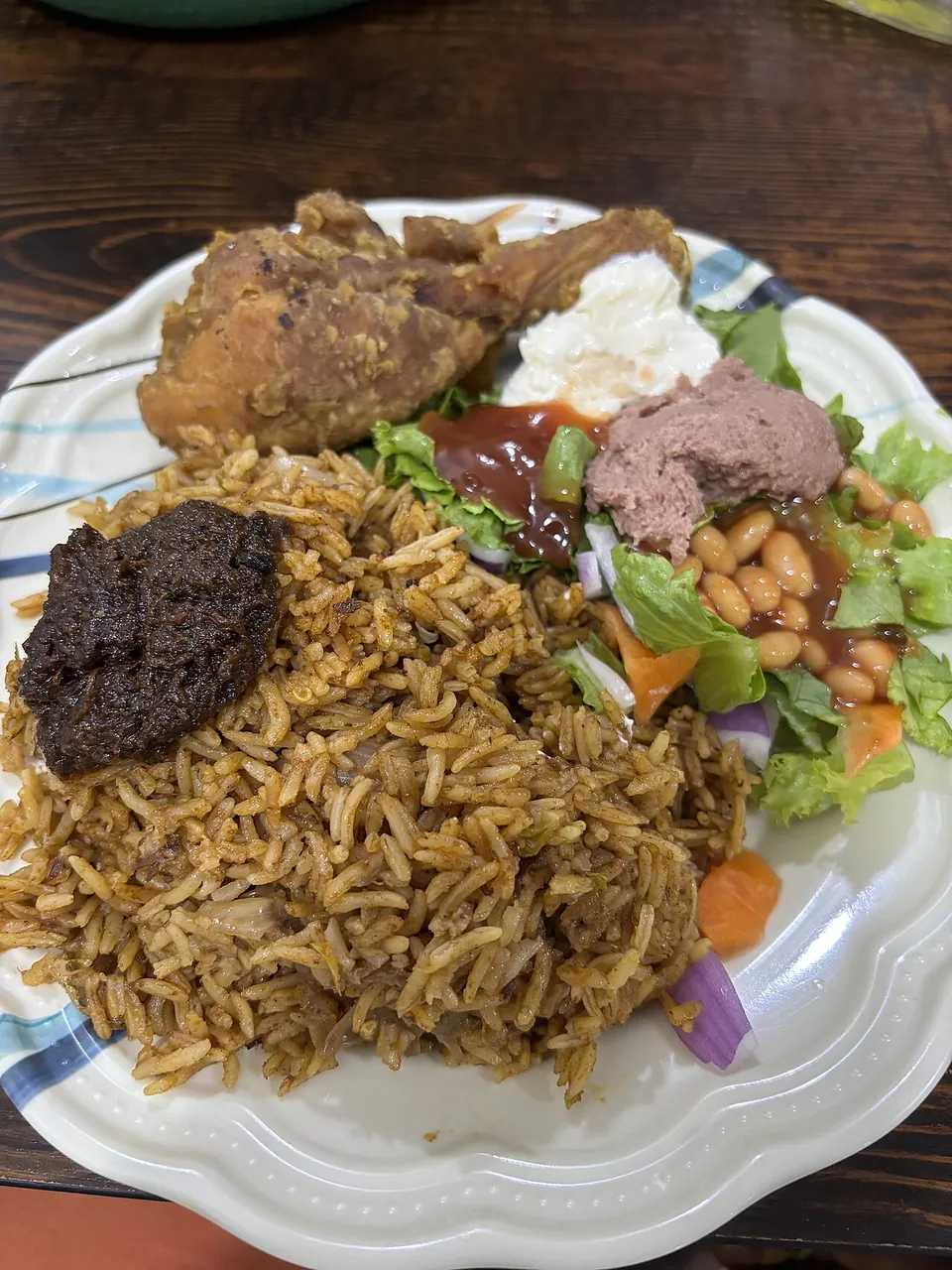
Jollof rice is a rice dish cooked red with tomato and chili, and today it is a national staple across West Africa. Both the tomato and the chili that set its color and flavor come originally from the New World. Carried into West Africa through the trans-Atlantic trade, they come into wide use only across the nineteenth century (roughly 1800–1900). Red jollof, cooked in its present form, belongs to the time after those crops crossed the sea and took root.
The foundation is a native rice cultivation, onto which the New World tomato and chili—and rice shipped from Southeast Asia—were layered. The agronomist Marc Dufumier sees present-day jollof as the product of intensive groundnut cultivation in central Senegal (pushed hard in the colonial period) meeting a flow of imported rice, and stresses a relatively recent emergence in the nineteenth and twentieth centuries. The spread of rice itself shows in the figures: per-capita rice consumption in West Africa doubled from 12 kilos a year in 1961 to 27 kilos by 1990 (FAO). The cheapness of the broken rice (brisures) that flowed in during the French colonial era is credited with encouraging a rice-centered way of eating.
Trace the ancestral type and it leads to thieboudienne (ceebu jën), the rice dish of the Wolof people of Senegal. From there jollof was carried across the region and branched into national versions—Ghanaian, Nigerian, and others.
How we know
Jollof rice has often been described, in blogs and encyclopedia entries, as having been born—tomato and all—in the Wolof empire of the twelfth to fourteenth centuries. Because the name jollof derives from the Jolof kingdom, the dish too is traced back to that era. But the tomato that gives it its red is a New World crop, and it reaches West Africa only in the nineteenth century (around 1850, or 1800–1900 at the widest). Tomato jollof could not have sat on a medieval table (the Cambridge History in Africa holds there is no evidence tomatoes were grown in West Africa before the nineteenth century). The age of the empire and the name has been mistaken here for the age of the dish now eaten.
The earliest trace in print, so far, comes from a cookbook published in London by Longmans in 1957: Miss Williams' Cookery Book, by R. Omosunlola Williams. Among the more than two hundred Nigerian recipes in its second part stands "Jollof Rice," written out in three different methods. By that year at the latest, the dish as it is cooked today was being set down as a recipe in West Africa. The dictionary record follows two years later: the Oxford English Dictionary cites The Guardian of 1959 for jollof rice, and traces the word itself to a spelling variant of the ruling state Jolof. An older book, the 1934 Kudeti Book of Yoruba Cookery, mentions jollof as well, but whether that entry stood in the original edition or was added in a later printing has yet to be settled, so it is not counted as the earliest appearance in print. The age of the name and the age of the dish now eaten remain, again, separate questions.
The scholarly view points to Senegal. Fatima Fall Niang of CRDS at Université Gaston Berger and others place jollof's ancestral type in the Wolof thieboudienne (ceebu jën) (The Conversation). In 2021 that thieboudienne was inscribed on UNESCO's list of intangible cultural heritage. Thieboudienne is seen as the ancestral dish, and from it jollof is thought to have spread across West Africa.
Even so, "Senegalese origin" does not close the matter. The food historian James C. McCann weighs, more than the place of origin, the routes by which the Mali empire and Djula trading peoples carried rice cultivation and cookery to the region's cities and commercial hubs (Stirring the Pot). Dufumier, for his part, stresses the modernity of the present style. The "Jollof Wars" that flared between Nigeria and Ghana in the 2010s are well known too, but that is a friendly contest over culinary identity, not a claim to the place of origin backed by primary evidence.
The full set of origin theories and the detailed verification log — traceable all the way to their sources — are available on the Japanese edition.
See the full origin theories and verification log (Japanese) →
Related dishes
Cross-links Sister dishes & same-name dishes (separate lineage)
Shares the key ingredient
- Pasta al pomodoroSouthern ItalyB
- Pizza MargheritaNaples (Italy)D
- ShakshukaMiddle East / North AfricaC
- Butter chickenDelhi (India)C
- Khao SoiB
- GazpachoAndalusia (Spain)C
- LecsóHungaryC
- Chana masalaNorth India (Punjab)C
- RatatouilleProvence, France (Nice)C
- ChakalakaSouth AfricaC
- KedjenouIvory CoastB
- Caprese saladCapri (Italy)C
- SaloonaPersian Gulf (Bahrain and Kuwait)C
- Shan khauk hswè (Shan noodles)Myanmar (Shan State)C
- American pizzaUnited StatesC
- FrancesinhaPorto (Portugal)D
- ChakhokhbiliGeorgia (Caucasus)C
- KachumberGujarat (Western India)C
- SalmorejoAndalusia (Spain)C
- Greek salad (horiatiki)GreeceC
- Shopska saladBalkans (Bulgaria)B
- Melanzane alla parmigianaItalyC