All dishes / 西欧
Caprese salad Period BOrigin theory CVerified
Some fields (dish name, region and gates) are shown from the Japanese-edition data.
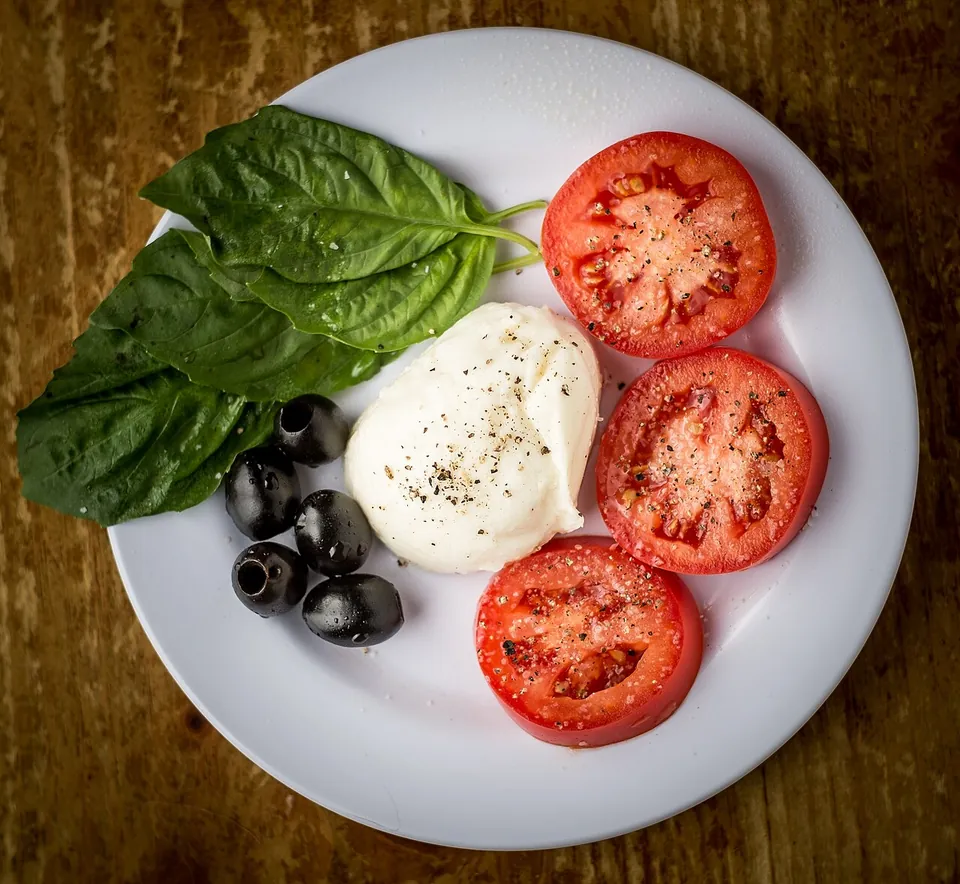
Red tomato, white mozzarella, green basil, laid out to echo the Italian flag: the Caprese salad. The patriotic reading was added later, and the legend that traces it back to a Roman emperor cannot stand at all.
Verification highlight popular claim → verdict → evidence
The earliest documented appearance is a 1926 Futurist banquet menu at the Grand Hotel Quisisana in Capri -- a record that the dish was served there, not that the Futurists invented it; no recipe for it appears in Marinetti's own cookbook, La Cucina Futurista (1932). The name became fixed in the 1930s and the dish spread internationally in the 1950s. Since tomatoes did not reach Europe until after the 16th century, and raw-eating tomato varieties spread later still, the legend tracing the dish back to the Roman emperor Tiberius is chronologically impossible and is rejected as a popular myth. Several competing accounts of who first combined the ingredients remain unresolved.
The three gates
- Ingredient-supply gate
- Tomatoes are a New World crop that only became established in Italy in the early modern period; the spread of tomatoes as a raw salad ingredient sets the practical lower bound. Mozzarella (from water buffalo or cow's milk) was already native. Tomatoes are the limiting ingredient.
- Cooking-technique gate
- No cooking is involved (ingredients are simply arranged raw), so technique poses little constraint; the dish took shape as a way of combining ingredients.
- Venue gate
- It spread through hotels and resorts on Capri, carried by early-20th-century Italian food culture and tourism.
Overview
The Caprese is a starter from the island of Capri: rounds of tomato and mozzarella arranged in alternation, basil tucked between, olive oil poured over. Nothing is cooked. The dish is simply assembled, and its taste turns on the freshness of the three ingredients—tomato, mozzarella, basil—and on how they are brought together.
The tomato is what the dish cannot do without. Tomatoes came from the New World; they reached Italy in the sixteenth century, and only from the early modern period did they come to the table raw, as salad. Mozzarella is an old cheese of this land. But until the tomato had crossed the sea and spread as something eaten raw, a three-color plate like this had no way of coming into being.
In the record, the Caprese appears on Capri in the first half of the twentieth century. Accounts of when it was devised range from the 1920s to the postwar years, but that it was born on Capri is not disputed. It spread from the island's hotels and resorts, within the Italian food culture and tourism of the early twentieth century.
How we know
Several origin tales stand side by side for the Caprese. The one with the oldest support is the story of a Futurist banquet. In 1926, at a Futurist gathering held at the Grand Hotel Quisisana on Capri, a 'Dinner of the Future' menu was served. Answering the Futurists' distaste for pasta, a light three-color dish—red tomato, white mozzarella, green basil—was set out. This 1926 date is, for now, the oldest reference that can be confirmed.
One often-repeated line says that 'the Caprese was invented by the Futurists.' But if you open 'La Cucina Futurista' (1932), the cookbook that Marinetti and his circle put before the public, the Caprese is not among its recipes. Closer to the sources than 'the Futurists created it as a new dish' is the record that it was already being served at their banquets. 1926 is not the year of its birth; it is the lower bound, the year by which it existed at the latest.
The name 'insalata Caprese' took hold, according to the Capri food historian Marino Barendson, in the restaurants of Capri in the 1930s. Then in the 1950s, served at the Quisisana to the exiled Egyptian king Farouk, the dish became known internationally. There is also a telling that a patriotic Capri stonemason in the postwar years pressed the flag's three colors into bread—but this one is thin on documentation and belongs to a later time than the Futurist banquet. The reading of the dish as a symbol of the flag looks to have been laid over it after it already existed.
And the oldest legend of all, the one that traces the Caprese to the Roman emperor Tiberius, who took his rest on Capri, cannot hold. The tomato reached Italy only from the sixteenth century, and the three-color arrangement appears only in the twentieth; a plate like this could not have stood on an ancient Roman table. The story of who devised it remains several theories in a row, but the single claim of an ancient origin has already fallen away.
The full set of origin theories and the detailed verification log — traceable all the way to their sources — are available on the Japanese edition.
See the full origin theories and verification log (Japanese) →
Related dishes
Shares the key ingredient
- Pasta al pomodoroSouthern ItalyB
- Pizza MargheritaNaples (Italy)D
- ShakshukaMiddle East / North AfricaC
- Jollof riceWest AfricaC
- Butter chickenDelhi (India)C
- Khao SoiB
- GazpachoAndalusia (Spain)C
- LecsóHungaryC
- Chana masalaNorth India (Punjab)C
- RatatouilleProvence, France (Nice)C
- Thieboudienne (ceebu jën)SenegalC
- ChakalakaSouth AfricaC
- KedjenouIvory CoastB
- SaloonaPersian Gulf (Bahrain and Kuwait)C
- Shan khauk hswè (Shan noodles)Myanmar (Shan State)C
- American pizzaUnited StatesC
- FrancesinhaPorto (Portugal)D
- ChakhokhbiliGeorgia (Caucasus)C
- KachumberGujarat (Western India)C
- SalmorejoAndalusia (Spain)C
- Greek salad (horiatiki)GreeceC
- Shopska saladBalkans (Bulgaria)B
- Melanzane alla parmigianaItalyC