All dishes / 北米
American pizza Period BOrigin theory CVerified
Some fields (dish name, region and gates) are shown from the Japanese-edition data.
American pizza is often said to begin with Gennaro Lombardi, who opened the country's first pizzeria in 1905. Newspaper research has shown that single-founder story to be something made up after the fact, unsupported by the record.
Verification highlight popular claim → verdict → evidence
Myth: Gennaro Lombardi opened America's first pizzeria in 1905 and single-handedly invented American pizza. Verdict: rejected -- newspaper research by Peter Regas found a May 9, 1903 Il Telegrafo advertisement for Filippo Milone's pizza, predating Lombardi by two years, revealing a lineage from Milone (c.1898) to Santillo (1901) to Lombardi; there was no single founder, but a multi-city transplantation by Italian immigrants followed by postwar chain-driven standardization. Key source: Carol Helstosky, Pizza: A Global History (Reaktion Books, 2008); Peter Regas's research reported in Smithsonian Magazine (2019).
The three gates
- Ingredient-supply gate
- Wheat, tomatoes (cultivated in the US from the colonial period, eaten from 1835), and cheese were all obtainable in the US by the early 20th century; the bottleneck is not ingredients but the "venue" -- the formation of a distinctly American style.
- Cooking-technique gate
- Mass-production baking in gas or electric deck ovens, already established by the late 19th/early 20th century; technology is not the bottleneck.
- Venue gate
- Italian immigrant pizzerias (New York, etc., from 1905) leading to postwar (1950s onward) national chains that established the thick-crust, heavy-mozzarella American style.
Overview
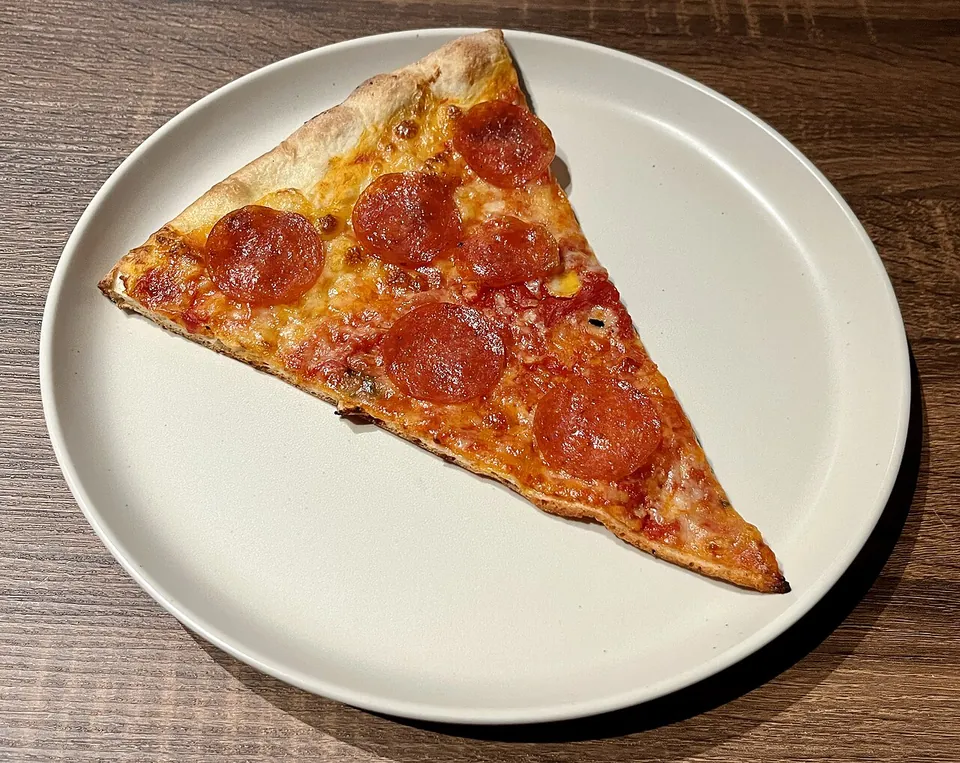
American pizza took root as Neapolitan immigrants brought pizza into several American cities across the late nineteenth and early twentieth centuries. In New York and other immigrant neighborhoods, a 'tomato pie' topped with tomato spread as cheap food for working people.
The ingredients were easy to come by in the America of this period. Wheat and tomato had been established here since colonial times, and cheeses including mozzarella were readily available domestically by the early twentieth century. The technique of mass-producing and baking dough in gas and electric ovens was already in place as well.
What pushed the dish into its present form was a change in the setting where pizza was served. The tomato pie that spread through small immigrant pizzerias took on a different character in the post-war 1950s. Driven by the strong demand of returning servicemen, chains like Pizza Hut and Domino's spread across the country, and over this process a distinctly American style — a thicker crust generously topped with mozzarella, different from the Italian original — set into place. Rather than tracing back to one inventor or one first shop, this is a dish that arose through transplanting into many places at once and then chained out after the war.
How we know
American pizza has long had a story of its beginning. In 1905, so the legend goes, Gennaro Lombardi of Naples opened the country's first pizzeria in New York, and American pizza started there — a single-founder tale.
Newspaper research pulled that account apart. The researcher Peter Regas found an advertisement for pizza by Filippo Milone in the Italian-language paper Il Telegrafo of May 9, 1903, the oldest record of pizza being served in New York, predating Lombardi's 1905 (Smithsonian Magazine, 2019; HISTORY, 'Meet a Long-Lost Father of New York City Pizza'). And 1905 was not the year Lombardi opened a shop, but merely the year he obtained a pizzeria license from the city. The shop itself had been opened earlier by Milone, then passed to Santillo, and then to Lombardi — a line of succession. The story of the 'first in America' and the 'single founder' was made up after the fact, tidied into shape once the shops were long established.
So how should the real emergence be told? The food historian Carol Helstosky's work, and Victoria Iacchetta's thesis tracing the post-war localization across many cities with footnotes, both describe it as a many-sourced transplant with no single inventor. Immigrants brought pizza into several cities — New Haven, Detroit, Chicago, Buffalo, Rochester — and through post-war chaining a distinctly American style set into place. That no one can decide who was first is itself the character of this dish. Taking the Neapolitan pizza of Margherita fame as its prototype, it is a case of a food that grew into something else once it had crossed the sea.
The full set of origin theories and the detailed verification log — traceable all the way to their sources — are available on the Japanese edition.
See the full origin theories and verification log (Japanese) →
Related dishes
Cross-links Sister dishes & same-name dishes (separate lineage)
Shares the key ingredient
- Pasta al pomodoroSouthern ItalyB
- ShakshukaMiddle East / North AfricaC
- Jollof riceWest AfricaC
- Butter chickenDelhi (India)C
- Khao SoiB
- GazpachoAndalusia (Spain)C
- LecsóHungaryC
- Chana masalaNorth India (Punjab)C
- RatatouilleProvence, France (Nice)C
- Thieboudienne (ceebu jën)SenegalC
- ChakalakaSouth AfricaC
- KedjenouIvory CoastB
- Caprese saladCapri (Italy)C
- SaloonaPersian Gulf (Bahrain and Kuwait)C
- Shan khauk hswè (Shan noodles)Myanmar (Shan State)C
- FrancesinhaPorto (Portugal)D
- ChakhokhbiliGeorgia (Caucasus)C
- KachumberGujarat (Western India)C
- SalmorejoAndalusia (Spain)C
- Greek salad (horiatiki)GreeceC
- Shopska saladBalkans (Bulgaria)B
- Melanzane alla parmigianaItalyC