All dishes / 東欧
Beef Stroganoff Period BOrigin theory CVerified
Some fields (dish name, region and gates) are shown from the Japanese-edition data.
Beef Stroganoff isn't an old Russian folk dish passed down through the centuries, and no one can show that a count's kitchen invented it. The earliest recipe anyone can actually trace appears in Elena Molokhovets's household manual A Gift to Young Housewives—in its 1871 edition, not the first edition of 1861. The familiar story that someone in the Stroganov family created it is a later guess worked backward from the famous name.
Verification highlight popular claim → verdict → evidence
Myth: Beef Stroganoff is often attributed to a specific member of the Stroganov family -- a chef inventing it for Count Pavel Stroganov in Siberia, or for Count Alexander Grigoryevich Stroganov's open table in Odessa. Verdict: no contemporary source supports either attribution; a French chef, Charles Briere, who submitted the dish to a French culinary competition in 1891, was later mistakenly credited as its inventor by Larousse Gastronomique, but the name and recipe predate him too. The earliest surviving recipe is in Elena Molokhovets's cookbook A Gift to Young Housewives, in its 1871 edition (absent from the 1861 first edition), building on older Russian dishes of diced beef with sour cream recorded as early as 1808. The dish is best understood as an anonymous Russian-French culinary refinement rather than a single inventor's creation. Main sources: Elena Molokhovets's 1871 cookbook; Wikipedia; The Moscow Times; Britannica.
The three gates
- Ingredient-supply gate
- Beef and sour cream were both already locally available in Russia
- Cooking-technique gate
- Quick searing of thinly sliced beef, a 19th-century French-influenced court technique
- Venue gate
- 19th-century Russian noble households, later spread internationally through cookbooks
Overview
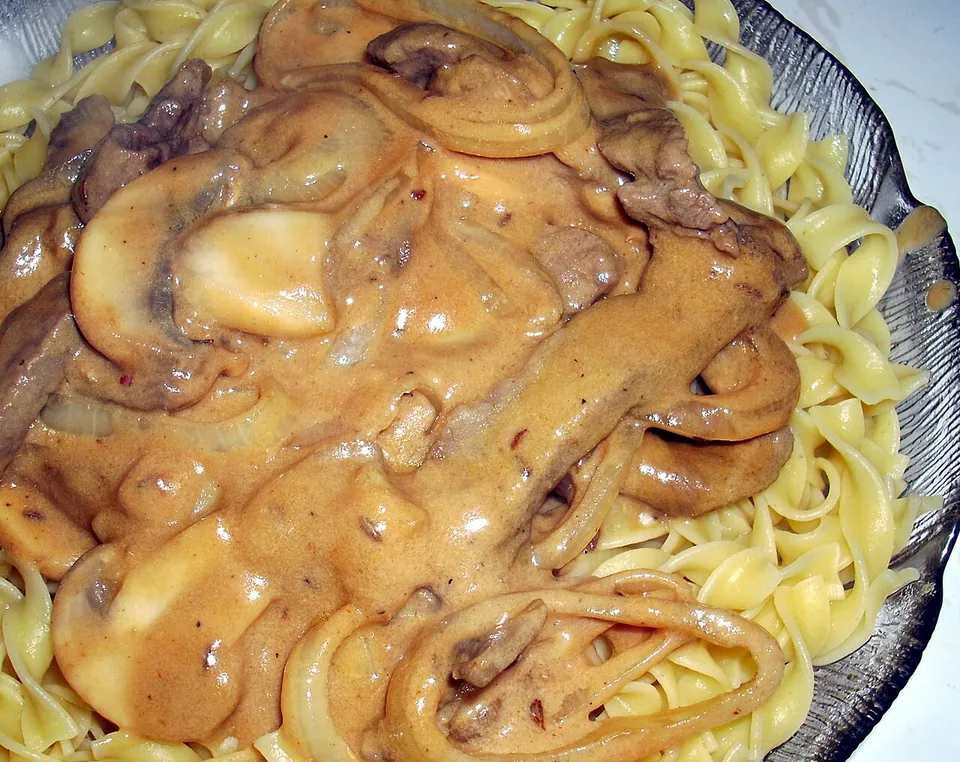
Beef Stroganoff is a Russian dish of thinly cut beef seared quickly and finished in a sour-cream sauce. Beef and sour cream were both long-established staples of the Russian kitchen, on the tables of nobles and farmhouses alike. What was new arrived with the cooking. In the kitchens of the nineteenth-century Russian nobility, chefs trained in France worked the fashionable techniques of the day—sautéing, butter sauces—and laid them over the native Russian habit of finishing a dish in sour cream. Out of that Russo-French meeting came the move that defines the dish: sear thin cuts of meat for moments, then cloak them in a rich sauce.
The oldest form we can pin down sits inside a printed cookbook. Molokhovets's A Gift to Young Housewives carries, in its 1871 edition, a recipe for beef "Stroganoff-style" (Govyadina po-strogonovski) sharpened with mustard. The 1861 first edition does not have it, so the written dish falls between the two—1871. What began in noble households then traveled outward through cookbooks and reached tables around the world.
How we know
The dish takes its name from the Stroganovs, one of Imperial Russia's great noble families, and from that name grew the story that someone in the household invented it. In one telling, a Siberian cook serving Pavel Stroganov shaved frozen beef into thin slices; in another, a France-trained cook devised it at the open table Alexander Grigorievich Stroganov kept in Odessa. The versions are many—and they disagree over which Stroganov, with none of them backed by a contemporary record. The English Wikipedia and a 2022 food-history piece in The Moscow Times treat the tale as a later invention worked backward from the family name: the dish carried a famous name, so someone in that family must have made it—the reasoning simply run in reverse.
Nor is that the only after-the-fact credit. In 1891 Charles Brière, a French chef in St. Petersburg, entered the dish in a competition run by the French journal L'Art Culinaire and won a prize; the later reference Larousse Gastronomique went on to name him its inventor. But both the name and the recipe were in print well before Brière. He popularized the dish; he did not originate it.
The record that came earlier settles the matter. Decades before the Stroganov invention tale circulated—and long before Brière—the 1808 Cook's Calendar (Povarennyi kalendar) already describes thin-cut beef fried in butter and finished with broth, vinegar, and sour cream, alongside an onion-and-sour-cream stew called klops. Molokhovets's 1871 recipe stands in the line of these older native dishes.
So who really created Beef Stroganoff? For now the question has no answer, and food historians have stopped looking for a single inventor. The plainer picture: France-trained cooks laid sautéing and butter sauces over older native sour-cream dishes, refining what was already there, and today's Beef Stroganoff sits at the end of that slow accumulation. The glamorous invention story falls away, and no single starting point can be named in its place. That no one can be called the first is where this dish comes to rest.
The full set of origin theories and the detailed verification log — traceable all the way to their sources — are available on the Japanese edition.
See the full origin theories and verification log (Japanese) →
Related dishes
Shares the key ingredient
- PhoVietnamC
- Chicago Italian beefChicago (USA)C
- Salt beef (the layer before canning)Ireland (Cork / Dublin)C
- AsadoRío de la Plata (Argentina / Uruguay)C
- Lomo saltadoLima (Peru)C
- BulgogiKorean Peninsula (South Korea)B
- ĆevapčićiBalkans (Serbia, etc.)C
- Proto-bulgogi (native grilled-meat proto-layer)Korean PeninsulaC
- Proto-goulash (pre-paprika herdsmen's meat stew proto-layer)HungaryC
- KharchoGeorgia (Caucasus)B
- Proto-rendang (pre-chili merendang proto-layer)West Sumatra (Minangkabau), IndonesiaC
- Nyama chomaEast Africa (Kenya, Tanzania)C
- Philly cheesesteakPhiladelphia (USA)B
- Pastel de chocloChileC
- NihariNorth India (Delhi / Awadh)C
- NikujagaJapanC
- Australian meat pieAustraliaC
- FajitasRio Grande Valley, Texas (USA)B
- Loco mocoHilo, Hawaii (USA)B
- KitfoGurage (Ethiopia)C
- Ropa viejaCubaC
- MachacaNorthern Mexico (Sonora / Sinaloa)C
- Ropa vieja (Iberian prototype)Canary Islands, SpainB
- TibsEthiopian HighlandsB
- BiltongSouth AfricaC
- Lok lakPhnom Penh (Cambodia)C
- Carne asadaNorthern Mexico (Sonora)C
- Hamburg steakHamburg (Germany)B
- Bò lúc lắc (Vietnamese shaking beef)Southern VietnamC
- Montreal-style smoked meatQuebec (Canada)D
- Kare-karePhilippinesC
- PastramiNew York (USA)D
- BraaiSouth AfricaC
- French dip sandwichLos Angeles, California (USA)C
Similar dishes Overlapping ingredient, period or region
More debunked origins
Other famous dishes whose popular origin story doesn't survive the sources.