All dishes / 西欧
Greek salad (horiatiki) Period BOrigin theory CVerified
Some fields (dish name, region and gates) are shown from the Japanese-edition data.
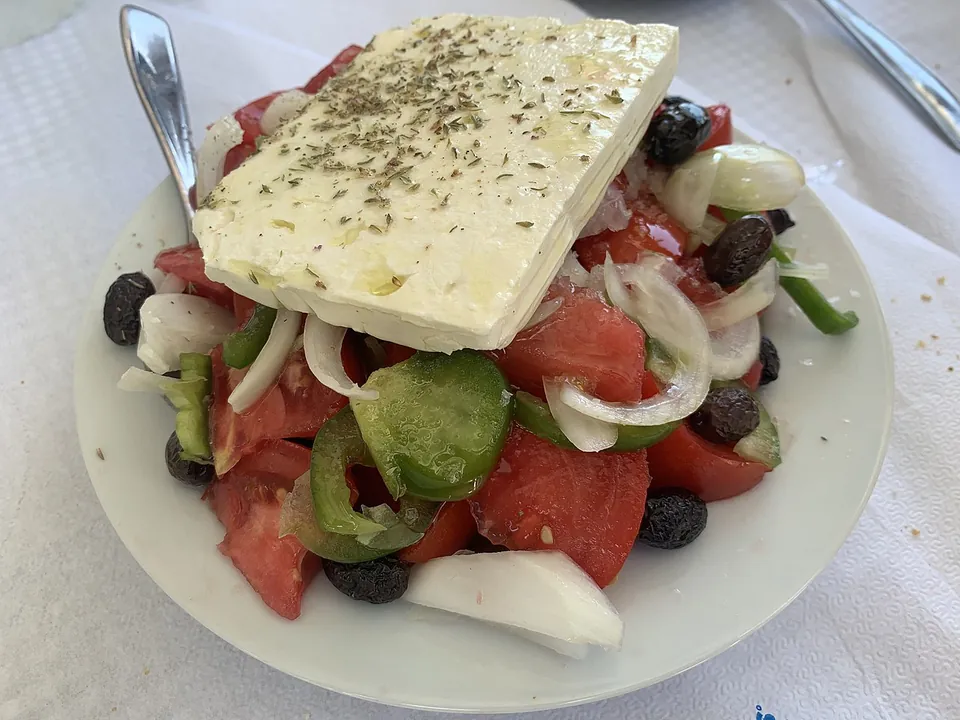
Greek salad—tomato and cucumber crowned with a slab of feta—looks like an old dish reaching back to the plain food of the countryside. But the very form served today in tourist tavernas is a fairly recent one, born in twentieth-century Athens.
Verification highlight popular claim → verdict → evidence
The popular story that an Athens taverna owner invented the feta topping in the 1960s-70s to dodge price controls rests only on the proponent's own vague, undocumented recollection.
The three gates
- Ingredient-supply gate
- Olives, feta, and cucumber are native to the Mediterranean. Tomato is a New World crop, and the current form could only take shape after it spread through the Mediterranean in the 19th century -- the limiting ingredient.
- Cooking-technique gate
- Just cutting raw vegetables and tossing them together; no special technique.
- Venue gate
- tavernas and urban eateries / popular / open to the public.
Overview
Horiatiki means 'village-style.' Beneath the dish lies the simple food of farmers and shepherds working the summer fields, who would carry out tomatoes, cucumbers, onions, olives, bread, and cheese and eat them separately, piece by piece. Olives, feta, and cucumbers are all long-established Mediterranean foods, on the region's tables from early on.
The tomato, the dish's centerpiece, arrived later. A New World crop, it reached Greece only around 1815 to 1828 (the wider Mediterranean is not a single case—some places saw it earlier). It became widely eaten in Greece by the end of that century, and a summer salad built around fresh tomato took shape only after that spread. Since the dish is nothing more than cut-and-tossed, no special technique is called for. The making of it rests on the ingredients coming together and on the habit of serving them cold on a plate.
The shift from the plain country salad to today's set form—served in tavernas with a slab of feta laid on top—came later still. The simple village food became known through tourism as 'Greek salad' and spread until it was called a national dish.
How we know
Horiatiki carries a neat anecdote about its birth. In the Athens of the 1960s and 70s, in the tourist-thronged Plaka district, the government set price ceilings on tomatoes and cucumbers. One taverna owner, the story goes, piled on the uncontrolled feta, insisted 'this is a different, new dish,' and priced it freely—and that, supposedly, is the start of the cheese-topped form served today.
As a tale it is appealing, but the support for it is thin. The owner said to have devised it cannot be identified, and the date is no more precise than 'sometime.' It belongs not to documented history but to the realm of a good story passed by word of mouth, and is best treated as such.
What can be said with confidence is this: the plain village salad as a foundation is old, but the cheese-topped form served today took hold only from the mid-twentieth century onward. The dish is made of two layers from different eras laid one over the other—a far-off memory of the countryside, and the improvisation of a modern Athens street corner.
The full set of origin theories and the detailed verification log — traceable all the way to their sources — are available on the Japanese edition.
See the full origin theories and verification log (Japanese) →
Related dishes
Shares the key ingredient
- Pasta al pomodoroSouthern ItalyB
- Pizza MargheritaNaples (Italy)D
- ShakshukaMiddle East / North AfricaC
- Jollof riceWest AfricaC
- Butter chickenDelhi (India)C
- Khao SoiB
- GazpachoAndalusia (Spain)C
- LecsóHungaryC
- Chana masalaNorth India (Punjab)C
- RatatouilleProvence, France (Nice)C
- Thieboudienne (ceebu jën)SenegalC
- ChakalakaSouth AfricaC
- KedjenouIvory CoastB
- Caprese saladCapri (Italy)C
- SaloonaPersian Gulf (Bahrain and Kuwait)C
- Shan khauk hswè (Shan noodles)Myanmar (Shan State)C
- American pizzaUnited StatesC
- FrancesinhaPorto (Portugal)D
- ChakhokhbiliGeorgia (Caucasus)C
- KachumberGujarat (Western India)C
- SalmorejoAndalusia (Spain)C
- Shopska saladBalkans (Bulgaria)B
- Melanzane alla parmigianaItalyC