All dishes / オセアニア
Australian meat pie Period BOrigin theory CVerified
Some fields (dish name, region and gates) are shown from the Japanese-edition data.
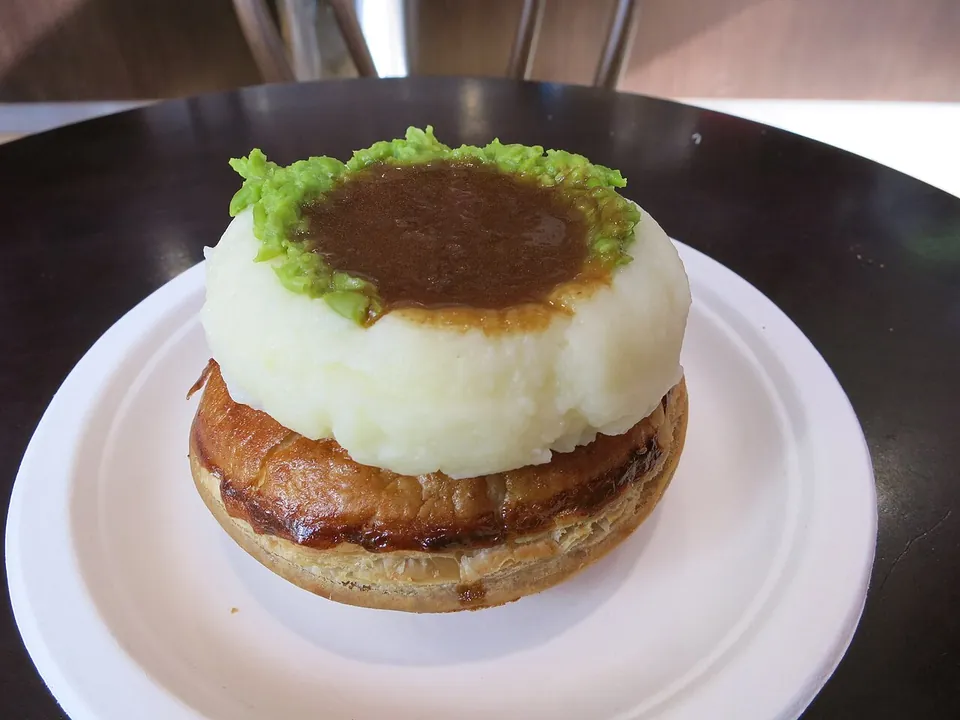
A hand-held pie of beef and gravy. It is called Australia's "national dish," but contrary to the popular tale that it was born in the gold rush, its shape settled slowly, with no one able to say who made it first or when.
Verification highlight popular claim → verdict → evidence
Myth: the Australian meat pie was invented during the 1850s gold rush. Verdict: refuted—pie-making is documented from the very first year of settlement (First Fleet surgeon George Worgan's 1788 diary records a pie made for a wedding feast), and street sales of pies predate the gold rush by a decade or two (the 'Flying Pieman', William Francis King, from the 1830s). The gold rush only helped spread an already-established food; there is no single inventor or invention date. Key sources: George Worgan's 1788 journal; Australian Dictionary of Biography (Flying Pieman).
The three gates
- Ingredient-supply gate
- Beef and wheat became locally established through British settlement, drawing on established livestock farming.
- Cooking-technique gate
- Pastry is rolled and folded around a filling, then baked—standard pie-making technique.
- Venue gate
- Workers' street stalls, pubs, and handheld food at sporting events.
Overview
The Australian meat pie is a palm-sized snack of beef and gravy sealed in a worked pastry crust. Eaten one to a hand at a stall, a pub, or a football match, it is part of everyday life in this country.
The pie itself crossed the sea with the settlers. In 1788, the year the First Fleet arrived, a pie already appeared at a feast marking the King's birthday. The craft of sealing a filling in pastry and baking it came from Britain, and Australia began with that technique and that form handed down.
The beef that fills it came with the same fleet. Cattle landed in 1788, escaped and went wild, and a herd was rediscovered at the Cowpastures in 1795; by 1820 they numbered fifty thousand. Beef for eating grew abundant on the land, and the pie could be filled with it. Wheat, too, was grown locally through British-style farming.
The form particular to this country settled in the later nineteenth century. The filling firmed into beef and gravy, taking on a shape distinct from the British pie. Commercial bakeries such as Sargent's, founded in 1891, established mass production, and in the twentieth century factory pies like Four'N Twenty (1947) spread until the pie earned its place as a national food. In 2003 the sitting prime minister called it the "national dish."
How we know
Born in a gold-rush mining town: that is the origin story long told about the Australian meat pie. But follow the records, and the account that pins its birth to that single moment loses its footing.
The culture of selling pies in the street was already established before the gold rush of 1851. William Francis King (1807-1873), known by the nickname "the Flying Pieman," was hawking pies around Hyde Park and Circular Quay in Sydney from about 1834, and by the 1840s he was a local celebrity (Australian Dictionary of Biography). Before the miners ever crowded in, the pie eaten from the hand was already part of the city's scenery.
So who created the "Australian meat pie," and when? In the record, no person and no year answers the question. The pie itself dates from the 1788 settlement, the street snack from the 1830s and 1840s, the beef-and-gravy form of its own from the later nineteenth century; cut in anywhere, you never reach a single inventor or a single moment of invention.
What scholars see is not a set of rival origin claims. Rather, opinion converges on a single point: that there is no identifiable moment of invention to be found. The continuous process by which a form carried from Britain was gradually remade on this land is what the pie descends from. Once the tidy story of a gold-rush birth is set aside, what remains is an honest conclusion, that the very lack of a settled answer is the answer.
The full set of origin theories and the detailed verification log — traceable all the way to their sources — are available on the Japanese edition.
See the full origin theories and verification log (Japanese) →
Related dishes
Shares the key ingredient
- PhoVietnamC
- Beef StroganoffRussiaC
- Chicago Italian beefChicago (USA)C
- Salt beef (the layer before canning)Ireland (Cork / Dublin)C
- AsadoRío de la Plata (Argentina / Uruguay)C
- Lomo saltadoLima (Peru)C
- BulgogiKorean Peninsula (South Korea)B
- ĆevapčićiBalkans (Serbia, etc.)C
- Proto-bulgogi (native grilled-meat proto-layer)Korean PeninsulaC
- Proto-goulash (pre-paprika herdsmen's meat stew proto-layer)HungaryC
- KharchoGeorgia (Caucasus)B
- Proto-rendang (pre-chili merendang proto-layer)West Sumatra (Minangkabau), IndonesiaC
- Nyama chomaEast Africa (Kenya, Tanzania)C
- Philly cheesesteakPhiladelphia (USA)B
- Pastel de chocloChileC
- NihariNorth India (Delhi / Awadh)C
- NikujagaJapanC
- FajitasRio Grande Valley, Texas (USA)B
- Loco mocoHilo, Hawaii (USA)B
- KitfoGurage (Ethiopia)C
- Ropa viejaCubaC
- MachacaNorthern Mexico (Sonora / Sinaloa)C
- Ropa vieja (Iberian prototype)Canary Islands, SpainB
- TibsEthiopian HighlandsB
- BiltongSouth AfricaC
- Lok lakPhnom Penh (Cambodia)C
- Carne asadaNorthern Mexico (Sonora)C
- Hamburg steakHamburg (Germany)B
- Bò lúc lắc (Vietnamese shaking beef)Southern VietnamC
- Montreal-style smoked meatQuebec (Canada)D
- Kare-karePhilippinesC
- PastramiNew York (USA)D
- BraaiSouth AfricaC
- French dip sandwichLos Angeles, California (USA)C