All dishes / 東アジア
Nikujaga Period BOrigin theory CVerified
Some fields (dish name, region and gates) are shown from the Japanese-edition data.
Togo Heihachiro, having tasted beef stew in Britain, ordered his navy cooks to recreate it—and nikujaga was born. This popular naval origin story is a fabrication, spread by a town-revival campaign in the late 1980s and 1990s, with no support in the historical record.
Verification highlight popular claim → verdict → evidence
A popular legend credits Admiral Togo Heihachiro with having beef stew he ate while studying in Britain recreated by navy cooks, giving rise to nikujaga. In fact this story was promoted from 1995 by a local tourism campaign in Maizuru, drawing on a 1988 TV program; navy cooking manuals already listed stew before Togo's posting there, and a naval historian judges the story 'roughly 90 percent wrong.' The better-supported account is that the dish developed gradually as a Japanese-Western fusion stew once the 1872 lifting of the meat-eating restriction made beef available to combine with already-established potatoes, onions, and soy-sauce-and-sugar simmering technique. The dish itself is attested in navy cooking records from 1904 and 1938, well before the name 'nikujaga' first appears in print in 1950 -- so the name's first appearance is later than the dish's actual emergence.
The three gates
- Ingredient-supply gate
- The limiting ingredient is beef, which became affordable to ordinary people only after Japan's 1872 lifting of the long-standing restriction on eating meat; potatoes had already arrived via Dutch traders around 1600, and onions were already being cultivated by the Meiji period, so the availability of beef sets the latest constraint.
- Cooking-technique gate
- Simmering in a sweet-savory broth of soy sauce and sugar (umani-style stewing).
- Venue gate
- A legend places its origin in navy shipboard cooking, but the dish more likely spread gradually as home cooking and everyday restaurant fare during the Meiji period, without a single point of origin.
Overview
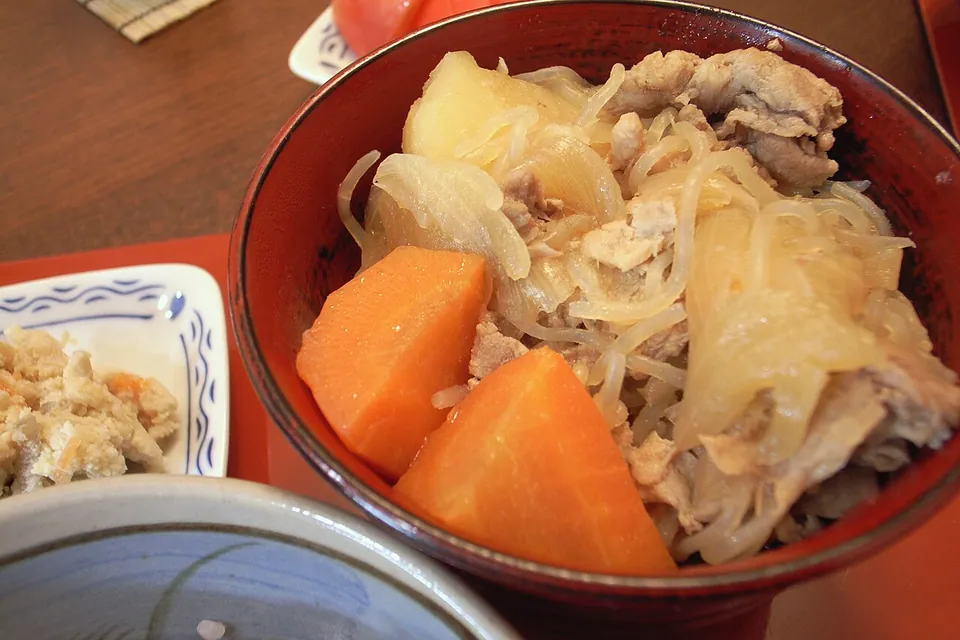
Nikujaga is a Japanese home dish of thinly sliced beef, potatoes, and onions simmered until sweet and savory in soy sauce and sugar. It took its recognizable shape in the late Meiji period, as blended Japanese-Western braises settled onto everyday tables across the country.
The dish cannot be traced back before Meiji, and the reason is the beef. Potatoes had reached Japan via Dutch ships as early as the Keicho era (around 1600), and onions were being grown, chiefly in Hokkaido, by the Meiji years. Beef alone stands apart. Under a long custom of avoiding animal flesh, beef only became a common food once the ban on eating meat was lifted in 1872. All three ingredients could meet in the same pot only after beef reached ordinary kitchens—in the late Meiji years.
The flavor rests on a sweet-savory braise built from soy sauce, sugar, and dashi. In folding foreign beef into an established braising method, nikujaga is one example of the blended Japanese-Western simmered dish. Nor did it belong to any single birthplace. Similar braises grew up in parallel in Meiji homes and cheap eateries, and as a sweetened stew in shipboard navy rations, before the dish put down roots as everyday home cooking.
The word "nikujaga" appears in print considerably later than the dish itself. The name settled through izakaya and the media in the 1970s and 1980s—a different moment from when the cooking itself came together.
How we know
Nikujaga carries a well-known origin story. Togo Heihachiro, having studied in Britain, is said to have wanted the beef stew he tasted there recreated at the naval bases in Maizuru and Kure; lacking wine and demiglace, his cooks reached for soy sauce and sugar, and nikujaga supposedly resulted. Passed down as a local specialty, the tale even became the banner of town-revival campaigns claiming to be its birthplace.
As history, the story has nothing to stand on. The navy already listed stew on its menus before Togo's posting, in the 1889 regulations for training ships' cooks. The very premise—a failed attempt by cooks who did not know stew—does not fit the dates. The path by which the tale spread can also be traced. It began with a 1988 television program, and in 1995 the "Maizuru Nikujaga Festival Committee" (headed by Shimizu Takao) promoted it as a Togo-linked anecdote for the sake of town revival. The naval historian Arima Kanjiro judged the story "about ninety percent wrong," and the naval-cuisine researcher Takamori Naoshi, finding nothing that could prove the Togo account, has traced how a television program and 1990s town-revival efforts grew the legend. This origin story is a tradition made up after the fact, and the record does not bear it out.
So where did nikujaga come from? One view names no inventor and sees it as a blended Japanese-Western braise that grew up on its own. When the lifting of the meat ban brought beef to ordinary people, it joined the native potatoes and onions and the sweet-savory soy-and-sugar braising method, and settled gradually as home and cheap-eatery fare. Records close to the period exist. Jiji Shinpo's 1904 "A Day's Meals on a Warship" mentions a sweet beef stew aboard ship, and the Naval Accounting School's 1938 Textbook of Naval Catering Management lists a "sweet braise" of beef, konnyaku, potato, and onion cooked with sugar and soy sauce. Neither records the invention of nikujaga itself, but both show that a dish close to it was already being cooked at the time.
Here the gap between name and dish matters. The earliest known appearance of the word "nikujaga" in print is said to be the spelling "niku-jaga" in a 1950 report on meal-ticket eateries in Shufu to Seikatsu. Yet the dish itself is already visible in the earlier records of 1904 and 1938. The name settled after the dish had come into being, so the first appearance of the name cannot be read as the moment of the dish's birth. Rather than crediting any single person, the better-grounded reading, for now, is that similar braises grew up across many tables and no one hand can be named as their author.
The full set of origin theories and the detailed verification log — traceable all the way to their sources — are available on the Japanese edition.
See the full origin theories and verification log (Japanese) →
Related dishes
Shares the key ingredient
- PhoVietnamC
- Beef StroganoffRussiaC
- Chicago Italian beefChicago (USA)C
- Salt beef (the layer before canning)Ireland (Cork / Dublin)C
- AsadoRío de la Plata (Argentina / Uruguay)C
- Lomo saltadoLima (Peru)C
- BulgogiKorean Peninsula (South Korea)B
- ĆevapčićiBalkans (Serbia, etc.)C
- Proto-bulgogi (native grilled-meat proto-layer)Korean PeninsulaC
- Proto-goulash (pre-paprika herdsmen's meat stew proto-layer)HungaryC
- KharchoGeorgia (Caucasus)B
- Proto-rendang (pre-chili merendang proto-layer)West Sumatra (Minangkabau), IndonesiaC
- Nyama chomaEast Africa (Kenya, Tanzania)C
- Philly cheesesteakPhiladelphia (USA)B
- Pastel de chocloChileC
- NihariNorth India (Delhi / Awadh)C
- Australian meat pieAustraliaC
- FajitasRio Grande Valley, Texas (USA)B
- Loco mocoHilo, Hawaii (USA)B
- KitfoGurage (Ethiopia)C
- Ropa viejaCubaC
- MachacaNorthern Mexico (Sonora / Sinaloa)C
- Ropa vieja (Iberian prototype)Canary Islands, SpainB
- TibsEthiopian HighlandsB
- BiltongSouth AfricaC
- Lok lakPhnom Penh (Cambodia)C
- Carne asadaNorthern Mexico (Sonora)C
- Hamburg steakHamburg (Germany)B
- Bò lúc lắc (Vietnamese shaking beef)Southern VietnamC
- Montreal-style smoked meatQuebec (Canada)D
- Kare-karePhilippinesC
- PastramiNew York (USA)D
- BraaiSouth AfricaC
- French dip sandwichLos Angeles, California (USA)C