All dishes / 東欧
Olivier salad Period BOrigin theory CVerified
Some fields (dish name, region and gates) are shown from the Japanese-edition data.
The salad without which no Russian New Year is complete. A lavish dish born in a high-end Moscow restaurant of the 1860s, it was remade over the Soviet years into a homely mix of potatoes and mayonnaise. But the famous tale that its inventor carried a secret sauce to his grave is closer to a story invented by a later memoir.
Verification highlight popular claim → verdict → evidence
The standard story credits chef Lucien Olivier with inventing the salad at Moscow's Hermitage restaurant around 1861-64 and taking the secret recipe to his grave, but a 2017 Kommersant investigation found Olivier was actually the manager/owner, not the cook, and the 'lost recipe' tale traces to a literary memoir with no documentary support. The dish's first printed recipe appears in 1894. The Soviet-era simplified version known as Stolichny salad, which most people eat today, has a separately disputed attribution and is largely a different dish from the original.
The three gates
- Ingredient-supply gate
- Potatoes are a New World crop that only became established in Russia from the 18th century on, setting a hard floor; mayonnaise itself is also a modern addition.
- Cooking-technique gate
- Boiling, dicing, and dressing with mayonnaise.
- Venue gate
- Originated at an upscale restaurant, later spread to home cooking and festive (New Year) tables.
Overview
When and where it took shape
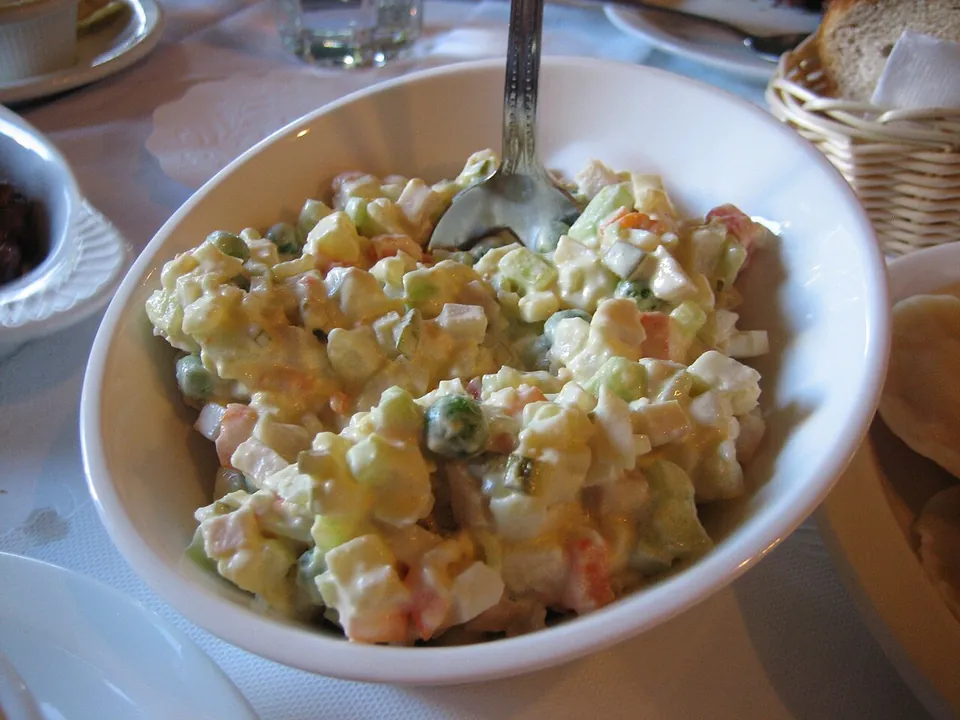
Olivier salad is the Russian standby of diced potato tossed with green peas and other vegetables in mayonnaise. It remains a fixture of the Russian New Year table.
Its original form reaches back to the second half of the nineteenth century, to the Moscow of the 1860s. It is a salad tied to the high-end restaurant Hermitage, and it bears the name of a man of French background, Lucien Olivier. The dish of that time, though, was nothing like today's home cooking: a lavish affair of costly ingredients — grouse, crayfish, capers — brought out by a sauce provençale, a kind of mayonnaise. It first appears clearly in the record in 1894, in a printed recipe carried by the Moscow cookery magazine Nasha Pishcha, where those ingredients are set out.
The foundation of this salad is the potato. The potato is a crop brought from the New World, and it settled broadly onto the Russian table only from the eighteenth century onward. A salad that spends this deep-rooted tuber freely is a dish of the era after the potato had become an everyday food.
The settings, too, tell the dish's story. Its birthplace was a high-end restaurant frequented by a select few, but over the Soviet years it turned into a plain, popular version and spread to home tables — above all to the table set to celebrate the New Year. The passage of a lavish dish into a national festive food is the history of this salad.
How we know
Olivier salad carries a famous tale, long handed down. Lucien Olivier, the story goes, was a genius cook who prepared the sauce at the heart of the salad as a trade secret, mixing it alone, never revealing the recipe to anyone, and carried it to his grave along with himself — so that the first taste was lost forever.
Yet no contemporary record supports this tale. The surviving official documents paint an Olivier who was not a cook standing in a kitchen. The 1868 Moscow address directory lists him as the manager of the Hermitage inn, and the 1877 merchant licence register records "Lucien Olivier, 40, French national, owner and manager of the inn." In other words, he was most likely a man on the business side of the establishment. The image of a cook who took a secret sauce to the grave owes much to a literary reminiscence set down by the later writer Gilyarovsky in Moscow and Muscovites, and it lacks any older support. It is close to a story made up after the fact.
At the same time, the broad outline — that this was a lavish salad of the high-end Hermitage — does not contradict the printed recipe of 1894. What collapsed within the tale is its core: that the cook Olivier invented a secret sauce and that its taste was lost.
A second question is when, and by whose hand, the plain salad we eat now came into being. Today's Olivier salad is a popular version in which the grouse and crayfish give way to chicken, with potato, boiled vegetables, and green peas dressed in mayonnaise; it was reconstituted in the Soviet period as Stolichny ("of the capital"). Its author is disputed: one account credits the restaurant chef Ivanov with reworking it in the early 1930s, another the chef Yermilin with inventing it in 1937, and the matter is still not settled. Some researchers see the imperial-era Hermitage original and the Soviet popular version as scarcely sharing anything — two dishes of separate lineage.
Who the Olivier who left his name really was, and by whose hand the dish now called "Olivier" took its shape — beneath the glittering tale, unsolved questions remain.
The full set of origin theories and the detailed verification log — traceable all the way to their sources — are available on the Japanese edition.
See the full origin theories and verification log (Japanese) →
Related dishes
Shares the key ingredient
- Vada pavMumbai (India)C
- PoutineQuebec (Canada)C
- Proto-ajiaco (pre-chicken Muisca highland stew proto-layer)Bogotá highlands (Cundinamarca)C
- Pani puriNorth IndiaC
- Aloo kachoriIndia (Rajasthan / North India)C
- VichyssoiseFrance / USA (disputed)B
- Bacalhau à BrásLisbon (Portugal)C
- Caldo verdeMinho (Portugal)C
- Pav bhajiMumbai (India)C
- Abgoosht (dizi)IranC
- Jansson's temptationSwedenC
- California burritoCalifornia (USA)C
- Shepherd's pieEnglandB
- StamppotNetherlandsC
- Sindhi biryaniSindh (Pakistan)C
- Patties (Sri Lankan)Sri LankaC
- OkroshkaRussiaC
- Potato chipsUnited StatesB
- DranikiBelarusC