All dishes / (未分類)
Pastrami Period BOrigin theory DVerified
Some fields (dish name, region and gates) are shown from the Japanese-edition data.
Who made the first pastrami in New York, and when? Sussman Volk, some say; no, Katz's, say others. None of these founding stories holds up to an independent record. What is certain is the dish's lineage: Eastern European Jewish immigrants remade a cured meat from the old country using New World beef.
Verification highlight popular claim → verdict → evidence
The two rival 'founder' legends — Sussman Volk's 1887 claim (family oral history only) and Katz's Delicatessen's 1888 founding date (debunked by food historian Robert F. Moss using Ellis Island and city-directory records; the deli actually dates to 1911) — are both unsupported as single-inventor origin stories. The better-supported account: Romanian/Bessarabian Jewish immigrants brought pastramă (itself descended from Ottoman pastırma), and in New York substituted cheap beef brisket for the goose breast used in the old country, curing and smoking it into the dish attested in print by 1895 (a Butte, Montana newspaper, per the OED).
The three gates
- Ingredient-supply gate
- Beef, salt, and spices were all readily available, posing no constraint on the dish's formation (a traditional-technique dish).
- Cooking-technique gate
- A curing process of salting, spicing, smoking, and steaming in the pastırma/pastramă tradition — the deciding factor in the dish's formation.
- Venue gate
- Eastern European Jewish delicatessens on New York's Lower East Side.
Overview
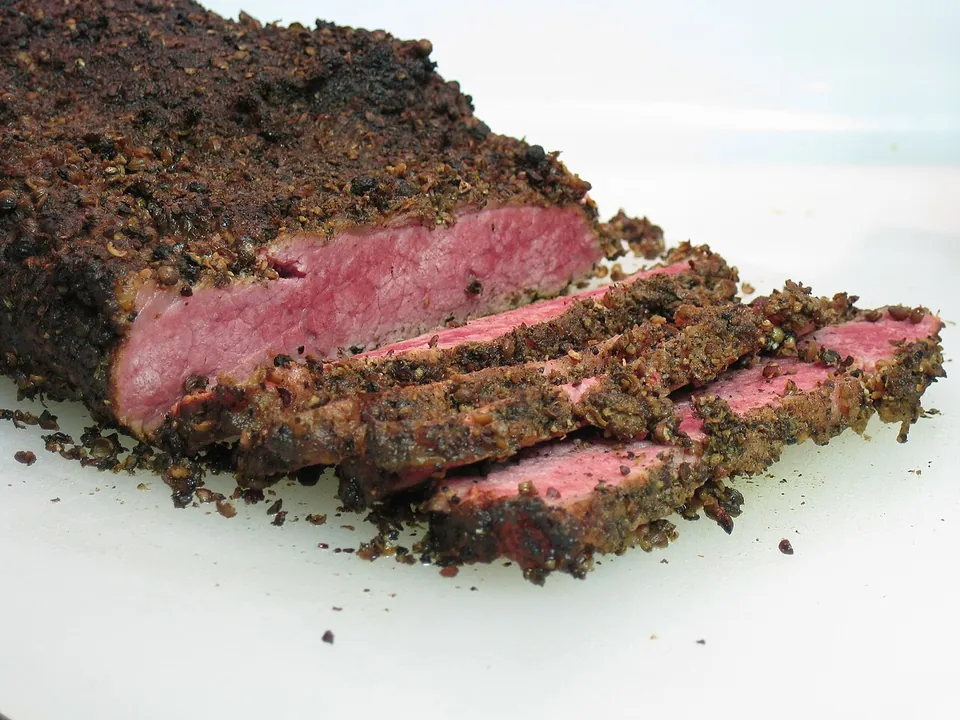
Pastrami is beef brisket—specifically the navel, the lower part of the breast—that is brined, coated with spices such as coriander, black pepper, and garlic, smoked, and finally steamed until it falls apart. In New York's delicatessens, it became famous piled thin between slices of rye bread.
Its ancestor lies far to the east. The Ottoman Turks had pastırma, beef that was salted, pressed, and dried; the word already appears in a price register of 1624. Carried into Romania, it became pastramă, its name built on a verb meaning "to preserve"—the name itself describing the method. In Romania and Bessarabia, this cured meat was often made from goose breast.
In the late nineteenth century, Romanian Jewish immigrants arrived in New York in growing numbers. They settled on the Lower East Side, and the kosher delicatessens they opened became the new stage for this meat. What was cheap in the New World was not goose but beef brisket, so pastramă turned into a beef dish. The handwork of brining, rubbing in spice, smoking, and steaming, together with the deli where it was served, was where a distinctly New York pastrami took shape.
The earliest surviving record of the English spelling "pastrami" is an 1895 advertisement in a Butte, Montana newspaper for "Roumania pastrami." But this marks only that the word was in use by that year; it does not fix the year the dish was born. The ending settled on -mi, one account suggests, by analogy with salami.
How we know
Pastrami has attracted no shortage of tellable founding stories. The most widely repeated holds that a man named Sussman Volk made the first pastrami sandwich in America in 1887. Yet the only thing behind the anecdote is a family tradition passed down by Volk's descendants; no independent contemporary record supports it. Even the encyclopedia entry that carries the date flags it as needing a source.
Another famous claim is the storefront sign reading "Katz's Delicatessen, established 1888." But the food historian Robert F. Moss traced Ellis Island arrival records and period city directories and set the story aside. The Iceland brothers whose name is tied to the shop came to America in 1902, and Iceland & Katz first appears in the directory in 1911—out of step with an 1888 founding. The actual founding, he finds, was around 1911.
So each "who was first" claim, examined one at a time, fails to stand. Who the true first inventor was remains, on the evidence, undecided.
What does come into focus lies on a different layer from the storefront disputes: the lineage. From Ottoman pastırma to Romanian pastramă, and then, in the late nineteenth century, carried to New York by Bessarabian and Romanian Jewish immigrants who swapped the old country's goose breast for cheap beef brisket and made it a local dish—this is a path that several food histories have arrived at independently.
From the same parent, an Eastern European Jewish cured meat, a branch also grew northward: Montreal smoked meat. Pastrami and smoked meat are not one descended from the other but siblings sharing a common ancestor. South and north of the border, the same heritage crystallized into two separate specialties.
The full set of origin theories and the detailed verification log — traceable all the way to their sources — are available on the Japanese edition.
See the full origin theories and verification log (Japanese) →
Related dishes
Cross-links Sister dishes & same-name dishes (separate lineage)
Shares the key ingredient
- PhoVietnamC
- Beef StroganoffRussiaC
- Chicago Italian beefChicago (USA)C
- Salt beef (the layer before canning)Ireland (Cork / Dublin)C
- AsadoRío de la Plata (Argentina / Uruguay)C
- Lomo saltadoLima (Peru)C
- BulgogiKorean Peninsula (South Korea)B
- ĆevapčićiBalkans (Serbia, etc.)C
- Proto-bulgogi (native grilled-meat proto-layer)Korean PeninsulaC
- Proto-goulash (pre-paprika herdsmen's meat stew proto-layer)HungaryC
- KharchoGeorgia (Caucasus)B
- Proto-rendang (pre-chili merendang proto-layer)West Sumatra (Minangkabau), IndonesiaC
- Nyama chomaEast Africa (Kenya, Tanzania)C
- Philly cheesesteakPhiladelphia (USA)B
- Pastel de chocloChileC
- NihariNorth India (Delhi / Awadh)C
- NikujagaJapanC
- Australian meat pieAustraliaC
- FajitasRio Grande Valley, Texas (USA)B
- Loco mocoHilo, Hawaii (USA)B
- KitfoGurage (Ethiopia)C
- Ropa viejaCubaC
- MachacaNorthern Mexico (Sonora / Sinaloa)C
- Ropa vieja (Iberian prototype)Canary Islands, SpainB
- TibsEthiopian HighlandsB
- BiltongSouth AfricaC
- Lok lakPhnom Penh (Cambodia)C
- Carne asadaNorthern Mexico (Sonora)C
- Hamburg steakHamburg (Germany)B
- Bò lúc lắc (Vietnamese shaking beef)Southern VietnamC
- Kare-karePhilippinesC
- BraaiSouth AfricaC
- French dip sandwichLos Angeles, California (USA)C