All dishes / 西欧
Hamburg steak Period BOrigin theory BVerified
Some fields (dish name, region and gates) are shown from the Japanese-edition data.
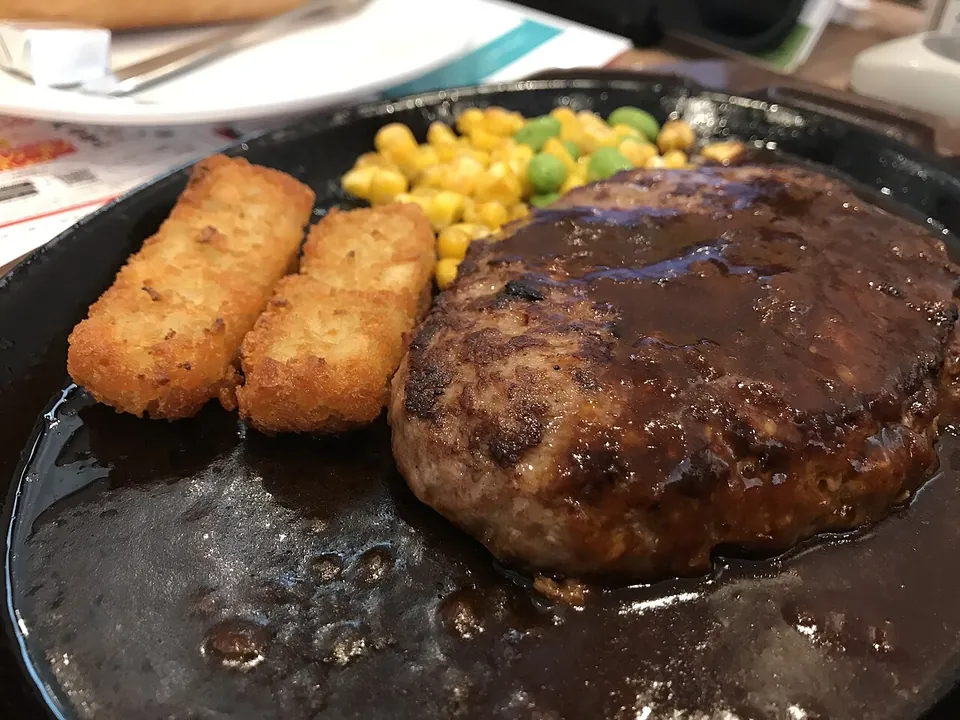
Hamburg steak, ground meat shaped and grilled, crossed to America bearing the name of Hamburg, Germany's largest port of emigration, and later led on to the hamburger. The famous story that pushes its earliest American record back to 1834 rests on a forged menu — and is an error.
Verification highlight popular claim → verdict → evidence
Myth: an 1834 (or 1837) Delmonico's menu already listed 'Hamburg steak' in New York. Verdict: the menu is a fabrication. Ellen Steinberg and Jack Prost (Gastronomica, 2008) showed its address didn't match Delmonico's real one, its typography was anachronistic, and it listed items the restaurant never served; the term 'hamburg steak' itself wasn't in use until around 1880. The earliest confirmed US menu appearance is Delmonico's in 1873.
The three gates
- Ingredient-supply gate
- Beef and onions were both native to Germany and Europe; no ingredient was the limiting factor (the precursor Frikadelle already existed in the 17th century).
- Cooking-technique gate
- Shaping and searing (or eating raw) ground meat was a long-established technique in Europe; technique was not the limiting factor.
- Venue gate
- Became a specialty at eateries in the port of Hamburg in the 19th century, then was carried to the US by German immigrants (recorded at Delmonico's in New York in 1873, among others).
Overview
Hamburg steak takes its origin from the ground-meat steak that became a specialty of the eating houses of nineteenth-century Hamburg. Hamburg was then Germany's largest port of emigration, and the ground-meat dish enjoyed there was carried to America along with the people crossing the sea.
Its ingredients were long established in Europe. Beef and onion were both rooted in the region, and cooking ground meat — shaping and grilling it, or eating it raw — had long been practised across Europe. Its forerunners reach back to the Frikadelle and Bratklops, ground-meat dishes visible in seventeenth-century Germany.
The dish appears on the American table on the current of German emigration that swelled after the revolutions of 1848. What these emigrants brought to New York and elsewhere came, in time, to be listed on menus under the port's name as 'Hamburg steak.' Its name is recorded on the menu of Delmonico's in New York in 1873 and of the Clipper in San Francisco between 1871 and 1884. It was a dish transplanted under the name of the port — and also the starting point from which it would later be laid between bread slices in America and turned into the hamburger.
How we know
One anecdote has long been handed down about the history of Hamburg steak: that 'Hamburg steak already appeared on Delmonico's menu of 1834 (by one account 1837).' If that were true, this dish would have been enjoyed in America long before the wave of immigration on the eve of the revolutions.
But that menu was a forgery. Ellen Steinberg and Jack Prost (A Menu and a Mystery, Gastronomica 2008, University of California Press) matched it up point by point: the address printed on it does not agree with the real Delmonico's, the typeface does not fit the period, items such as 'Pork and Beans' that the real house did not serve appear on it, and printed menus were not yet in common use in 1834 to begin with. In the words too, 'hamburg steak' only begins to be used around 1880 — a term that did not yet exist in the 1830s. The firm earliest attestation that can be traced in the American record is Delmonico's menu of 1873. The forged menu had made the American reception of the dish look nearly half a century older than it was.
At the core of the history one older view remains. Shaping and grilling ground meat, or eating it raw, was commonplace across Europe, and independent sources pointing to any one place of origin are scarce. On that reckoning it is nearer the truth to say that the dish itself was broadly European, while the name of the emigration port Hamburg was fixed to it as a trade name on the American side. In the English-speaking world, the port's name is attached to a ground-meat dish as far back as the 'Hamburgh Sausage' in Hannah Glasse's The Art of Cookery of 1758. The dish may be common to Europe, but the name of the port took hold as a brand — and it is the history of that name that tells what Hamburg steak really is.
The full set of origin theories and the detailed verification log — traceable all the way to their sources — are available on the Japanese edition.
See the full origin theories and verification log (Japanese) →
Related dishes
Cross-links Sister dishes & same-name dishes (separate lineage)
Shares the key ingredient
- PhoVietnamC
- Beef StroganoffRussiaC
- Chicago Italian beefChicago (USA)C
- Salt beef (the layer before canning)Ireland (Cork / Dublin)C
- AsadoRío de la Plata (Argentina / Uruguay)C
- Lomo saltadoLima (Peru)C
- BulgogiKorean Peninsula (South Korea)B
- ĆevapčićiBalkans (Serbia, etc.)C
- Proto-bulgogi (native grilled-meat proto-layer)Korean PeninsulaC
- Proto-goulash (pre-paprika herdsmen's meat stew proto-layer)HungaryC
- KharchoGeorgia (Caucasus)B
- Proto-rendang (pre-chili merendang proto-layer)West Sumatra (Minangkabau), IndonesiaC
- Nyama chomaEast Africa (Kenya, Tanzania)C
- Philly cheesesteakPhiladelphia (USA)B
- Pastel de chocloChileC
- NihariNorth India (Delhi / Awadh)C
- NikujagaJapanC
- Australian meat pieAustraliaC
- FajitasRio Grande Valley, Texas (USA)B
- Loco mocoHilo, Hawaii (USA)B
- KitfoGurage (Ethiopia)C
- Ropa viejaCubaC
- MachacaNorthern Mexico (Sonora / Sinaloa)C
- Ropa vieja (Iberian prototype)Canary Islands, SpainB
- TibsEthiopian HighlandsB
- BiltongSouth AfricaC
- Lok lakPhnom Penh (Cambodia)C
- Carne asadaNorthern Mexico (Sonora)C
- Bò lúc lắc (Vietnamese shaking beef)Southern VietnamC
- Montreal-style smoked meatQuebec (Canada)D
- Kare-karePhilippinesC
- PastramiNew York (USA)D
- BraaiSouth AfricaC
- French dip sandwichLos Angeles, California (USA)C