All dishes / 北米
Montreal-style smoked meat Period BOrigin theory DVerified
Some fields (dish name, region and gates) are shown from the Japanese-edition data.
The popular claim that Montreal's smoked meat was invented by Schwartz's, founded in 1928, collapses in front of older records. It was born not in a single shop but across a whole neighborhood of Eastern European Jewish immigrants.
Verification highlight popular claim → verdict → evidence
The popular claim that Schwartz's (1928) originated Montreal smoked meat is disproven: smoked meat advertisements appear in Montreal as early as 1894, well before Schwartz's opened, and the true first creator cannot be identified from the historical record. The dish instead crystallized as Eastern European (Romanian) Jewish immigrants' pastrami-style salting, smoking, and steaming techniques localized in Montreal's immigrant quarter between the 1880s and 1908 (David Sax, Save the Deli; The Canadian Encyclopedia; Tourisme Montreal).
The three gates
- Ingredient-supply gate
- Beef, salt, and spices were all available from the settlement period onward -- no scarce ingredient held the dish back (this is a technique-driven dish).
- Cooking-technique gate
- Salt-curing, smoking, and steaming preservation techniques.
- Venue gate
- Eastern European Jewish delicatessens in Montreal.
Overview
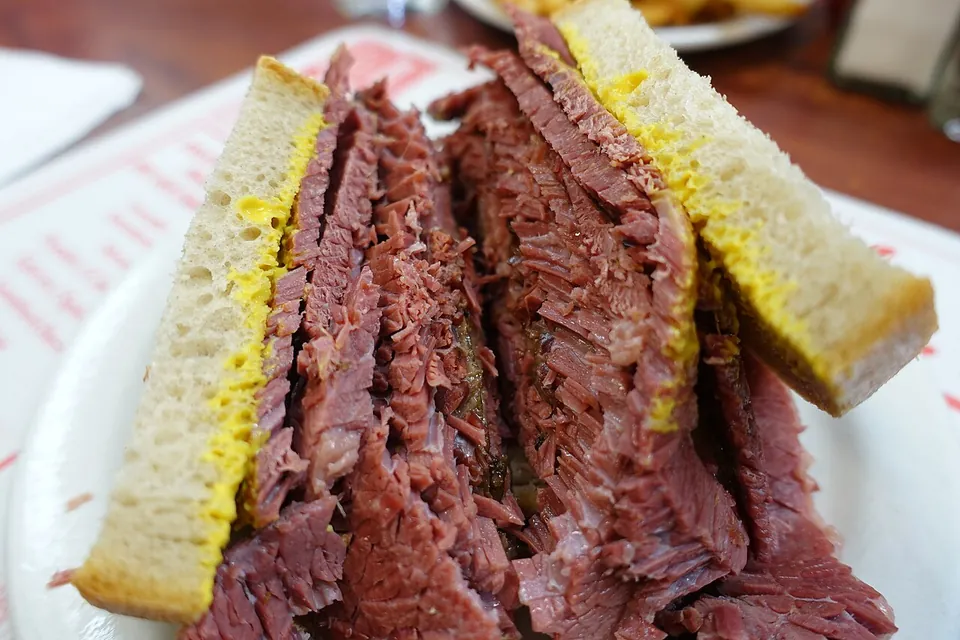
Montreal-style smoked meat is a cured beef made from brisket, the cut from the front of the chest, packed for a long time in a peppery, salt-heavy spice cure, then smoked, steamed, and sliced thin. It belongs to the same family as pastrami, but its heavily peppered character made it the face of this city.
The dish took hold in Montreal between the end of the 19th century and the early 20th. Jewish immigrants from Romania and elsewhere in Eastern Europe arrived carrying the curing, spicing, and smoking techniques handed down at home. They lived and did business in the immigrant quarter along The Main, the boulevard running north to south through the city. The cured-beef methods they brought were rebuilt here around locally available brisket and pepper, and steaming, into a distinctly local style.
Beef, salt, and spices were all to be had in settlement-era Montreal. What shaped the dish was the way the preserving and processing craft carried from the old country put down roots in the delicatessens of the immigrant quarter and settled into the city's everyday taste. It surfaces in print in 1894, by which year advertisements naming smoked meat had already appeared in the city.
How we know
Ask about smoked meat and you will hear that Schwartz's, founded in 1928, was where it began. The name of the storied deli on its sign is easy to remember, and it makes a tidy tourist story. But follow the contemporary records that would support the anecdote, and the story does not stop there.
Advertisements naming smoked meat had already appeared in Montreal newspapers by 1894. Aaron Sanft's kosher butcher shop, open since 1884, was making and selling smoked meat and corned beef, as the historian Eiran Harris records. Schwartz's, in 1928, was not the shop that created the dish but one of the outlets that spread a taste already there. Being the first to open a shop and being the first to create a dish are not the same thing.
So who was the first to make it? Aaron Sanft in 1884, Itzak Rudman in 1902, Herman Rees Roth and the British-American Delicatessen in 1908, Benjamin Kravitz in 1910: the claims compete, and none can be narrowed to one. Even David Sax's food-history book Save the Deli (2010) and the survey in the Canadian Encyclopedia find that the first person cannot be pinned down in the sources and is likely unresolvable.
Yet these names all point to the same immigrant continuum and the same window of the 1880s to the 1900s, and that does not move. The question of who was first has no answer, but the fact that it has no answer is itself what tells the true story of this dish. Smoked meat was not invented by a single genius; it grew into its own taste through many hands, within the neighborhood of people who came from Eastern Europe.
The full set of origin theories and the detailed verification log — traceable all the way to their sources — are available on the Japanese edition.
See the full origin theories and verification log (Japanese) →
Related dishes
Cross-links Sister dishes & same-name dishes (separate lineage)
Shares the key ingredient
- PhoVietnamC
- Beef StroganoffRussiaC
- Chicago Italian beefChicago (USA)C
- Salt beef (the layer before canning)Ireland (Cork / Dublin)C
- AsadoRío de la Plata (Argentina / Uruguay)C
- Lomo saltadoLima (Peru)C
- BulgogiKorean Peninsula (South Korea)B
- ĆevapčićiBalkans (Serbia, etc.)C
- Proto-bulgogi (native grilled-meat proto-layer)Korean PeninsulaC
- Proto-goulash (pre-paprika herdsmen's meat stew proto-layer)HungaryC
- KharchoGeorgia (Caucasus)B
- Proto-rendang (pre-chili merendang proto-layer)West Sumatra (Minangkabau), IndonesiaC
- Nyama chomaEast Africa (Kenya, Tanzania)C
- Philly cheesesteakPhiladelphia (USA)B
- Pastel de chocloChileC
- NihariNorth India (Delhi / Awadh)C
- NikujagaJapanC
- Australian meat pieAustraliaC
- FajitasRio Grande Valley, Texas (USA)B
- Loco mocoHilo, Hawaii (USA)B
- KitfoGurage (Ethiopia)C
- Ropa viejaCubaC
- MachacaNorthern Mexico (Sonora / Sinaloa)C
- Ropa vieja (Iberian prototype)Canary Islands, SpainB
- TibsEthiopian HighlandsB
- BiltongSouth AfricaC
- Lok lakPhnom Penh (Cambodia)C
- Carne asadaNorthern Mexico (Sonora)C
- Hamburg steakHamburg (Germany)B
- Bò lúc lắc (Vietnamese shaking beef)Southern VietnamC
- Kare-karePhilippinesC
- BraaiSouth AfricaC
- French dip sandwichLos Angeles, California (USA)C