All dishes / 東南アジア
Pho Period BOrigin theory CVerified
Some fields (dish name, region and gates) are shown from the Japanese-edition data.
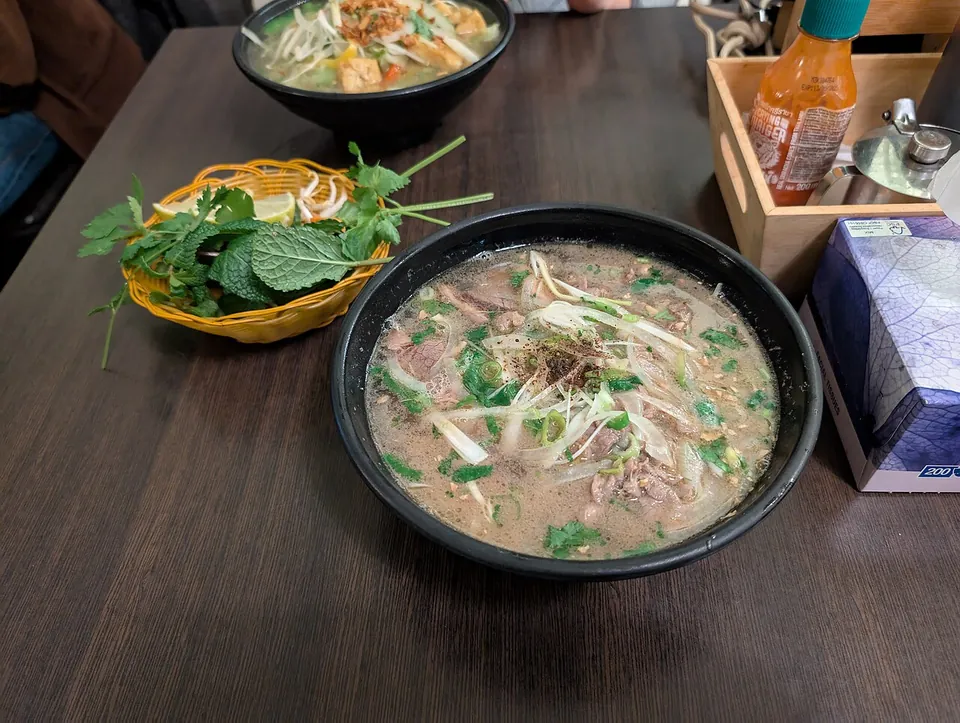
The name phở comes from the French pot-au-feu, so the dish itself must be a French import—this pleasant-sounding etymology has lost its footing in both linguistics and in the food on the plate.
Verification highlight popular claim → verdict → evidence
Popular claim: pho's name derives from French 'pot-au-feu' (feu). Verdict: refuted -- linguists trace 'pho' to Cantonese 'nguu nhuc phan' (beef noodle), a street-vendor call recorded as early as 1919, six years before the 1937 dictionary entry that first likened the dish to pot-au-feu. The dish itself emerged in early 20th-century Hanoi from French-introduced beef combined with Chinese flat rice noodles, repurposing the earlier water-buffalo soup xao trau. Key sources: Encyclopaedia Britannica; Erica Peters (2019); Vu Hong Lien (2016).
The three gates
- Ingredient-supply gate
- Rice noodles and beef
- Cooking-technique gate
- Beef consumption introduced under French colonial rule, combined with Chinese noodle craft
- Venue gate
- Hanoi street stalls
Overview
Pho was born in northern Vietnam, in early-twentieth-century Hanoi. Its earliest appearance in writing is a short story from 1907; a detailed survey of Hanoi's foods compiled that same year by Georges Dumoutier does not yet mention it. Pho was still a novelty then, a food only beginning to appear on street corners. By 1913 Nguyễn Công Hoan was recalling street vendors selling it, and in 1931 a dictionary finally recorded a definition. A birth somewhere across the 1900s and 1910s is a firm reading.
Three currents met in this single bowl. The first was beef. In Vietnam cattle had long been draft animals for the rice fields, and eating their meat day to day was not the custom. Under French colonial rule, Western-style slaughter spread through Hanoi, and beef bones and cuts the French cared little for began to pile up in the markets. The technique of an existing water-buffalo soup, xáo trâu, was turned toward this surplus beef and bone. The second current was the flat rice noodle (bánh phở) sold at Chinese-run stalls—rice noodle making itself was an old craft rooted in Vietnam's rice culture, and here it met the beef broth in one bowl. The third was the place: the street stalls of Hanoi. Beef released by French slaughter, the handiwork of a local buffalo soup, Chinese rice noodles—these crossed at the stalls of a colonial city and became pho. This multicultural picture, drawn by Andrea Nguyen, Britannica, Erica J. Peters, and Vu Hong Lien, is the one now widely accepted.
How we know
The name phở comes from the French feu, that is pot-au-feu (a rich braise of beef and vegetables), and so the dish itself must be French in origin—this etymology has followed pho for a long time.
But the record does not bear the story out. First, the food itself does not match. Pot-au-feu is a hearty pot simmered with several kinds of vegetables, while pho is a spare arrangement of clear broth, rice noodles, and beef; the gap is too wide to see one as the parent of the other. Second, the sounds do not line up. Food historians and linguists grant no phonetic bridge from feu to phở, and the discussion on Language Log, argued by V. Mair of the University of Pennsylvania, sets the claim aside.
The decisive point is the order of the documents. The earliest text that likens pho to pot-au-feu is Gustave Hué's dictionary of 1937. Yet six years earlier, in 1931, the first substantial Vietnamese dictionary, Việt Nam Tự điển, already defined phở as "from phấn: thin slices of rice cake simmered with beef." Phấn is the Cantonese word for "powder" or rice flour. A definition tracing the word to Chinese thus stood on its own before any comparison to French feu appeared.
And the reading now considered strongest is exactly this Cantonese origin. The vendors' cry of Chinese stalls calling out "beef noodle" (ngưu nhục phấn, ngau yuk fan in Cantonese) passed through nhục phở and lục phở, dropped its final sound, and contracted to phở—a shift that works phonetically and fits the fact that Chinese rice noodles belong to this dish. A stall cry recorded in 1919 Hanoi, "Yoc Pheu!", is taken to be exactly this rendering of "beef noodle."
Pho is not the offspring of a euphonious French etymology. It is a multicultural bowl in which colonial Hanoi's French beef, a local buffalo soup, and Chinese rice noodles came together—and even its name traces back to the cry of a Chinese stall. This is the true face of pho, held up by dictionaries and by scholarship.
The full set of origin theories and the detailed verification log — traceable all the way to their sources — are available on the Japanese edition.
See the full origin theories and verification log (Japanese) →
Related dishes
Shares the key ingredient
- Beef StroganoffRussiaC
- Chicago Italian beefChicago (USA)C
- Salt beef (the layer before canning)Ireland (Cork / Dublin)C
- AsadoRío de la Plata (Argentina / Uruguay)C
- Lomo saltadoLima (Peru)C
- BulgogiKorean Peninsula (South Korea)B
- ĆevapčićiBalkans (Serbia, etc.)C
- Proto-bulgogi (native grilled-meat proto-layer)Korean PeninsulaC
- Proto-goulash (pre-paprika herdsmen's meat stew proto-layer)HungaryC
- KharchoGeorgia (Caucasus)B
- Proto-rendang (pre-chili merendang proto-layer)West Sumatra (Minangkabau), IndonesiaC
- Nyama chomaEast Africa (Kenya, Tanzania)C
- Philly cheesesteakPhiladelphia (USA)B
- Pastel de chocloChileC
- NihariNorth India (Delhi / Awadh)C
- NikujagaJapanC
- Australian meat pieAustraliaC
- FajitasRio Grande Valley, Texas (USA)B
- Loco mocoHilo, Hawaii (USA)B
- KitfoGurage (Ethiopia)C
- Ropa viejaCubaC
- MachacaNorthern Mexico (Sonora / Sinaloa)C
- Ropa vieja (Iberian prototype)Canary Islands, SpainB
- TibsEthiopian HighlandsB
- BiltongSouth AfricaC
- Lok lakPhnom Penh (Cambodia)C
- Carne asadaNorthern Mexico (Sonora)C
- Hamburg steakHamburg (Germany)B
- Bò lúc lắc (Vietnamese shaking beef)Southern VietnamC
- Montreal-style smoked meatQuebec (Canada)D
- Kare-karePhilippinesC
- PastramiNew York (USA)D
- BraaiSouth AfricaC
- French dip sandwichLos Angeles, California (USA)C