All dishes / 中東・北アフリカ
Manti Period COrigin theory CVerified
Some fields (dish name, region and gates) are shown from the Japanese-edition data.
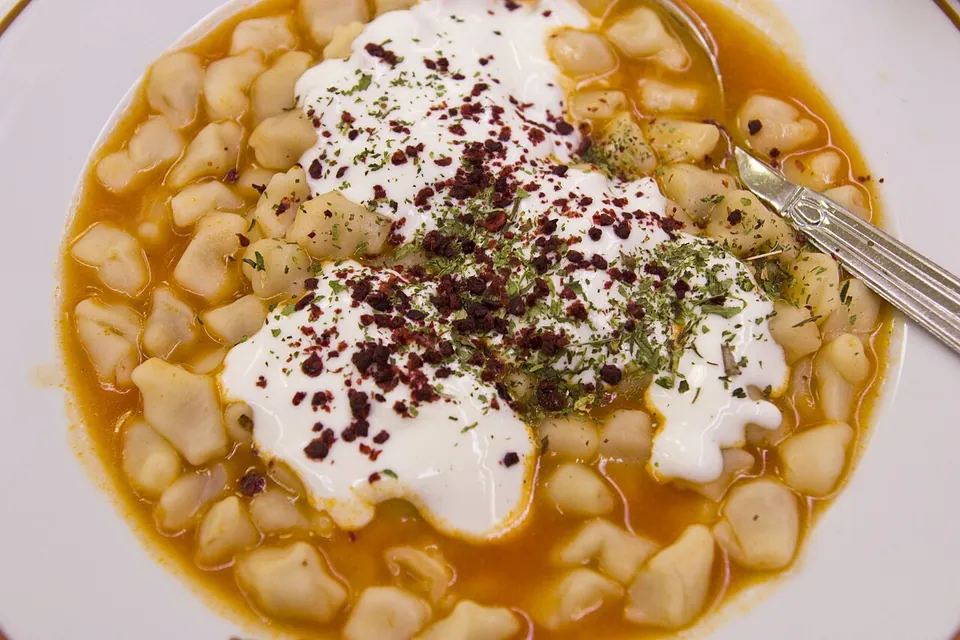
Manti, the small Turkish dumplings served under a blanket of garlicky yogurt, look like the very face of Turkish cooking. Yet their trail leads back to the food of Central Asian nomads, and the oldest surviving record of them sits not in Anatolia but in a Mongol-era court far to the east.
Verification highlight popular claim → verdict → evidence
The leading account traces manti to Central Asia, carried west by Turkic and Mongol peoples and settling in Anatolia during the medieval period (13th-15th century). The earliest solid written record is the 1330 Yinshan Zhengyao, a Yuan-dynasty Chinese court dietary text, which describes 'manta' -- a steamed dumpling of minced mutton, fat, and scallion -- the earliest secure attestation, from the eastern (Mongol) end of the route. A minority view holds that manti instead originated in the Middle East and spread eastward, but this is weakened by the eastern origin of the earliest record and by the fact that the dish's entry in the earliest Ottoman cookbook (a 15th-century translation of a 13th-century Arabic original) was not present in that Arabic source but added later, pointing to a Central Asian or Anatolian rather than Middle Eastern culinary lineage.
The three gates
- Ingredient-supply gate
- Wheat and meat (sheep or cattle) were both already available locally, so the ingredient side is not the binding constraint; the constraint is the dumpling technique of wrapping and boiling, together with the nomadic trade routes that carried it west.
- Cooking-technique gate
- Wrapping small portions of ground meat filling in wheat dough and boiling it (sometimes steaming), served with a yogurt sauce; established in Anatolia during the medieval period.
- Venue gate
- From the food of Turkic nomads in Central Asia, carried west through Mongol-era conquest and trade, to home and court cooking in Anatolia (for example, Bursa).
Overview
Manti are little parcels of ground lamb wrapped in thin sheets of rolled wheat dough, boiled (steamed in some regions) and dressed with a yogurt sauce. Both the wheat for the wrappers and the lamb for the filling were long-familiar ingredients across Anatolia, so nothing about the raw materials stood in the way. What gave the dish its shape was the technique of folding filling into small wrappers and boiling them, and the nomadic and trading routes along which that technique traveled.
The dish is thought to have begun with the food of the Turkic nomads of Central Asia. Along the Silk Road, as the Mongols expanded their reach across the thirteenth and fourteenth centuries, it spread east and west and took root in Anatolia. Its oldest appearance in writing comes from the Yinshan Zhengyao, a dietary treatise compiled at the Yuan court in 1330 by the court dietitian Hu Sihui. There it appears as manta: ground lamb mixed with fat, scallion and dried tangerine peel, wrapped in a thin sheet and steamed. This record from the eastern, Mongol-ruled world is the firmest starting point we can trace for manti today.
On the Ottoman side to the west, the oldest surviving record is a fifteenth-century cookbook by Sirvani, where manti appears as a steamed dumpling of ground lamb with chickpeas and cinnamon, said to have been a favorite of the conqueror Mehmed II. The present-day form, boiled and served with yogurt, shows up in writing in a cookbook of 1844, as a dish called Tatar boregi. The name manti is a word spread widely across Central Asia, and some hold that it shares a root with the Chinese mantou.
How we know
For a long time the story of manti held that its oldest record was a fifteenth-century Ottoman cookbook, and several rival accounts competed over where the dish had first appeared. One of them had it born in the Middle East and carried east along the Silk Road to China and Korea.
What redrew this picture was the Yinshan Zhengyao, the dietary treatise compiled at the Yuan court in 1330. The late-twentieth-century food-history work that translated and annotated this book into English (Buell and Anderson) showed that the manta recorded there was a dumpling of lamb wrapped in a thin sheet and steamed. The oldest manti to appear in writing was thus neither in the Middle East nor in Anatolia to the west, but in the Mongol-ruled east. And the Sirvani cookbook long taken as the earliest Ottoman source turns out, when traced back, to be a translation of a thirteenth-century Abbasid cookbook written in Arabic; its manti entry is absent from that thirteenth-century original and was added by Sirvani himself. The dish, in other words, did not descend from the Arab and Persian cooking of the Middle East but entered from the side of Asia Minor and Central Asia.
With that, the idea of a Middle Eastern birth spreading eastward lost its footing. The earliest record in the Yuan court's writings, the etymology, and recent scholarship all converge on the larger line of a westward transmission out of Central Asia, and this is now the settled view. Even so, when the present Anatolian form (boiled and dressed with yogurt) took hold, and how far the Central Asian and Turkish versions should be counted as separate dishes, remain open to further work.
The full set of origin theories and the detailed verification log — traceable all the way to their sources — are available on the Japanese edition.
See the full origin theories and verification log (Japanese) →
Related dishes
Cross-links Sister dishes & same-name dishes (separate lineage)
- Sister dish (shared ancestor)KhinkaliGeorgia (highlands — Khevsureti/Mtiuleti)C
- Sister dish (shared ancestor)PelmeniSiberia (Russia)C
- Sister dish (shared ancestor)MomoTibet / NepalC
- Sister dish (shared ancestor)BuuzMongoliaB
- Sister dish (shared ancestor)Manti (Central Asian)Central Asia (Uzbekistan / Kazakhstan)C
- Same name, different dish (separate lineage)MandiHadhramaut (Yemen)C
Shares the key ingredient
- Railway mutton curryIndia (British Indian Railways)C
- MansafJordan (Levant)C
- SajjiBalochistan (Pakistan)C
- KhorkhogMongoliaC
- BoodogMongoliaC
- HareesPersian Gulf (Bahrain / Kuwait)C
- Instant-boiled mutton (shuan yangrou)Beijing (China)B
- LahmacunAnatoliaC
- KarahiLahore (Pakistan)C
- KoftaLevantB
- Seekh kebabLahore (Pakistan)C
- ZarbJordan (Levant)B
- HaggisScotlandC
- Jingisukan (Genghis Khan)Hokkaido (Japan)D