All dishes / 中東・北アフリカ
Mansaf Period BOrigin theory CVerified
Some fields (dish name, region and gates) are shown from the Japanese-edition data.
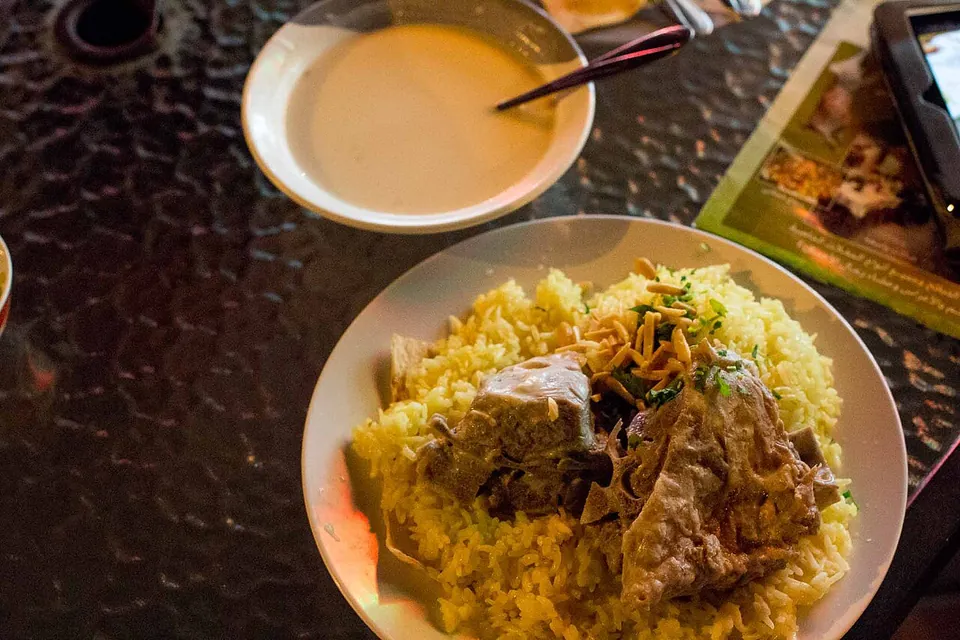
The Jordanian tradition that the ninth-century-BC Moabite king Mesha had mansaf made has no support in the historical record. The mansaf of today, lamb with a fermented-milk sauce over rice, became a national dish far later, in the middle of the twentieth century.
Verification highlight popular claim → verdict → evidence
Myth: mansaf originates with the ancient Moabite king Mesha or with Abraham. Verdict: sources reject this — the current form (with rice and jameed sauce) only crystallized in the 20th century, and no contemporary ancient text mentions the dish; the true etymology is a serving tray, not the folk origin 'nasafa' (to destroy). Key sources: Joseph Massad, Colonial Effects (2001); R. Dozy, Supplément aux dictionnaires arabes (1881, primary source).
The three gates
- Ingredient-supply gate
- Lamb, jameed (dried fermented yogurt), and rice are all Old World ingredients native to the Levant. No New World crop acts as a limiting factor.
- Cooking-technique gate
- Preservation technique of drying fermented yogurt into jameed, plus slow-simmered lamb.
- Venue gate
- From a Bedouin gathering of hospitality to Jordan's national and festive dish
Overview
Mansaf is a dish of the Levant, centred on Jordan. It was first the food of the Bedouin, served when they hosted guests as they crossed the desert. Today it is a national feast, indispensable at celebrations, and in 2022 it was inscribed on UNESCO's list of intangible cultural heritage.
The mansaf we know was not always like this. The old Bedouin dish was plainer: lamb or camel meat with thin flatbread (shrak) and clarified butter (ghee). That was the basic form. Jameed, a fermented and dried preserving-yoghurt, was long familiar, but dissolving it in water and pouring it over the meat as a sauce came only with the modern shift from nomadic life to settlement.
What reshaped the dish into its present form was the movement of people and goods. As trade routes widened, first cracked wheat (bulgur) and then, in the 1950s, rice entered the table, taking the place of bread as the staple beneath the meat. By the early 1960s a white sauce of dissolved jameed had replaced the clarified butter and stock, and pine nuts and other garnishes were added. So the simple nomadic dish of meat, bread, and butter was recombined into today's version of rice and fermented-milk sauce.
What lifted the dish to the status of a national one was the course of modern Jordan. After independence, and above all after the war of 1967, Jordan came to root its sense of itself in the figure of the Bedouin. In that current, mansaf, once the food of the nomads' table of welcome, was chosen as a dish to stand for the nation. A regional dish for guests became a national symbol by way of the feast.
How we know
Jordan has a tradition that traces mansaf back to antiquity. It holds that Mesha, the Moabite king of the ninth century BC, had the dish made in order to set his people apart from the Hebrews; some versions tie it instead to Abraham of the Book of Genesis. The name, one telling goes, comes from nasafa, 'to destroy', marking the shattering of a pagan custom.
These ancient-origin stories find no support in the sources. The plain derivation of the name mansaf points instead to the large tray on which the dish is served; the reading 'nasafa = to destroy' is a later gloss fitted to the Mesha tale after the fact. The mansaf of today, made with a fermented-milk sauce and rice, took its form only in the middle of the twentieth century, and could not yet have existed in the time of a ninth-century-BC king, still less in Abraham's day. Nowhere in the contemporary record, the Mesha Stele among it, does the dish appear. The oldest surviving record of the rice form of mansaf is in fact a nineteenth-century Arabic dictionary, R. Dozy's Supplément aux dictionnaires arabes (1881), which lists mansaf ruzz, 'a mound of cooked rice'. To push the origin back into antiquity is best seen as a tradition made up after the fact, one that the work of binding a nation into a single story called for. This does not deny the age of the nomadic dish-type itself, meat with dairy and bread; what it denies is the claim that today's mansaf began with a single ancient king. Joseph Massad's Colonial Effects (Columbia University Press) traces how mansaf was built up into a national dish across the Mandate and independence years.
Set against this tradition is a stepwise account that keeps to the sources. Starting from the Bedouin dish of meat, bread, and butter, bulgur enters before 1945, rice replaces it in the 1950s, and a fermented-milk sauce takes over from butter and stock in the early 1960s: a study of the district of Hartha in northern Jordan (Alobiedat, 2016) and work in the journal Contemporary Levant setting the change in its political economy both record this shift. Where the first dish arose, though, the scholars do not agree. Some point to Hebron and Palestine, some to a broad span from Syria to the Hejaz, some to the Bedouin themselves in the national telling; the source stays undecided. Far closer to the record than a glittering tale of a king's invention is the modern story of a dish recombined, little by little, in the course of settlement and the making of a nation.
The full set of origin theories and the detailed verification log — traceable all the way to their sources — are available on the Japanese edition.
See the full origin theories and verification log (Japanese) →
Related dishes
Shares the key ingredient
- Railway mutton curryIndia (British Indian Railways)C
- MantiAnatolia (Turkey)C
- SajjiBalochistan (Pakistan)C
- KhorkhogMongoliaC
- BoodogMongoliaC
- HareesPersian Gulf (Bahrain / Kuwait)C
- Instant-boiled mutton (shuan yangrou)Beijing (China)B
- LahmacunAnatoliaC
- Manti (Central Asian)Central Asia (Uzbekistan / Kazakhstan)C
- KarahiLahore (Pakistan)C
- KoftaLevantB
- Seekh kebabLahore (Pakistan)C
- ZarbJordan (Levant)B
- HaggisScotlandC
- Jingisukan (Genghis Khan)Hokkaido (Japan)D