All dishes / 中東・北アフリカ
Lahmacun Period BOrigin theory CVerified
Some fields (dish name, region and gates) are shown from the Japanese-edition data.
Lahmacun, the thin flatbread claimed as both Turkish and Armenian, takes its name from the Arabic for 'meat with dough,' and its oldest layer lies in the Arab Levant. It cannot be pinned to any single nation as its birthplace.
Verification highlight popular claim → verdict → evidence
Turkey and Armenia each claim lahmacun as their own. The older layer belongs to neither. The name is Arabic, lahm bi-ajin, meat with dough, and the earliest recipe stands in a 13th-century Aleppo cookbook by Ibn al-Adim (d. 1262), where minced meat is spread over a round of thin dough and baked (edited and translated by Charles Perry as Scents and Flavors, Library of Arabic Literature, NYU Press, 2017). The words turn up next in Jacob Berggren's French-Arabic guide of 1844, which defines lahm el-ajin as small pies of minced meat baked in an oven, and in the Beirut cookbook Ustadh al-Tabbakhin of 1885. The quarrel is about something later: Ayfer Bartu notes that lahmacun was unknown in Istanbul until the middle of the 20th century and spread through Turkey only from the 1950s, and Armenian accounts follow communities from Aintab, Urfa and Cilicia who settled in Aleppo. The tomato and pepper of the modern topping are American crops, so the version eaten today can be no older than their arrival in the Old World.
The three gates
- Ingredient-supply gate
- Wheat is native, but the tomato and pepper (paprika) in the modern recipe are New World crops, so their arrival in the Old World (no earlier than the 16th century) is a hard physical lower bound.
- Cooking-technique gate
- A thin sheet of dough is spread with a minced-meat paste and baked briefly in a very hot oven.
- Venue gate
- A humble street food, typically from an ocakbasi (oven-side) stall.
Overview
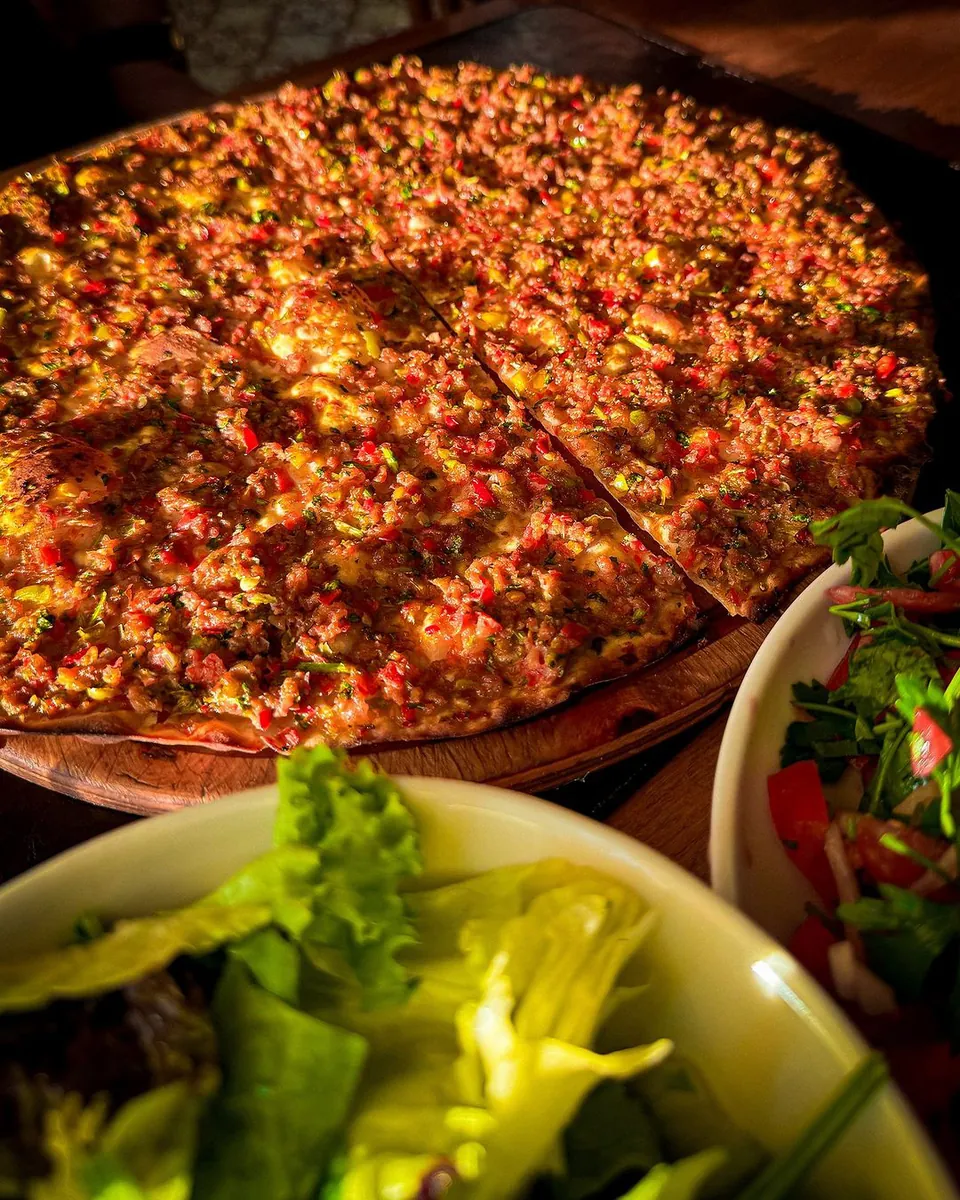
Lahmacun is made by rolling wheat dough paper-thin, spreading it with a thin paste of minced lamb or beef worked together with vegetables, and baking it briefly in a very hot oven. The dough is as thin as paper, and its edge rises fragrant as it bakes. It is usually rolled up and eaten by hand, a humble dish long served at street-corner ovens and snack stalls.
At the oven, the wheat dough is stretched to the brink of tearing, the raw minced paste is spread very thin, and the round is slid into a fierce fire. In tens of seconds the dough bakes through, its edge curling up crisp into a light sheet, and the baker keeps feeding rounds into the oven and drawing out the finished ones. It has spread bound to the ovens of the town more than to the home kitchen.
Its main players, wheat and lamb, are ingredients long rooted in this region. Baking a thin sheet of dough with meat laid on top belongs to a West Asian oven tradition carried down over centuries. The tomato and pepper (paprika) that lend color and flavor to the modern recipe are newer arrivals from across the sea, added to taste as seasoning rather than as anything the dish depends on. The pairing of thin dough, minced meat, and oven had been repeated in this land for a long time.
How we know
Lahmacun is known as a specialty of Gaziantep and Şanlıurfa in southeastern Turkey, and both Turkey and Armenia take pride in it as their own. The name itself, though, points the dish's lineage another way. Lahmacun derives from the Arabic laḥm bi-ʿajīn (meat with dough, or bread), and the shape of the word marks an Arab origin distinct from either Turkish or Armenian.
A dish of finely chopped meat laid on thin dough and baked in an oven is recorded in the Kitāb al-Wuṣla, a cookbook compiled in thirteenth-century Aleppo by the historian Ibn al-ʿAdīm (d. 1262), as a single-line recipe for minced meat spread on a round of thin dough and baked. This is the oldest surviving record (it can be checked in Charles Perry's scholarly edition and translation, Scents and Flavors: A Syrian Cookbook, NYU Press, 2017). The word's independent first appearance in writing is corroborated from another direction as well: a French-Arabic dictionary compiled by Jacob Berggren in 1844 records, among the Arabic vocabulary of Syria and Egypt, a 'small baked pastry filled with minced meat.' A Lebanese cookbook published in 1885 shows the same kind of dish. The food historian Nawal Nasrallah likewise independently identifies the earliest recipe as Ibn al-ʿAdīm's thirteenth-century book, and holds that the Turkish lahmacun is a direct borrowing, in both word and preparation, from the Arabic lahm b'ajeen. The oldest layer of the minced-meat flatbread lies in the Arab cooking of the Levant, and it lies there earlier than its taking root as a Turkish or Armenian national dish.
The lahmacun of today spread much later. According to the food historian Ayfer Bartu, the dish was not known in Istanbul until the mid-twentieth century, and it spread across Turkey only from the 1950s on. On the Armenian side, communities from Aintab, Urfa, and Cilicia who had moved to Aleppo are said to have carried and spread it. Trace the oldest layer and it reaches the Arab cooking of the Levant, but the way the dish took root in local food cultures in modern times does not fit within any one nation's story. Rather than deciding on a single country of origin, it is better seen as a dish handed down across many lands.
The full set of origin theories and the detailed verification log — traceable all the way to their sources — are available on the Japanese edition.
See the full origin theories and verification log (Japanese) →
Related dishes
Shares the key ingredient
- Railway mutton curryIndia (British Indian Railways)C
- MansafJordan (Levant)C
- MantiAnatolia (Turkey)C
- SajjiBalochistan (Pakistan)C
- KhorkhogMongoliaC
- BoodogMongoliaC
- HareesPersian Gulf (Bahrain / Kuwait)C
- Instant-boiled mutton (shuan yangrou)Beijing (China)B
- Manti (Central Asian)Central Asia (Uzbekistan / Kazakhstan)C
- KarahiLahore (Pakistan)C
- KoftaLevantB
- Seekh kebabLahore (Pakistan)C
- ZarbJordan (Levant)B
- HaggisScotlandC
- Jingisukan (Genghis Khan)Hokkaido (Japan)D