All dishes / 南アジア
Momo Period COrigin theory CVerified
Some fields (dish name, region and gates) are shown from the Japanese-edition data.
Momo, the steamed dumpling that fills the eateries of the Himalayas. The sweet legend of a seventh-century princess who carried it, and the tale of a Nepali princess who spread it as far as China and Japan, both lack support in the historical record. Its real history is later, and closer to the feet of traders.
Verification highlight popular claim → verdict → evidence
A legend holds that a 7th-century Nepali princess, Bhrikuti, brought momo to Tibet as a bride of Songtsen Gampo, but this lacks documentary support and does not match the timing of the dumpling concept's spread via Mongol contact in the 13th century, so it is not accepted as the origin story. The better-supported account is that the dumpling concept reached Tibet from China via Mongol intermediaries around the 13th century and was reworked there with local ingredients, then carried on to Nepal by Newar traders by the 14th century -- though whether it moved from Tibet to Kathmandu or the reverse remains unsettled.
The three gates
- Ingredient-supply gate
- Wheat and meat (yak, mutton, or water buffalo) were both already available locally, so the ingredient side is not the binding constraint; the constraint is the dumpling technique of wrapping and steaming or boiling, together with the mountain trade routes that carried it.
- Cooking-technique gate
- Wrapping ground meat filling in wheat dough and steaming it (sometimes boiling), a dumpling technique established on the Tibetan plateau.
- Venue gate
- From home cooking on the Tibetan plateau to urban food in the Kathmandu Valley, carried there by Newar traders.
Overview
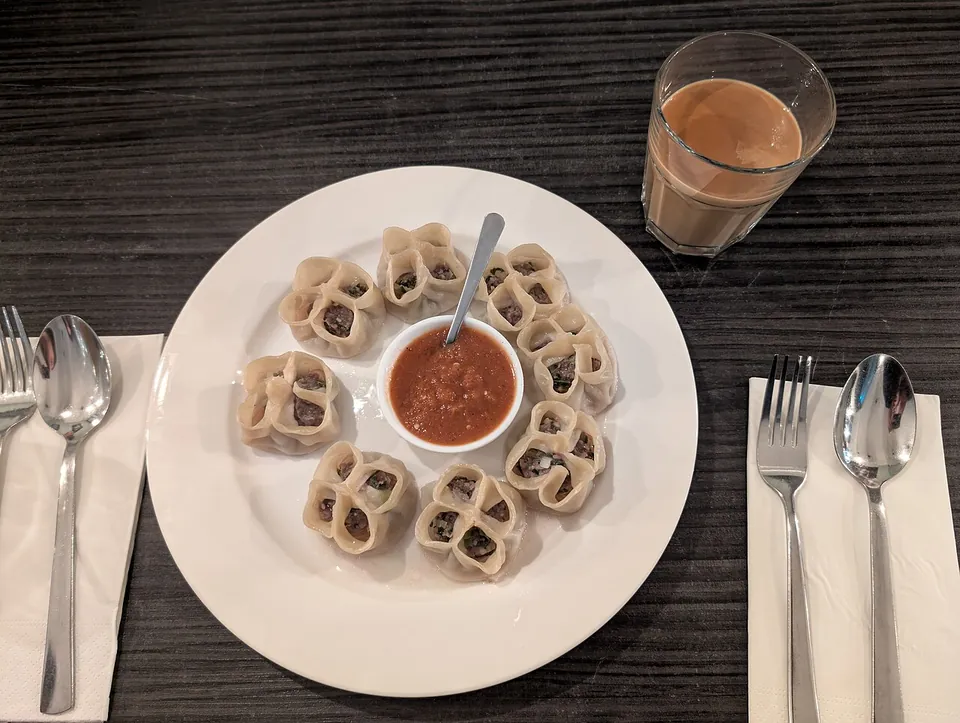
Momo is a dumpling made by wrapping a ground-meat filling in a thin sheet of wheat dough and steaming it (or, in some areas, boiling it). Both the wheat of the wrapper and the buffalo or mutton of the filling are local materials long present across the Tibetan plateau and the Himalayas, on everyday tables from early on. When the handwork of enclosing a filling in dough and steaming it took root on this plateau, momo stood up as a dish.
The concept of the wrapped, steamed dumpling is generally thought to have reached Tibet from China and Central Asia in the thirteenth century, carried by the Mongol expansion. The Mongol court cookbook Yinshan Zhengyao (early fourteenth century) sets down a dumpling culture stretching from China through Persia to Central Asia, and this cross-border current was the window through which it reached Tibet. As it took root on the plateau, the wrapper was rebuilt with highland grain and the filling with yak or mutton, and it settled in as a steamed dish. The name momo comes from Tibetan, and a link to the Chinese momo (饃饃) has been suggested.
From Tibet to Nepal, the trade of the Newar merchants who moved through the Kathmandu valley did the carrying. It reached Nepal by the fourteenth century, and there a distinctive, spice-forward version grew up. A highland home dish became, through the traffic of traders, the food of the valley's cities. Which came first, the Kathmandu valley or Tibet, is not settled, and views differ on the direction it traveled.
How we know
Momo has a long-told origin tale. In the seventh century, when the Nepali princess Bhrikuti married King Songtsen Gampo of Tibet, she is said to have brought momo to the plateau with her dowry. Tying the origin of a dish to the glamour of a royal marriage, this story is still passed down among people today.
But no contemporary record supports the legend. Even the food-history piece in Smithsonian magazine can only introduce it within the frame of "legend holds." The concept of the wrapped, steamed dumpling is conventionally taken to have reached Tibet in the thirteenth century, by way of the Mongols, several centuries removed from the story of the seventh-century princess.
In recent years another story has spread as well. Momo, it says, was originally a Newar dish, and a Nepali princess carried it to Tibet, China, Korea, and Japan at the end of the fifteenth century. But tracing its source leads only to a chef's video and regional media, never to a scholarly citation. Both the fifteenth-century date and the wide transmission across East Asia are tangled with the legend of the real Bhrikuti, who lived in the seventh century -- an eight-hundred-year gap and a transmission with no support behind it. It is a kind of origin myth born of local pride.
What can be traced with confidence goes as far as the thirteenth-century arrival of the dumpling concept and the fourteenth-century transmission by Newar merchants. The name momo (mog-mog) appears in writing as "a small meat patty" in Sarat Chandra Das's Tibetan-English Dictionary (1902), a well-known early instance, though a dictionary lags oral use by centuries and so does not give the year of origin itself. Which of Tibet and Nepal formed it first is still unresolved.
The full set of origin theories and the detailed verification log — traceable all the way to their sources — are available on the Japanese edition.
See the full origin theories and verification log (Japanese) →