All dishes / 東アジア
Khorkhog Period BOrigin theory CVerified
Some fields (dish name, region and gates) are shown from the Japanese-edition data.
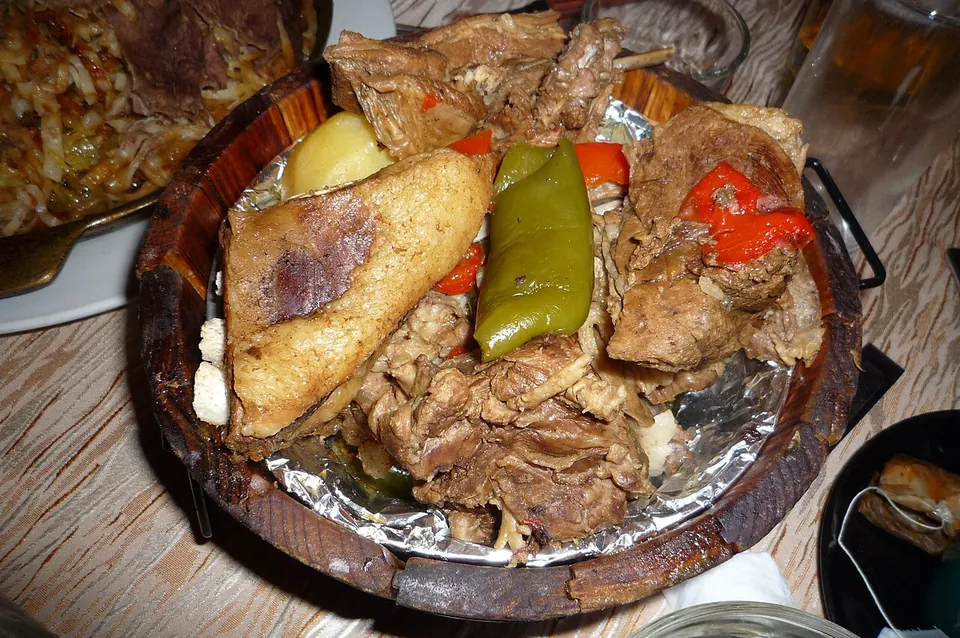
Khorkhog, the great hospitality dish of the Mongolian steppe, cooks meat from the inside out with fire-heated stones. The searing-stone technique itself is deeply old, yet the form we know today, meat packed into a metal can, is a surprisingly recent 20th-century invention.
Verification highlight popular claim → verdict → evidence
A story claiming that Genghis Khan (Temüjin) cooked meat with heated stones in a horsehide pot, supposedly recorded in the Yuan Shi, could not be confirmed in any primary or scholarly source and appears to be a fabricated claim — it was not adopted. Instead, khorkhog traces to two coexisting layers: an ancient hot-stone cooking tradition in the lineage of boodog, possibly reaching back to the Stone Age, and a 20th-century standardization using metal milk-can containers repurposed from Soviet army surplus during the Soviet garrison period in Mongolia.
The three gates
- Ingredient-supply gate
- Sheep and goat meat were native to the Mongolian pastoral world, with no ingredient acting as a bottleneck. Potato is a modern-era side ingredient, with no earlier native root-vegetable precursor.
- Cooking-technique gate
- Heated stones are sealed in a container with the meat (a milk can or a butchered animal's stomach) and cook it from the inside.
- Venue gate
- A pastoral camp and hospitality dish on the steppe, taking its current form as milk cans became common.
Overview
Khorkhog is a Mongolian hot-stone dish in which fire-heated stones and mutton are sealed together in a metal vessel and cooked from within. The glowing stones nestle among the pieces of meat, and instead of an outside flame it is the heat and steam radiating from inside the vessel that cook it through. It has long been served at encampments and gatherings out on the grassland, a dish woven into the life of herding.
The sheep and goats at its center are long-established animals of the Mongolian herding country. Cooking meat with hot stones is itself an old practice, kin to boodog, in which meat and heated stones are stuffed into the hide or stomach of an animal and roasted. Just how deep a past steppe cooking carries is something recent archaeology has borne out: a 2024 study by Wilkin and colleagues showed that Bronze Age metal cauldrons from around 750 BCE, roughly 2,700 years ago, were already used locally to process blood and milk, part of a continuous line reaching into present-day Mongolian foodways.
The form most people picture today, however, is far younger. Only once metal cans became common goods did the present, portable and easy-to-handle version take shape. Onto the thick old trunk of hot-stone cooking, a new branch, a modern piece of equipment, was grafted.
How we know
Khorkhog is often tied to a grand origin story: that Genghis Khan fashioned a pot from the hide of a wild horse and cooked meat with heated stones, and that this was the original khorkhog. But no contemporary record supports the tale. Trace it to its source and it leads to a passage written up by generative AI, confirmed by neither primary sources nor scholarship. For all its sweep, the story has nothing behind it.
What is certain is quieter, and more interesting: a double lineage.
One strand is that cooking meat with hot stones was present on the herding lands long before. It connects to boodog, the old method of roasting a whole sheep or marmot, a line researchers trace as far back as the Stone Age. The Bronze Age cauldron study noted above (Wilkin et al. 2024, Scientific Reports) likewise shows how far older than expected the steppe's cooking traditions run.
The other strand is that the present-day form itself is a 20th-century product. Shirchin Baatar, a leader of the Mongolian community in San Francisco, told KQED that khorkhog was born in the Soviet era and that its father is boodog. During the Soviet garrison years, Mongolians repurposed surplus 40-liter Red Army water cans for cooking, and the practice later standardized around the readily available milk can. That portability carried khorkhog from the grassland into the cities.
That an old hot-stone method existed and that the present equipment and form settled in modern times do not contradict each other; both are true at once. More than a grand imperial anecdote, it is this double history, a Stone Age technique meeting a single water can, that feels truest to what khorkhog is.
The full set of origin theories and the detailed verification log — traceable all the way to their sources — are available on the Japanese edition.
See the full origin theories and verification log (Japanese) →
Related dishes
Lineage Family, predecessor, variants
Shares the key ingredient
- Railway mutton curryIndia (British Indian Railways)C
- MansafJordan (Levant)C
- MantiAnatolia (Turkey)C
- SajjiBalochistan (Pakistan)C
- HareesPersian Gulf (Bahrain / Kuwait)C
- Instant-boiled mutton (shuan yangrou)Beijing (China)B
- LahmacunAnatoliaC
- Manti (Central Asian)Central Asia (Uzbekistan / Kazakhstan)C
- KarahiLahore (Pakistan)C
- KoftaLevantB
- Seekh kebabLahore (Pakistan)C
- ZarbJordan (Levant)B
- HaggisScotlandC
- Jingisukan (Genghis Khan)Hokkaido (Japan)D