All dishes / 東アジア
Buuz Period BOrigin theory BVerified
Some fields (dish name, region and gates) are shown from the Japanese-edition data.
Buuz, the steamed dumpling at the heart of the Mongolian New Year, carries its lineage in its very name: buuz traces back to the Chinese baozi, and the dish itself belongs to a family of steamed dumplings that spread across Eurasia.
Verification highlight popular claim → verdict → evidence
The name derives from the Chinese baozi, and its steaming technique and mutton-and-onion filling took shape through the blending of Mongol and Chinese cuisine at the Yuan court, spreading widely through Qing-era trade. No fabricated origin legend (such as a Genghis Khan invention story) appears anywhere in the literature to refute — scholarship consistently converges on this Chinese-baozi-derived, Yuan-court-fusion account. Key source: the Yuan court dietary text Yinshan Zhengyao (飲膳正要, Hu Sihui, 1330), which records a near-identical mutton-and-onion dumpling called Shilön Horns.
The three gates
- Ingredient-supply gate
- Both wheat and mutton are native to Eurasia; the wheat wrapper (flour milling and wheat supply) is the bottleneck.
- Cooking-technique gate
- Minced mutton filling is wrapped in wheat dough and steamed.
- Venue gate
- The centerpiece dish of Mongolian nomadic festivals (Tsagaan Sar/New Year) and everyday family meals.
Overview
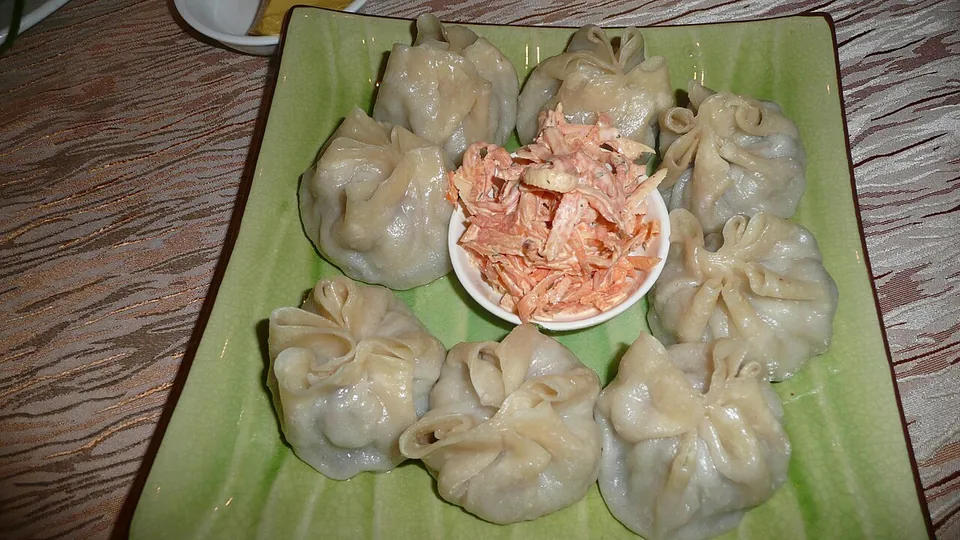
Buuz is a Mongolian steamed dumpling, made by wrapping a filling of minced mutton in a wheat-flour skin and steaming it. Bitten into, each parcel releases its collected juices, and it takes pride of place at the feast of Tsagaan Sar, the Mongolian New Year, and at the family table.
The wheat of the skin and the mutton of the filling are both staples long rooted in the Eurasian interior, close at hand in the everyday life of the herders. Grinding the wheat into flour, wrapping minced mutton in that skin, and steaming it: once this handwork came together, buuz took its shape.
The steamed-dumpling technique and the mutton filling settled into Mongolia across two eras. The first was the Yuan dynasty (the reign of Kublai, thirteenth to fourteenth centuries), when Mongol pastoral cooking mingled with that of China. The second was the Qing period (from the seventeenth century onward), when trade with China widened and the dish reached ordinary tables. Already in the Yuan court, minced mutton was combined with mutton fat, onion, tangerine peel, ginger, and spices and wrapped in a wheat skin. That dumpling looks almost exactly like today's buuz.
How we know
The name buuz itself tells the story of where the dish comes from. It is held to descend from the Chinese baozi, carried into Mongolia together with the steamed-dumpling technique. The names that share this root — buuz, mantu, mandu, and the rest — are spread across a region that roughly matches the old extent of the Mongol Empire. The chain of names and the overlap of their distribution trace out the road the dish traveled. That said, no linguistic study has yet worked out how buuz shifted in sound from baozi, so the etymology rests for now on the agreement of several reference works rather than on scholarship.
What anchors this account more firmly is a single book from the imperial kitchen. The Yinshan Zhengyao (1330), a dietary manual of the Yuan court compiled by Hu Sihui, gathers 236 recipes, of which 72 use mutton, ranging from soups to dumplings. One dish, rendered as 'Shilön Horns,' is a dumpling of minced mutton, mutton fat, onion, tangerine peel, ginger, and spices folded into a wheat skin — almost identical to today's buuz, mutton and onion wrapped in a wheat skin and steamed. Paul Buell and Eugene Anderson's scholarly translation (2010) reads out this dish. The tradition of a baozi-derived name and the primary record of mutton dumplings actually being made in the court kitchen come together, and the history of buuz stands up as the story of a family of steamed dumplings reaching back at least to the fourteenth-century Yuan court.
Buuz did not arise in isolation. The same idea — minced meat wrapped in a wheat skin and steamed — runs on to the manti of Central Asia, the mandu of Korea, the momo of Tibet and Nepal, and the baozi of China. These share the Chinese baozi as a common ancestral form while crossing Eurasia and taking on the shape of each land, a family of kindred steamed dumplings. Buuz is one of the fruits that this wide reach bore on the Mongolian steppe.
The full set of origin theories and the detailed verification log — traceable all the way to their sources — are available on the Japanese edition.
See the full origin theories and verification log (Japanese) →
Related dishes
Cross-links Sister dishes & same-name dishes (separate lineage)
- Sister dish (shared ancestor)MantiAnatolia (Turkey)C
- Sister dish (shared ancestor)KhinkaliGeorgia (highlands — Khevsureti/Mtiuleti)C
- Diffusion prototypeBaoziChinaC
- Sister dish (shared ancestor)KhuushuurMongoliaB
- Sister dish (shared ancestor)BanshMongoliaC
Shares the key ingredient
- PierogiPolandC
- EmpanadaRío de la Plata (Argentina)C
- BliniRussiaB
- PirozhkiRussiaB
- CheburekiCrimea (Crimean Tatar)C
- BelyashiVolga-Ural (Tatar / Bashkir)C
- JalebiNorthern IndiaB
- Fortune cookieCalifornia (USA)C
- StroopwafelGouda (Netherlands)C
- LamingtonQueensland (Australia)C
- ChimichangaTucson, Arizona (USA)C
- YantıkCrimea (Crimean Tatar)C
- VarenykyUkraineC
- MandaziEast Africa (Swahili Coast)C
- LángosHungaryC
- Daoxiaomian (knife-cut noodles)Shanxi (China)C
- Dobos torteHungaryB
- SambusaEast Africa (Swahili Coast)B
- SarburmaCrimea (Crimean Tatars)B
- ThenthukTibet / NepalB
- ShumaiGuangzhou (China)B
- Jiaozi (gyoza)ChinaC
- Hohhot shaomaiHohhot (China)B
- OliebollenNetherlandsC
- MarquesitaYucatán (Mexico)D
- Halwa puriLahore (Pakistan)D
- Roti prataSingaporeB
- SopaipillaNew Mexico (USA)C
- CoyotaSonora (Northern Mexico)C
- RunzaMidwestern United StatesB
- Kashyk-ash (къашыкъ-аш, Crimean Tatar spoon-dumpling soup)Crimea (Crimean Tatar)C
- KulebyakaRussiaB
- Spring roll (Chinese)ChinaC
- ChuchvaraUzbekistan (Samarkand / Fergana)C
- DamperAustraliaC
- SamsaCentral AsiaC
- HalushkyUkraineC
- BanitsaBalkans (Bulgaria)C
- Har gowGuangzhou (China)C