All dishes / 中東・北アフリカ
Mandi Period COrigin theory CVerified
Some fields (dish name, region and gates) are shown from the Japanese-edition data.
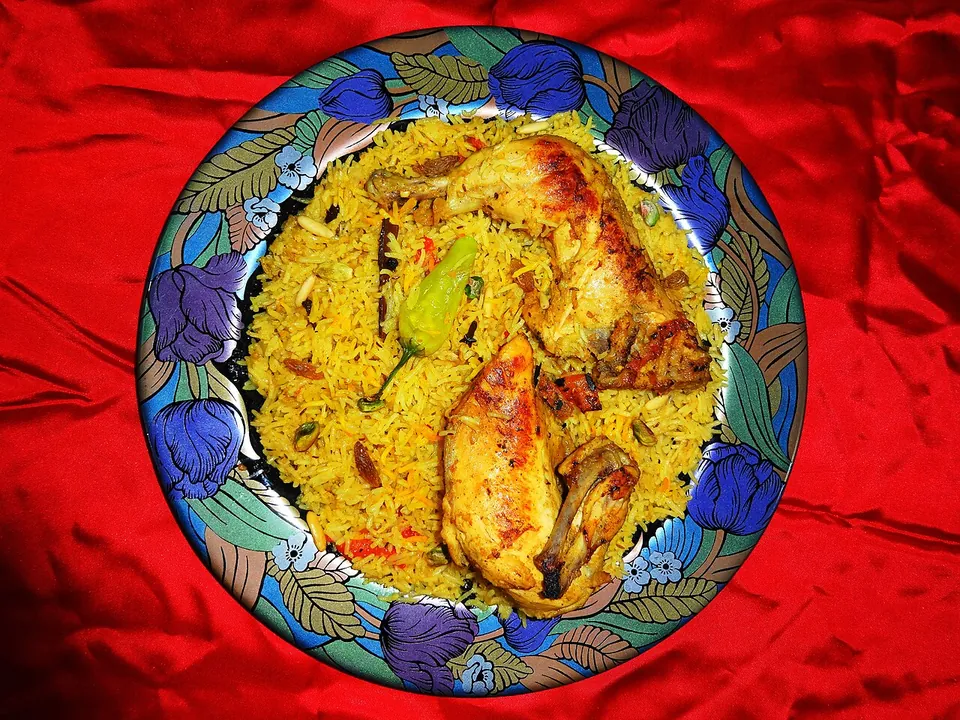
Mandi, the festive dish of Hadhramaut in Yemen. Meat is hung inside a pit dug into the ground while rice cooks below it, and this distinctive underground steam-roasting is what makes the dish. It is sometimes billed as an ancient Yemeni dish from time immemorial, but the rice at its heart is a grain that came across the sea.
Verification highlight popular claim → verdict → evidence
Popular claim: mandi originated in 'ancient, pre-Islamic' Yemen. Verdict: refuted -- rice, an essential and non-native ingredient introduced via Indian Ocean trade and first recorded as a crop in 10th-century Yemen (al-Hamdani), cannot have been part of the dish before roughly 950 CE; the underground-oven technique itself may be far older, but a rice-based mandi cannot predate rice's arrival (Agricultural crops in South Arabia/Yemen in the first millennium CE).
The three gates
- Ingredient-supply gate
- Sheep are native livestock; rice became established in the South Arabian trade sphere early on (within the native range) -- no New World ingredient limits the date.
- Cooking-technique gate
- Meat is hung to cook by radiant heat inside an underground clay oven (tannur) while rice steams beneath it -- a distinctive, regionally specific technique that is the limiting factor.
- Venue gate
- A Hadhrami festive and hospitality dish that spread across the Arabian Peninsula.
Overview
Mandi is a Yemeni rice dish of lamb (or chicken) and rice prepared with saffron and spices. Its home is the Hadhramaut region of southern Yemen, where it is known as a dish for hospitality and celebration, and from there it spread across the whole of the Arabian Peninsula. The name is traced to the Arabic nada (dew), reflecting the moist texture of the meat.
What gives the dish its character is the method: a pit oven (tannur / taboon) dug into the ground. Charcoal is lit inside the pit and heated, the meat is hung to roast, and the rice set below catches the dripping fat and aroma as it cooks. This steam-roasting in the earth decides both the flavor and the name of mandi.
Lamb is an animal long kept in this land, and the meat for hospitality was there to hand. Rice, the other main ingredient, is a different matter: it is not a native crop of South Arabia. Rice was carried in over the Indian Ocean trade, and the tenth-century geographer al-Hamdani records it as a cultivated crop in his Sifat jazirat al-Arab (Description of the Arabian Peninsula). Mandi in its current form, which cannot do without rice, took shape only after rice had taken root in the region.
How we know
Two views of mandi's origin sit side by side. One holds it a native invention of Hadhramaut; the other treats it as one form of the pit-roasted meat (in the zarb / madfun lineage) found across the Arabian Peninsula and into the Levant. Roasting meat in an underground oven was not unique to Hadhramaut. The thirteenth-century Aleppo cookbook Kitab al-Wusla ila l-habib (Scents and Flavors) records roasting a whole sheep in a pit oven, showing that steam-roasting in the earth was practiced by the medieval period at the latest. In 1927 Tawfiq Canaan recorded the Palestinian zarb (sheep roasted in a small cave-like oven), a sign that the technique was spread across a wide area. Mandi can be read as the form that added rice, cooked together, to that pit-roasting.
Meanwhile, restaurant promotion often carries the line that mandi was born in ancient, or pre-Islamic, highland Yemen from time immemorial. But no independent source stands behind that deep antiquity. The clue lies instead in the rice. Rice reaches South Arabia no earlier than the latter half of the first millennium, and al-Hamdani's tenth-century record is the first firm mention of it as a cultivated crop. Until rice crossed the sea and arrived, a rice-based mandi had no way of existing in this land. The claim of hoary antiquity comes apart here.
The technique of steam-roasting meat in an underground oven may itself reach back further. But that is a separate matter from the making of mandi with its cooked-in rice. Whether mandi is a distinct invention of Hadhramaut or a widely shared tradition localized here remains undecided, the sources too thin to settle it. And despite the shared name, it is a different dish from the Central Asian dumpling manti.
The full set of origin theories and the detailed verification log — traceable all the way to their sources — are available on the Japanese edition.
See the full origin theories and verification log (Japanese) →
Related dishes
Cross-links Sister dishes & same-name dishes (separate lineage)
- Same name, different dish (separate lineage)MantiAnatolia (Turkey)C
- Sister dish (shared ancestor)Mazbi (madhbi)Yemen (Hadhramaut)C
Shares the key ingredient
- BiryaniSouth Asia (Deccan / Mughal)C
- DosaSouth India (Tamil Nadu / Karnataka)C
- PaellaValencia, SpainC
- Risotto alla milaneseMilan (Lombardy, Italy)C
- Nasi gorengIndonesia (Java)C
- JambalayaNew Orleans (Louisiana, USA)C
- MujaddaraLevant (Syria, Lebanon, Palestine)B
- DoriaYokohama, JapanB
- IdliSouth IndiaC
- MaqlubaPalestine / LevantC
- White mixed rice (hondonban / goldongban — Bibimbap precursor)Korean PeninsulaC
- Rice and native-grain upma layer (sada upma, pre-semolina)South IndiaC
- KiribathSri LankaD
- KabsaSaudi ArabiaC
- PlovUzbekistan (Samarkand / Fergana)C
- MachboosPersian Gulf (Bahrain / Kuwait)B
- Gallo pintoCosta Rica / NicaraguaC
- Dal bhatNepalB
- KoshariEgyptC
- PilauEast Africa (Swahili Coast)C
- Rice-and-lentil koshari base layer (pre-pasta, pre-tomato)EgyptC
- Bánh cuốnVietnamB
- MahshiEgyptB
- PolowIranC
- PulaoNorth IndiaC
- PilavAnatoliaC
- Kabuli palawAfghanistanC
- Pilaf (French)FranceC
- Pilaf (Japanese-style)JapanC
- TahdigIranC
- Arroz de mariscoAlgarve (Portugal)C
- CasadoCosta RicaC
- Nan gyi thokeMyanmarC
- Mont diMyanmarC
- AranciniSicily (Italy)C