All dishes / 中東・北アフリカ
Harees Period BOrigin theory CVerified
Some fields (dish name, region and gates) are shown from the Japanese-edition data.
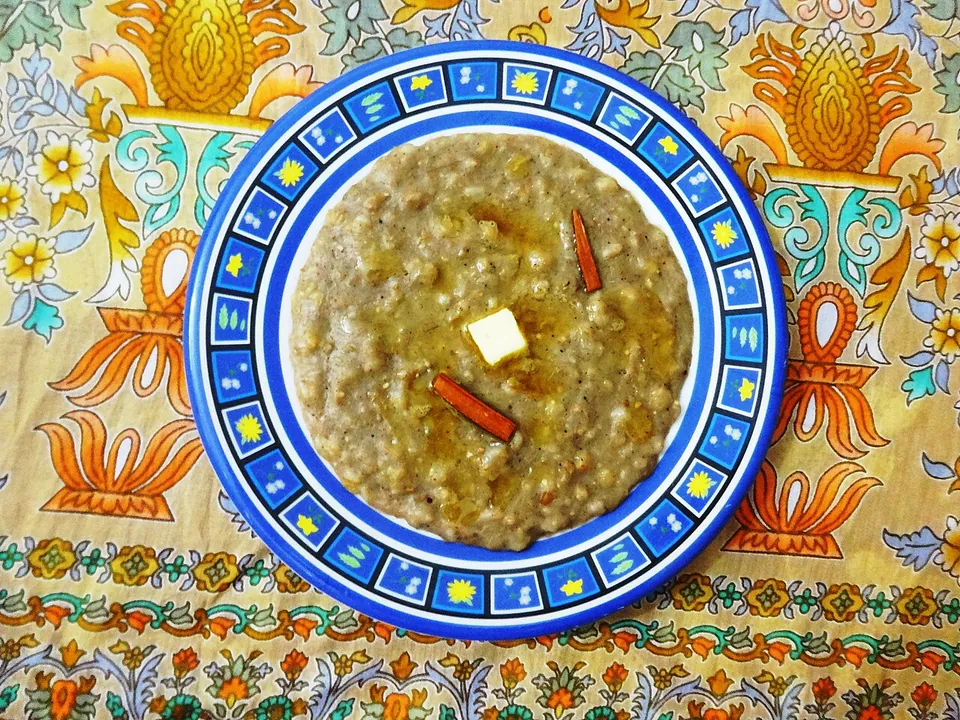
Across the Arabian Gulf, harees is a porridge of wheat and meat cooked down and pounded into one smooth mass, ladled out of great pots at every Ramadan and feast. A well-worn tale credits a fourth-century saint with inventing it on the spot, but that story grew out of a mishearing of the dish's own name.
Verification highlight popular claim → verdict → evidence
Armenian legend credits Saint Gregory the Illuminator, in the 4th century, with both inventing this wheat-and-meat porridge and naming it: boiling a sheep for the poor and running short, he is said to have thrown in wheat and shouted "harelu" (stir it) to his helper, giving the dish its name. But no contemporary record supports this cherished story. The name more plausibly derives from the Arabic word for pounding, matching the technique of cracking wheat into porridge. The dish itself continues a wheat-and-meat porridge tradition going back to the Sassanid era, long before the saint, and first appears in writing only in the 10th century -- some six hundred years after Gregory -- in a Baghdad cookbook. Attaching a saint's name to a festive dish after the fact is a recurring pattern elsewhere, and the claim that one saint invented and named this dish is not backed by sources, though the dish's deep roots in Armenia as a charitable, festive food are not in dispute.
The three gates
- Ingredient-supply gate
- Both wheat and lamb are Old World natives; the limiting factor was access to cracked wheat.
- Cooking-technique gate
- Wheat and meat are simmered for a long time and pounded into a porridge-like consistency.
- Venue gate
- Served at Ramadan and festive gatherings; a Gulf home-cooked dish.
Overview
What the dish is
Harees is made by simmering cracked wheat with lamb or chicken for hours on end and beating the mixture with a pestle until the fibers loosen, the grain and meat dissolve into each other, and the whole thing turns thick and even. It is kept alive across the Gulf — in Bahrain, Kuwait, the UAE, and Oman — and above all it is cooked in large pots to break the Ramadan fast or to mark a celebration.
Wheat and meat, its two staples, are both old ingredients of the Old World, and both were on hand here from early on. What sets harees apart from other dishes of grain and meat is the way it is worked. Kept over the fire for hours and pounded without pause, the ingredients lose their edges and become a dense, uniform paste. The dish takes its name from an Arabic word meaning "to pound" — the patient work of simmering the food and then crushing it with a pestle is the heart of the dish itself.
The occasions on which it is served say as much about it as the recipe. It is cooked in home kitchens as everyday food, but it is also the pot that goes up at gatherings — during Ramadan, at weddings — as a dish to share with the neighbors. That role, a single pot shared among many, is what has rooted harees so firmly in Gulf life.
How we know
On paper, the lineage of harees runs a long way back. A tenth-century cookbook compiled in Baghdad by Ibn Sayyar al-Warraq records harisa, a dish of wheat and meat simmered and pounded together — the old shape of harees. The same dish appears in the thirteenth-century cookbook of al-Baghdadi and in the book of Ibn Razin in al-Andalus, so it was clearly a dish known across the medieval Islamic world. Behind that lies an older stratum still: a Sasanian-Persian tradition of stewing wheat with meat. In the bazaars of medieval Persia there were permanent harisa shops, the harisa-pazi, and the chronicles of Bukhara even record one of those stalls burning down. It was that woven into daily life — an old and well-attested dish.
In Armenia, though, there is a famous story about the origin of this same wheat-and-meat porridge, called harissa. In the fourth century, Saint Gregory the Illuminator was boiling lamb as alms for the poor; when the meat ran short for the number of mouths, he stretched it with wheat, and as he stirred he cried "harekh" — "stir it." That cry, the story goes, gave the dish its name, and the saint gave the dish itself.
But the anecdote finds no support from the side of food history. First, the name harissa comes from an Arabic word meaning "to pound," which fits the actual method — beating the wheat with a pestle — exactly, not the exclamation "stir it" said to have been misheard. Second, the wheat-and-meat porridge itself is far older than Gregory's legend, going back to Sasanian times, and its first appearance in writing is a tenth-century Arab cookbook. No contemporary record ascribes its invention to a single fourth-century saint. This kind of tale — a local holy man who created a festival dish — is a stock story attached after the fact to celebrated regional foods across many lands. The saintly naming legend takes nothing away from the antiquity of the dish or from its religious meaning as almsgiving, but as an account of the origin it does not hold.
So where did it really begin? The truth is that this is still unsettled. The Armenian highlands are a homeland of wheat, and the same porridge has long been rooted there as a festival and alms dish. Whether it passed there from the Arab-Persian harisa, or arose separately in a land where grain farming and herding overlap, cannot be stated with certainty. In 2011, when a related wheat-and-meat dish, keşkek, was inscribed on UNESCO's heritage list as a tradition of Turkey, the Armenian side protested the attribution of origin. That keşkek, however, appears in writing only from the fourteenth century, far later than the tenth-century Arab harisa. The oldest recorded form lies in the medieval Arab cookbooks, but that does not cancel out the independence of a local wheat-and-meat porridge. Several cultures have carried the same dish, each telling it down the generations as its own. That coexistence is what makes up the history of harees.
Far to the east, incidentally, the stewed haleem that became a specialty of Hyderabad in India is said to descend from this harees.
The full set of origin theories and the detailed verification log — traceable all the way to their sources — are available on the Japanese edition.
See the full origin theories and verification log (Japanese) →
Related dishes
Cross-links Sister dishes & same-name dishes (separate lineage)
Shares the key ingredient
- Railway mutton curryIndia (British Indian Railways)C
- MansafJordan (Levant)C
- MantiAnatolia (Turkey)C
- SajjiBalochistan (Pakistan)C
- KhorkhogMongoliaC
- BoodogMongoliaC
- Instant-boiled mutton (shuan yangrou)Beijing (China)B
- LahmacunAnatoliaC
- Manti (Central Asian)Central Asia (Uzbekistan / Kazakhstan)C
- KarahiLahore (Pakistan)C
- KoftaLevantB
- Seekh kebabLahore (Pakistan)C
- ZarbJordan (Levant)B
- HaggisScotlandC
- Jingisukan (Genghis Khan)Hokkaido (Japan)D