All dishes / 中東・北アフリカ
Couscous Period BOrigin theory CVerified
Some fields (dish name, region and gates) are shown from the Japanese-edition data.
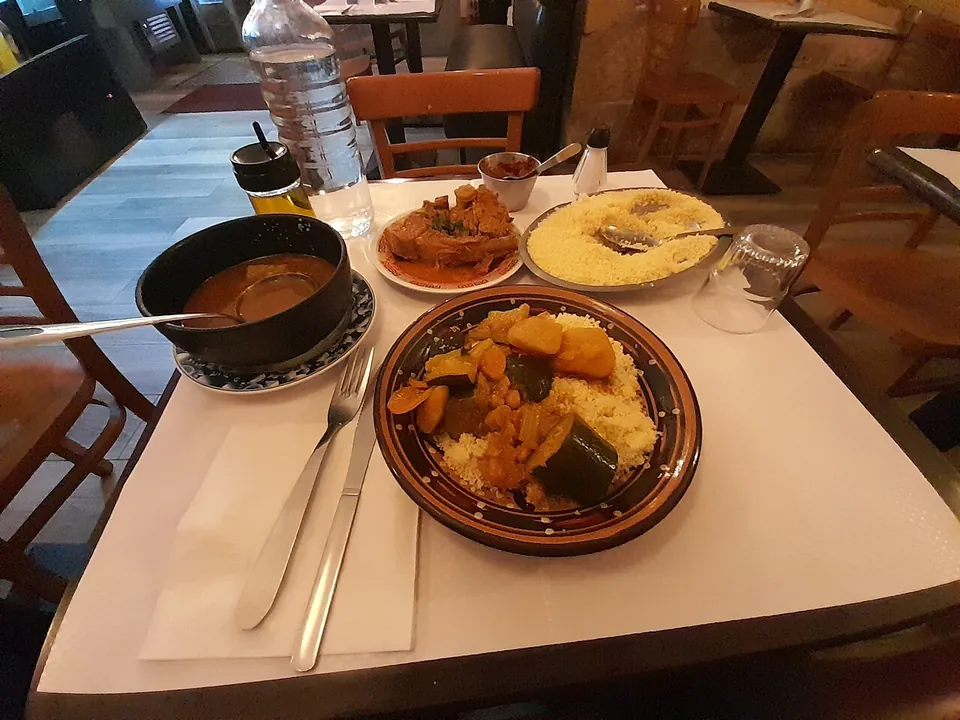
Couscous is a granular steamed dish that originated with the Berbers of North Africa, with its firm first appearance in writing in a thirteenth-century Maghrebi cookbook. Some accounts push its roots back to antiquity, but the record that cannot be moved emerges in the medieval period.
Verification highlight popular claim → verdict → evidence
Attributed to the Berber (Amazigh) people of the Maghreb; the earliest secure documentation is in 13th-century cookbooks (Kitab al-Tabikh and Ibn Razin). The decisive factors for dating are the cooking technique (rolling semolina and steaming) and the first written attestation. A rival claim tracing couscous to ancient Numidia rests only on an archaeological interpretation of pot shapes, so the origin is presented as competing theories.
The three gates
- Ingredient-supply gate
- Durum wheat is native to the Mediterranean/West Asia; no New World ingredients involved.
- Cooking-technique gate
- Hand-rolling semolina into granules, then steaming it in a couscoussier.
- Venue gate
- Berber household and communal tables, later spreading across the Maghreb.
Overview
Couscous is made by rolling durum-wheat semolina by hand into small grains and steaming them in a couscoussier, a two-tiered steamer. Its main ingredient, durum wheat, is an old crop long native to the lands from the Mediterranean to western Asia; in North Africa it had spread as the principal wheat by the first millennium AD. Under the early Arab empire, foods made from semolina—dried pasta and couscous among them—were being produced across the region. As raw material, it had been on this soil far longer than the medieval period.
Its firm first appearance in writing comes in the thirteenth century. The Almohad-era Maghrebi cookbook Kitāb al-Ṭabīkh fī al-Maghrib wa al-Andalus carries a recipe for a steamed couscous 'known to all,' and the work of Ibn Razīn al-Tujībī, a scholar from Murcia, likewise records methods of preparing couscous in the Maghreb and al-Andalus. The food historian Charles Perry places its emergence between the late Zirid period and the rise of the Almohads, in the eleventh to thirteenth centuries—a firm dating grounded in the written record.
Rolling semolina by hand into grains and steaming them over the vapor rising from the broth in the lower tier: this two-tiered steaming technique is what shaped couscous into a single dish. As a setting, it began at the tables of Berber households and communities and in time spread across the whole of the Maghreb.
How we know
That couscous belongs to the Berbers (the Amazigh) can be seen in its very name. The word couscous derives from the Berber seksu / k'esksu, and a food encyclopedia (Encyclopedia.com) also notes its Berber origin and its basis in durum-wheat semolina.
Against this, one account claims a far older origin. The historian Lucie Bolens held that the tombs of Numidia from the age of King Massinissa (238–149 BC) contain steamers and sieves that appear to be prototypes of the couscoussier, pushing couscous back into antiquity.
What supports this ancient-origin claim, however, is an archaeological reading of vessel shapes, and it is thin on independent corroboration. A vessel coming to light does not directly attest to the existence of couscous itself. The oldest datable physical evidence of something clearly identifiable as a couscoussier is in the ninth-century layer at Tiaret in Algeria, followed by the twelfth-century layer at the Igiliz site in Morocco. Couscous shows itself plainly in writing in the thirteenth century. Durum wheat, for its part, was still present only in small amounts in the third century BC, out of step with a steamed couscous that presupposes large quantities of semolina.
Bolens was a real food historian, and her ancient-origin claim is no fabrication but stands recorded here as a competing scholarly view. Meanwhile the Berber origin and the thirteenth-century first appearance in writing have each been tested and settled. Rather than reducing the origin in a single leap to the oldest possible trace, this dish is best mapped by keeping apart the record that shows itself plainly and the conjecture that rests on interpretation.
The full set of origin theories and the detailed verification log — traceable all the way to their sources — are available on the Japanese edition.
See the full origin theories and verification log (Japanese) →