All dishes / 西欧
Haggis Period BOrigin theory CVerified
Some fields (dish name, region and gates) are shown from the Japanese-edition data.
Haggis is Scotland's national dish. Yet the label "an ancient dish native to Scotland" has no documentary backing. Offal puddings were common across Britain, north and south, from early on; the first printed recipe is in fact on the English side; and no inventor can be named.
Verification highlight popular claim → verdict → evidence
Popular claims of ancient Roman or Norse origin, and of haggis being a purely ancient Scottish dish, are both refuted. The oldest surviving recipe, Liber Cure Cocorum (c.1430), is actually English, so no single inventor can be pinned down. Key source: the Liber Cure Cocorum manuscript.
The three gates
- Ingredient-supply gate
- Sheep offal, oatmeal, and suet were all locally available; no New World ingredients involved.
- Cooking-technique gate
- Stuffing offal and oatmeal into a stomach casing and boiling it.
- Venue gate
- A rural dish for using up offal and preserving it, later elevated into Scotland's national dish.
Overview
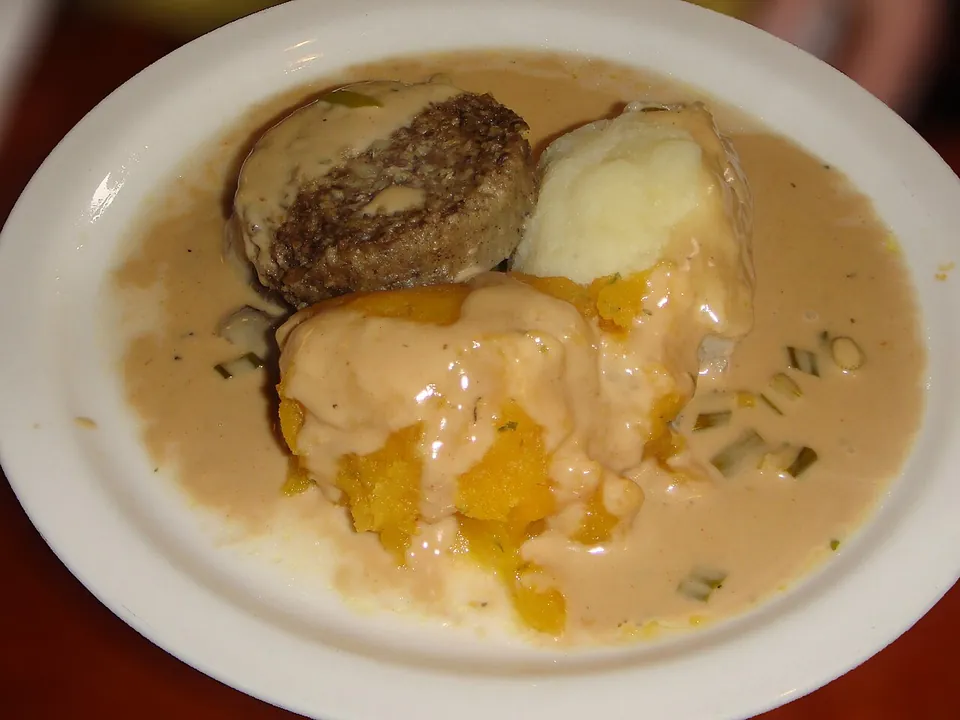
Haggis is a pudding of sheep's offal, the heart, liver and lungs, minced and mixed with oatmeal, suet, onion and spice, packed into a sheep's stomach and boiled in the bag. Today it is known as the national dish of Scotland.
Its ingredients had all long been present in this land. The offal, the oatmeal and the suet were all local; no New World ingredient goes into it. Treating the stomach as a bag, filling it and boiling it was a method seen widely across medieval Britain. It began as a plain rural dish for using up, without waste, the innards left after an animal was butchered: perishable offal cooked together with grain and fat, at once a way of keeping it and a way of putting it to use.
Puddings of this kind, offal and grain, existed on both sides of Britain in the Middle Ages. The word haggis (hagws, hagese) is recorded in England in the first half of the fifteenth century, and the first printed recipe appears in 1615, in the English writer Gervase Markham's book. On the Scottish side, a poem from before the early sixteenth century mentions haggeis, and the record does not allow the birthplace to be fixed to one side.
Haggis becoming a symbol of Scotland is a later event, separate from the making of the dish. The poet Robert Burns wrote his Address to a Haggis in 1786, and from then on haggis was drawn as a dish of national pride. The age of the dish and the newness of the national symbol need to be held apart.
How we know
Two popular tales surround haggis with a claim of ancient pedigree. One holds that the ancient Romans, or the Norse Vikings, brought it. The other holds that it is an ancient dish native to Scotland alone.
Take the first. Boiling offal and grain in a stomach is found widely in the ancient foodways of many peoples, which makes it easy to attach to some incoming group. But no independent source ties the particular dish haggis to ancient Rome or Scandinavia, and the idea stays within the realm of an origin legend.
Take the second. The offal-and-oatmeal pudding was old on both sides of Britain, and the first printed recipe is on the English side, in Markham (1615). The earliest attestation of the word, too, is early-fifteenth-century England. The picture of an ancient dish native to Scotland is not carried by the record. Its standing as a national dish is comparatively recent, built up after Burns's poem of 1786.
So who invented it? The food historian Catherine Brown put forward an English-origin argument in 2009 and stirred debate, but the word and the recipe appearing first on the English side does not by itself mean the dish was born there. First attestation is not invention. The Scottish side also has a mention from before the early sixteenth century, and the record does not settle which side gave rise to it. The sound conclusion is to trace haggis to a medieval offal pudding shared by north and south Britain, with no inventor to be named. Its Scottishness as a symbol was added long after the dish itself.
The full set of origin theories and the detailed verification log — traceable all the way to their sources — are available on the Japanese edition.
See the full origin theories and verification log (Japanese) →
Related dishes
Shares the key ingredient
- Railway mutton curryIndia (British Indian Railways)C
- MansafJordan (Levant)C
- MantiAnatolia (Turkey)C
- SajjiBalochistan (Pakistan)C
- KhorkhogMongoliaC
- BoodogMongoliaC
- HareesPersian Gulf (Bahrain / Kuwait)C
- Instant-boiled mutton (shuan yangrou)Beijing (China)B
- LahmacunAnatoliaC
- Manti (Central Asian)Central Asia (Uzbekistan / Kazakhstan)C
- KarahiLahore (Pakistan)C
- KoftaLevantB
- Seekh kebabLahore (Pakistan)C
- ZarbJordan (Levant)B
- Jingisukan (Genghis Khan)Hokkaido (Japan)D