All dishes / 中央アジア
Manti (Central Asian) Period BOrigin theory CVerified
Some fields (dish name, region and gates) are shown from the Japanese-edition data.
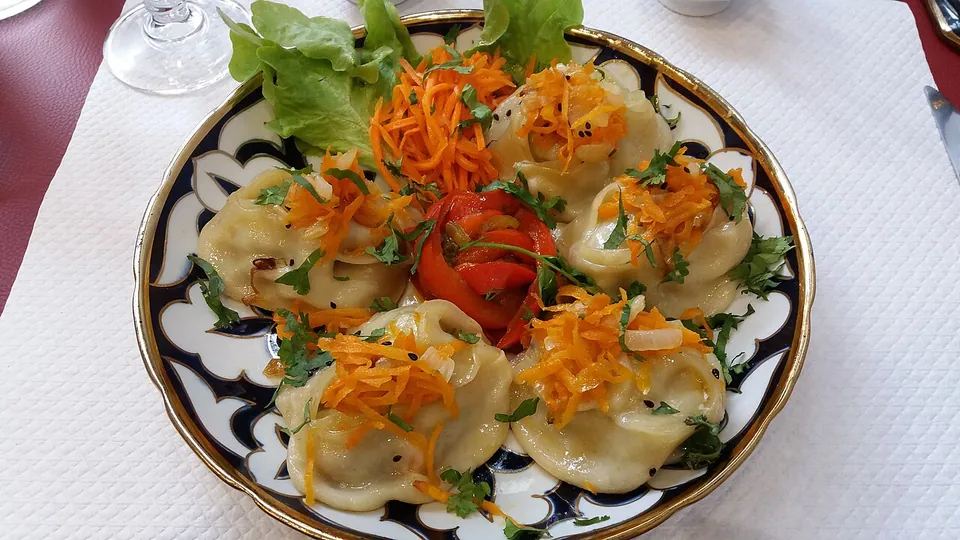
Manty is the steamed dumpling of Central Asia, wheat dough folded around minced mutton. The long-held idea that its name descends from the Chinese mantou is now being read the other way around.
Verification highlight popular claim → verdict → evidence
Mantu is a steamed dumpling that developed among the Turkic mounted-nomad peoples of Central Asia and, according to the leading theory, spread across Eurasia -- to Anatolia and East Asia -- via the Silk Road and the Mongol expansion. The current leading view on etymology runs 'Turkic manti to Chinese mantou,' displacing the older idea that the dish traces back to the Chinese word for steamed bun. As a dish, it appears in the Yuan-dynasty court dietary text Yinshan Zhengyao (1330) as a mutton-filled steamed dumpling, showing that a Central-Asian-style steamed dumpling was already established by that date at the latest. Excavations at the Astana tombs in Turfan, Xinjiang, have turned up wheat-wrapped, meat-filled dumplings from the Tang and earlier dynasties, providing physical evidence for an older layer of the dumpling tradition -- though these were half-moon-shaped boiled dumplings, not the steamed manti form itself. Other theories locate the true point of origin further west, in the Middle East or western Eurasia, or propose parallel, multi-site development; the documentary, linguistic, and archaeological evidence has not fully converged. Pinpointing the earliest record that directly documents its establishment in Central Asia remains an open question for further research.
The three gates
- Ingredient-supply gate
- Both wheat and mutton were native to Central Asia and locally available.
- Cooking-technique gate
- Wrapping filling in kneaded dough and steaming it.
- Venue gate
- A home-cooked dish among both nomadic and settled peoples.
Overview
Manty is made by rolling wheat dough thin, folding it around a filling of minced mutton, and steaming it. It is a familiar dish on the tables of Uzbekistan and Kazakhstan, at home among nomadic and settled peoples alike.
Its two lead ingredients, wheat and mutton, are both long-established staples of the Central Asian land. The life of herding sheep across dry steppe and the work of milling wheat into flour sat side by side here from early on. Both the wrapper and the filling are made from what people already had at hand.
What gives the dish its form is the handwork of rolling the dough thin, wrapping the filling and steaming it over rising vapour. When the craft of folding met the craft of steaming, manty took on its recognisable shape. This style settled in Central Asia in the medieval period, roughly the thirteenth to fifteenth centuries. It grew up as the food of Turkic nomads and spread, through the Mongol expansion and the traffic of the Silk Roads, east into Asia and west into Anatolia. Holly Chase describes how nomads carried frozen or dried manty on the move and boiled or steamed them at camp. Being a portable preserve is what carried this dumpling far.
The steamed-dumpling family does not end in Central Asia. In Anatolia there is manti, wrapped very small, often spoken of as a sister of the mantou-type dumplings. Among these kin scattered across the wide expanse of Eurasia, Central Asian manty carries on the mutton filling and the steaming craft as its own style.
How we know
Trace the history of manty and the name itself becomes the first point of debate. Manti, it was long said, branched off from the Chinese mantou: the name of a Chinese steamed food reaching all the way west to become the name of a steppe dumpling. That was the story.
Recent scholarship reads the direction the other way. In Crossroads of Cuisine (Brill, 2020), Buell, Anderson and their co-authors attribute the word manty to the early Turkic peoples of central Eurasia, including the Yakut of Siberia, and place the Greek manti, the Korean mandu and the Chinese mantou or mantai as derivatives of it. The flow runs from Turkic manti to Chinese mantou, not the reverse. The word mantou is not old enough in classical Chinese to support the older claim that manti came from it, and that older claim is now being set aside.
The view that its homeland lies with the Central Asian Turkic peoples has support in a primary source. The Yinshan Zhengyao, the imperial dietary manual compiled by Hu Sihui in 1330 under the Yuan, records a manta steamed with mutton fat, chopped white scallion, cumin and pepper. Buell and Anderson's scholarly translation and commentary reads this as a steamed mutton dumpling, which shows that a Central Asian style of steamed dumpling was established by that year at the latest. From the Astana tombs at Turpan in Xinjiang, moreover, wheat-skinned, meat-filled dumplings of the Tang to Six Dynasties period (roughly 220 to 907) have been excavated, showing in physical form that an old layer of dumplings existed along the western Silk Road. These, though, are half-moon boiled dumplings rather than the steamed manti proper, a distinction worth keeping in mind.
Even so, not everything has converged on a single point. Some place the exact homeland of the dumpling further west, in the Middle East and western Eurasia, and some hold that it arose in parallel at several places. The direction of travel, eastward to Anatolia and East Asia, does not conflict with current scholarship, but where the first homeland lay, and whether it arose in one place or budded in many at once, is something the sources, the linguistics and the archaeology do not yet fully settle. So here the Turkic homeland is given as the main view, with the western-origin view set alongside it.
The full set of origin theories and the detailed verification log — traceable all the way to their sources — are available on the Japanese edition.
See the full origin theories and verification log (Japanese) →
Related dishes
Cross-links Sister dishes & same-name dishes (separate lineage)
Shares the key ingredient
- Railway mutton curryIndia (British Indian Railways)C
- MansafJordan (Levant)C
- SajjiBalochistan (Pakistan)C
- KhorkhogMongoliaC
- BoodogMongoliaC
- HareesPersian Gulf (Bahrain / Kuwait)C
- Instant-boiled mutton (shuan yangrou)Beijing (China)B
- LahmacunAnatoliaC
- KarahiLahore (Pakistan)C
- KoftaLevantB
- Seekh kebabLahore (Pakistan)C
- ZarbJordan (Levant)B
- HaggisScotlandC
- Jingisukan (Genghis Khan)Hokkaido (Japan)D