All dishes / 東欧
Pelmeni Period BOrigin theory CVerified
Some fields (dish name, region and gates) are shown from the Japanese-edition data.
Pelmeni are called a Russian national dish, yet their roots are not necessarily Russian. One account has them inherited from the native peoples of the Urals and Siberia; another has them descend from the Chinese dumpling, carried west by the Mongols. Neither has won out, and the dish comes down to us undecided.
Verification highlight popular claim → verdict → evidence
Two competing accounts, both undecided: (a) Finno-Ugric Ural/Siberian indigenous origin, from the etymology pel'nyan ('ear-bread'; Vasmer 1986); (b) transmission from Chinese jiaozi via Mongol/Central Asian contact. All ingredients are native to the region, so ingredient availability does not help date the dish. First appears in Russian print relatively late (Semivsky, 1817).
The three gates
- Ingredient-supply gate
- Wheat and meat are both native to the region; the dish does not depend on New World ingredients (native — not limiting).
- Cooking-technique gate
- Thin-rolled dough wraps a meat filling, then boiled — a technique well suited to freezing and storage in a cold climate.
- Venue gate
- Home cooking; common-people stratum; everyday food; Ural/Siberian Slavic and Finno-Ugric communities.
Overview
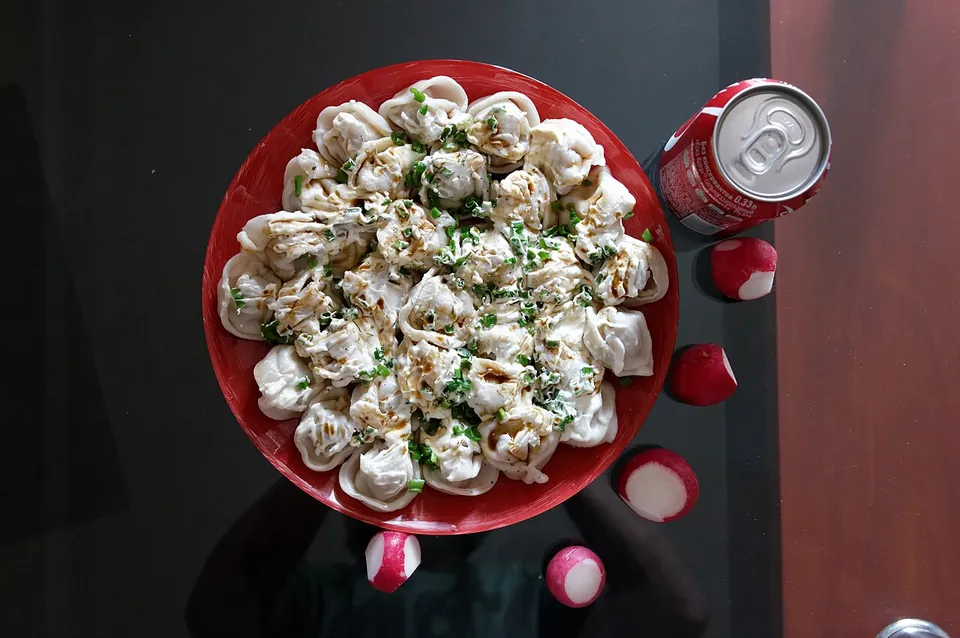
Pelmeni are the small Siberian parcels of minced meat, wrapped in thinly rolled dough and boiled. As a kind of dish they seem to go back to the late medieval and early modern period, but the name appears in Russian writing rather late, and a gap opens between the age of the food and the first time it was recorded.
The ingredients were all at home in this land. Wheat, and the minced pork, beef, and mutton, were long-familiar things that the Urals and Siberia could readily supply. What gave the dish its form was the handwork of rolling the dough thin, wrapping the meat, and boiling it, together with how neatly that suited life in a cold country.
Wrapped and boiled, pelmeni keep well once frozen. Through the long Siberian winter they were made in quantity and stored in the snow, a preserved food and a daily one, boiled only as much as was needed. Semivsky, whose 1817 book set down life in eastern Siberia, wrote them up in just this way: made above all in winter, and, boiled in water when they were wanted, making a fine soup for the road. Then, in the mid-nineteenth century, the railway carried the dumpling across the whole of Russia, pushing a regional keeping-food out into a food of the entire country.
How we know
Pelmeni's beginning comes down in two stories, apart in geography and in people alike.
One sees them arising among the native peoples of the Urals and Siberia — the Komi, Udmurt, Mansi and other Finno-Ugric peoples — and derives the name from the Komi and Udmurt pelnyan, ear-bread (pel, ear; nyan, bread). When Russians moved east in the sixteenth and seventeenth centuries and spread across the Urals and Siberia, so the account runs, they took up the local food and raised it into a dish of their own. The linguistic evidence for this line has grown firmer of late. Vasmer's etymological dictionary parses pelnyan in its text as ear plus bread, and notes that whether the borrowing came from Komi or Udmurt cannot be pinned down. The Komi scholars Lytkin and Gulyaev read pel as the common Permic word for ear and nyan as bread borrowed from an Indo-European, Indo-Iranian source. The word's origin points to the Permic peoples who lived in the Cis-Urals from the ninth to the thirteenth century.
The other is the Chinese-and-Mongol account. Pelmeni as a boiled parcel are taken as a simplified adaptation of the Chinese dumpling, carried by the Mongols from China to Siberia and the Urals. The line this account leans on is a passage in Semivsky's 1817 book on eastern Siberia, which sets pelmeni down as small filled cakes made after the example of the Chinese. That is not a remark that they looked like something Chinese; it says they were made in the Chinese manner. But it is the surmise of a Russian observer of the early nineteenth century about the food in front of him. Who had brought it, and when, and from where — that he did not look into.
Yet all that holds this transmission account up is that one line of surmise and the overlap of form — dough, filling, shaping, and cooking are much alike. On the food-history side too, there are writers who name wonton as the most reasonable candidate while admitting that no firm evidence can be offered. A boiled wrapped dumpling can arise separately in many places, so a single resemblance of form is no proof of transmission.
The two stories tie in with a further view: that similar dishes came by several routes — Crimean Tatar, Dagestani, Central Asian — in different eras. The oldest record of pelmeni in Russian is that one book of Semivsky's, from 1817; Avdeyeva in 1837 records the word as Siberian dialect, and Radetzky in 1855 gives a concrete recipe of pork or venison with onion. All fall in the late early-modern to early nineteenth century, far later than the age of the dish itself. A first record shows not when a food was born but when it came to be written down. The 1817 book carries us this far and no further: by that year at the latest, pelmeni were part of life in eastern Siberia. In short, it will not fit into a single origin. The very either-or of Russian-born or come-from-outside does not apply to this dish from the start.
The full set of origin theories and the detailed verification log — traceable all the way to their sources — are available on the Japanese edition.
See the full origin theories and verification log (Japanese) →
Related dishes
Cross-links Sister dishes & same-name dishes (separate lineage)
- Sister dish (shared ancestor)PierogiPolandC
- Sister dish (shared ancestor)MantiAnatolia (Turkey)C
- Sister dish (shared ancestor)VarenykyUkraineC
- Sister dish (shared ancestor)Kashyk-ash (къашыкъ-аш, Crimean Tatar spoon-dumpling soup)Crimea (Crimean Tatar)C
Shares the key ingredient
- SamosaIndian subcontinent (Delhi Sultanate)B
- KhachapuriGeorgia (Caucasus)C
- Hot dogNew York, United StatesB
- HaleemHyderabad (Deccan)C
- KobeteCrimea (Crimean Tatar)C
- BrikTunisiaC
- BoortsogMongoliaC
- Mission burritoSan Francisco, California (USA)C