All dishes / 南アジア
Seekh kebab Period COrigin theory CVerified
Some fields (dish name, region and gates) are shown from the Japanese-edition data.
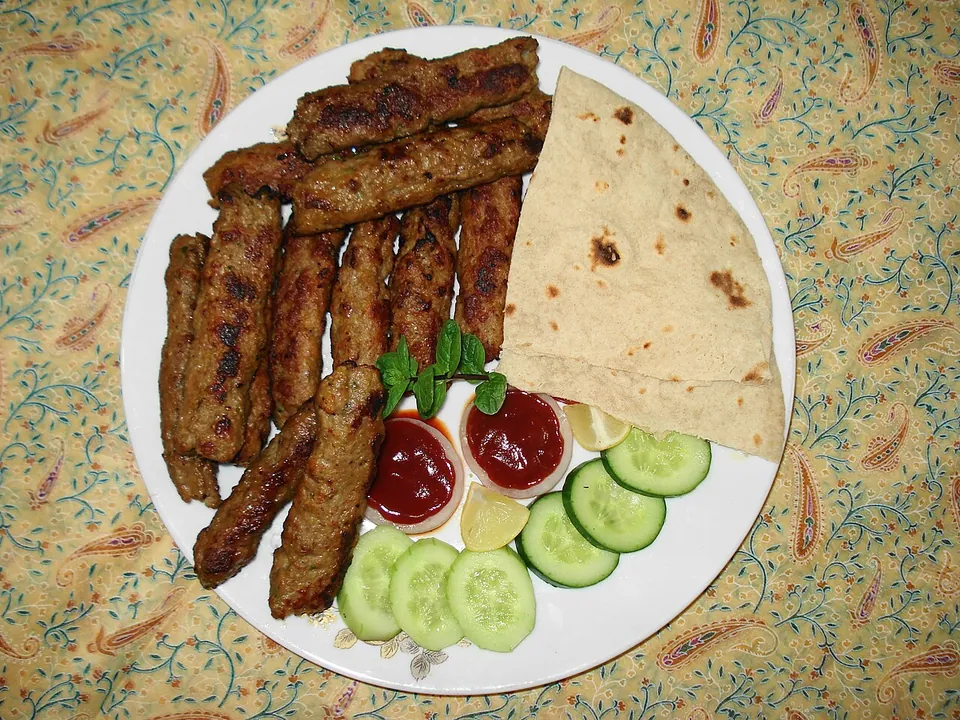
Ground meat wrapped around a metal skewer and grilled over charcoal—the seekh kebab is usually credited to the kitchens of the Mughal emperors. Yet a cookbook written for a sultan of Malwa, before the Mughal dynasty ever reached India, already names the sīkh kabāb and describes minced meat fastened to a skewer and grilled.
Verification highlight popular claim → verdict → evidence
Skewered ground meat grilled over charcoal, seekh kebab is often credited to the Mughal court, but a cookbook from the earlier Malwa Sultanate (circa 1495-1505) already describes minced meat wrapped around a skewer and basted with ghee under the name sikh kabab, pushing its presence in South Asia back before the Mughals.
The three gates
- Ingredient-supply gate
- Ground mutton or beef is a native staple; the ingredient factor is not the limiting one
- Cooking-technique gate
- Skewering ground meat on metal rods and grilling over charcoal (a candidate for the limiting factor)
- Venue gate
- Grilled fare of urban Muslim street stalls and banquets
Overview
The seekh kebab is spiced minced lamb pressed around a metal skewer and cooked over an open charcoal fire. 'Seekh' goes back to the Classical Persian sīx, 'skewer', and entered South Asia through Urdu. Skewer-grilling itself is generally taken to belong to an old line of fire cookery among the peoples of Persia, Central Asia and the Turkic steppe.
Lamb and beef were long-established local meats, and mincing them with spice is ordinary kitchen work. Getting the mince onto a skewer takes a further knack. The soft meat has to be squeezed around the metal tightly enough to hold when it meets the fire; a hot charcoal bed sets the surface at once, and the cook turns the skewer until the heat reaches the middle. Because the metal carries heat into the meat from the inside, a thin sleeve of mince cooks through in minutes.
That way of cooking pays off where charcoal is lit to order and skewer follows skewer over the coals: the street grill, and the banquet that has to put meat in front of a crowd. In the Muslim towns of South Asia the seekh kebab settled in as food served straight off the fire.
The form eaten today—mince worked through with a generous load of spice—was shaped during the Mughal period (sixteenth to eighteenth centuries), when skewer-grilled meat met the spices of the Awadhi and Punjabi courts and took on the shape now grilled on the street corners of Lahore and Karachi.
How we know
'The seekh kebab was invented in the Mughal court' is the story usually told, and with the lavish reputation of Mughal cooking behind it, it sits neatly.
The Mughal dynasty came to India in 1526. Before that, at Mandu, capital of the Malwa sultanate in central India, a cookbook was compiled for the sultan's kitchen: the Niʿmatnāma, written around 1495–1505, surviving as British Library MS Or.149 and translated by Norah M. Titley as The Sultan's Book of Delights. Folio 20b describes mince wrapped in cotton and fastened to a skewer, brushed every hour with ghee scented with camphor, musk and rose water, and grilled until it reddens—minced meat on a skewer, exactly. Folio 61a carries the phrase itself: 'first make sīkh kabāb, then put it in the broth and eat it with stuffed bread.' Folio 135b lists 'plain rural kabābs and plain rural sīkh (skewered meat)', and the glossary at the end of the translation defines kabāb as 'skewered meat, see also sīkh'. Skewered mince was being cooked in a South Asian sultan's kitchen before the Mughal emperors reached the north.
The word itself needs care. Medieval Persian and Arabic kabāb does not always mean something cooked on a skewer: the same Niʿmatnāma gives a kabāb fried in ghee and a fish kabāb baked in an earthen pot. The age of the word is therefore not the age of skewer-grilling—which is why the passages that carry sīkh, 'skewer', are the ones that count: f.61a with the phrase, and f.20b with the skewer in the method.
The first year in the record is not the year of birth. The Niʿmatnāma shows that skewered mince was being made in South Asian courts by the end of the fifteenth century; how much further back it runs, the book does not say. Whether skewer-grilling was carried in from Persia and Central Asia, or grew up locally—putting meat on a rod over a fire is done in many places—cannot be settled from the sources now in hand, and both readings stand side by side. What is clear is that the Mughal court took a skewer-grill that already existed, married it to spice, refined it and spread it. It did not invent it.
The full set of origin theories and the detailed verification log — traceable all the way to their sources — are available on the Japanese edition.
See the full origin theories and verification log (Japanese) →
Related dishes
Shares the key ingredient
- Railway mutton curryIndia (British Indian Railways)C
- MansafJordan (Levant)C
- MantiAnatolia (Turkey)C
- SajjiBalochistan (Pakistan)C
- KhorkhogMongoliaC
- BoodogMongoliaC
- HareesPersian Gulf (Bahrain / Kuwait)C
- Instant-boiled mutton (shuan yangrou)Beijing (China)B
- LahmacunAnatoliaC
- Manti (Central Asian)Central Asia (Uzbekistan / Kazakhstan)C
- KarahiLahore (Pakistan)C
- KoftaLevantB
- ZarbJordan (Levant)B
- HaggisScotlandC
- Jingisukan (Genghis Khan)Hokkaido (Japan)D