All dishes / 東欧
Khinkali Period COrigin theory CVerified
Some fields (dish name, region and gates) are shown from the Japanese-edition data.
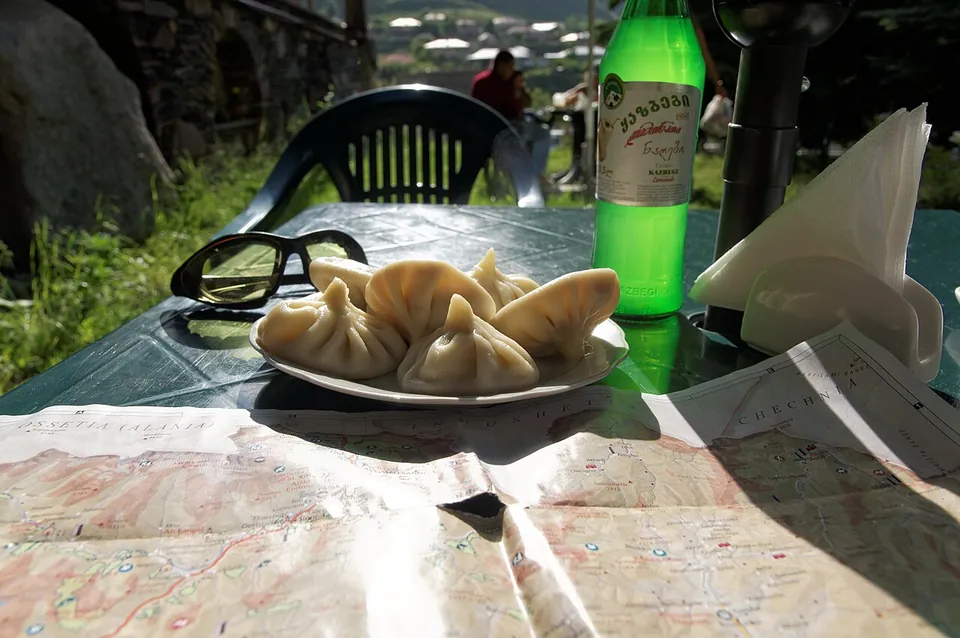
A dumpling from the Georgian highlands, its twisted crown looking almost like a sun emblem. Stories of how it got its name, from "the priest's wife Khinda" or "the head of the Mongol khan," have long been told, but trace the history of the word and each turns out to be a later invention.
Verification highlight popular claim → verdict → evidence
Folk etymologies -- that khinkali is named after a priest's wife, Khinda, or derives from the Mongol word 'khan' -- are rejected: linguistically, the name traces through medieval Georgian to the Avar word khinkal, part of a pan-Caucasian dumpling-word family with cognates in Lezgin, Ingush, and Circassian (per Wiktionary), making the folk stories later inventions. Separately, and left unresolved, is the origin of the dish itself: indigenous invention in the Georgian highlands versus transmission of the dumpling technique via the 13th-century Mongol expansion and Silk Road trade.
The three gates
- Ingredient-supply gate
- Lamb, beef, and wheat are all native to the Caucasus highlands and are not limiting; what actually constrains the earliest date is the meat-dumpling technique itself (wrapping and boiling, roughly 1200-1400) and the highland setting.
- Cooking-technique gate
- A wrap-and-boil dumpling technique that seals in meat juice and pleats the dough; this technique became established in the Caucasus in the medieval period (roughly 1200-1400).
- Venue gate
- Highland homes and highland food culture, later also urban eateries; everyday fare, home-made, associated with highland communities.
Overview
Khinkali is a Georgian dumpling: meat wrapped in a wheat wrapper, pleated and twisted up into a crown, then boiled. It has been handed down since old times in the steep northern highlands of Georgia, in places such as Pshavi, Khevsureti, and Mtiuleti. Today it is a fixture in the eating houses of Tbilisi and other cities, but its home lies in the life of the cold, high mountains.
In the highlands, sheep were the most ready meat, so khinkali too was originally filled with lamb. On a bitter winter's day, biting into hot meat and the juices sealed inside makes a fortifying food well suited to hard, high-altitude living. The radiating pleats formed by gathering the wrapper have been likened, in local belief, to a sun emblem. In both its ingredients and its shape, it is bound up inseparably with the culture of the mountains.
For this food to come together, it takes the craft of wrapping meat in a wrapper, boiling it, and keeping the juices within. This technique is thought to have taken hold in the highlands of the Caucasus in the medieval period. In time it came down from the mountains to the popular eating houses of the cities and became a dish loved across all of Georgia. It stands in a sisterly relation to manti and buuz, meat dumplings distributed widely across Eurasia.
How we know
In its homeland, several stories have been passed down about the origin of the name khinkali. One tale holds that a priest's wife named Khinda began making it, so it is called khinkali from "khin (Khinda) + kali (woman)." Another ties it to the Mongol khan who came storming in from the east, explaining that the name means "the head of the khan." Both set a person's name or the prestige of a conqueror at the beginning, and both make satisfying stories.
But trace the history of the word and these two origin tales lose their footing. Khinkali (khinkali) is, by way of medieval Georgian, ultimately a loan from the Avar word khinkal (xinkal) of Dagestan in the northeast Caucasus, with cognate words in Lezgian, Ingush, and Circassian. The name, in other words, came across from the dumpling vocabulary that spans the whole Caucasus; it does not spring from any particular person's name or from the "khan." Both the priest's wife and "the head of the khan" are dismissed as folk etymologies that attached a meaning to a similar-sounding word.
Still, the origin of the name and the origin of the dish itself must be considered separately. The Avar khinkal is a different form of food, boiled dough served with a meat-and-garlic sauce, while the shape of today's khinkali, pleated to seal the juices within, is held to have grown up in the Georgian highlands. As for where it began, two views stand side by side: one that it arose natively in the high country of Pshavi and Khevsureti, and one that in the Mongol expansion of the thirteenth century the idea of the meat dumpling passed westward from China through Mongolia and Russia and took root here. On the latter, the world food historian Rachel Laudan argues that the distribution of stuffed dumplings overlaps with the extent of the Mongol Empire, while cautioning that the Mongols did not invent them. Neither origin account carries dated sources recording when it was born. What is certain is that this dish, having borrowed its name from the Caucasian vocabulary, became native in the Georgian highlands and worked its present form into shape within that land's life and belief.
The full set of origin theories and the detailed verification log — traceable all the way to their sources — are available on the Japanese edition.
See the full origin theories and verification log (Japanese) →