All dishes / 南アジア
Biryani Period BOrigin theory CVerified
Some fields (dish name, region and gates) are shown from the Japanese-edition data.
"The empress Mumtaz, moved by the sight of gaunt soldiers, had a rice-and-meat dish cooked for them"—the romantic tale of biryani's birth has no contemporary record to support it. Stories that credit a dish to one named person are, more often than not, invented after the fact.
Verification highlight popular claim → verdict → evidence
Popular claim: Biryani was invented by Mughal empress Mumtaz Mahal to feed malnourished soldiers. Verdict: no contemporary source supports this romantic origin story. What the court manuscripts actually show is that biryani took shape as Persian-style pilau merged with local spiced rice in the Mughal court -- documented in the Ain-i-Akbari and the 17th-century Nuskha-i-Shahjahani, which records five kinds of beriyan (layered rice) by 1658. Competing claims -- a pre-Mughal Persian route via Arab traders to the Malabar coast, and a supposed ancient Tamil ancestry -- remain unresolved or refuted, so no single origin is settled. Main sources: Lizzie Collingham's Curry: A Tale of Cooks and Conquerors; the Ain-i-Akbari and Nuskha-i-Shahjahani court manuscripts; Wikipedia.
The three gates
- Ingredient-supply gate
- Rice and spices were both already locally available, so no ingredient was the limiting factor.
- Cooking-technique gate
- Persian-style dum (sealed slow-steaming) technique and large-scale Mughal court cooking
- Venue gate
- court kitchen / royal court and elite
Overview
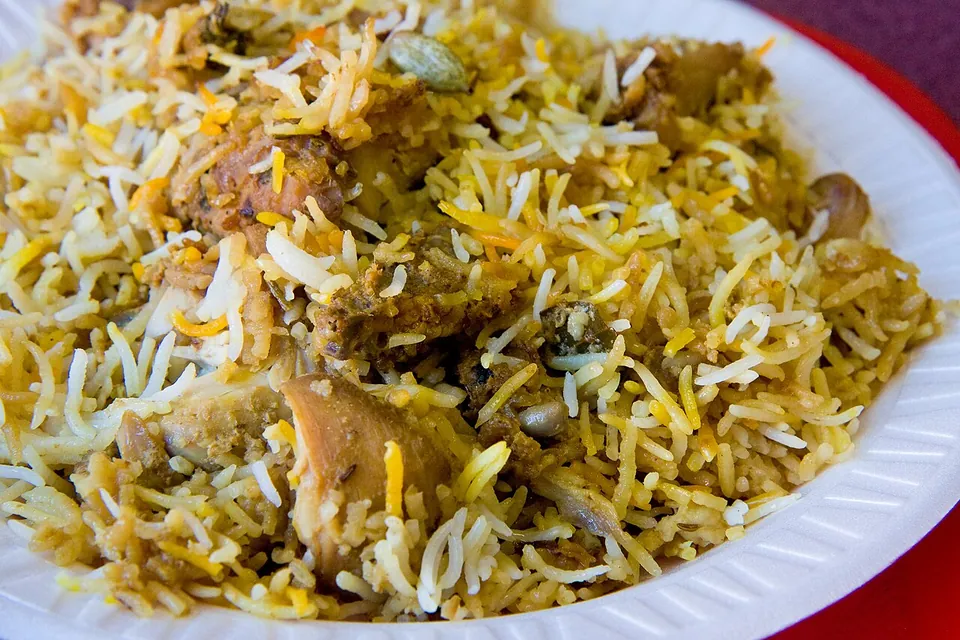
Biryani took its shape between the sixteenth and eighteenth centuries, across the Deccan and the wider realm of the Mughal empire. It is a festive dish: fragrant rice, meat, and generous spice layered and steamed together.
Both the rice at its heart and the spices that flavor it were long-established in South Asia, on people's tables from early on. What drew these ingredients into a single dish was a technique of slow steaming carried from Persia, and a kitchen large enough to work it. The pot is sealed, the fire kept low, and the aromas coaxed slowly into the rice—this laborious method entered South Asia and married the mass-cooking apparatus of the Mughal court and the regional kingdoms, and out of that meeting biryani rose. From there it spread into the cities.
The name traces to the Persian zer biryan (frying beneath, or the golden fry), which refers to frying meat and onions before the rice is cooked—the very posture of the cooking, layered and fried-then-steamed, survives in the name. Persian pilau, meat marinated in yogurt with fragrant rice, melded in the Mughal court with a locally spiced rice, and became biryani. This is the best-supported account. The Ain-i-Akbari, recording the reign of the sixteenth-century emperor Akbar, notes steamed cookery and a golden rice; a manuscript from the court of the emperor Jahangir, the Alwan-e-Nemat, records a fried rice dish; and a manuscript from the seventeenth-century court of Shah Jahan, the Nuskha-i-Shahjahani, lists several dishes that look like biryani's direct forerunners. Later, when the emperor Aurangzeb pushed his armies south, the Hyderabad line branched off, and from the mid-eighteenth century onward the Lucknow line, each taking on its own regional character.
How we know
Biryani has a beautiful birth story. Mumtaz Mahal, the empress who rests in the Taj Mahal, took pity on undernourished soldiers and had a nourishing dish of meat and rice cooked for them—so it goes.
But the tale has lost its footing, for a simple reason: not one contemporary record of it can be found. Even the specialist encyclopedia that traces biryani's history states plainly that there is no record, only legend. The more lavish an anecdote that credits a single person with the invention, the more it tends to lack evidence from its own time—a familiar shape for an origin story worked up after the fact.
Other stories that lack backing exist too. The claim that biryani is an ancient Indian dish and no Mughal invention takes as its ancestor the meat-and-rice (oon soru) sung in Tamil classical poetry of around the second century. But the food historian K. T. Achaya and others judge the ancient meat-rice and the later medieval rice dishes to be separate lineages. The antiquity of the idea of cooking meat and rice together is one thing; the moment when the particular style of biryani—layered, fried, and steamed—came into being is another. A claim that the armies of Timur, the Central Asian conqueror, brought it in during his late-fourteenth-century campaigns fares no better, since Central Asia itself holds no record of the time to show it.
Set these anecdotes aside, and what remains as the most credible thread is the view that Persian pilau grew at home in the Mughal court. Biryani is a dish that branched out in South Asia from that Persian pilau as its ancestral type, and its direct forerunners are recorded in the court manuscripts already mentioned. It was not one person's flash of inspiration but a confluence—Persian technique and Mughal mass-cooking meeting a locally spiced rice.
Still, there are voices for a road apart from the northern court. The food historian Salma Husain argues that biryani was carried from Persia to the Deccan first, before the Mughal period, by the hands of pilgrims and wandering soldier-statesmen. As a coastal route, some hold that Arab traders from the seventh century onward brought meat-and-rice dishes by way of the Malabar coast in the southwest, and that the local Muslim community raised it into a dish of their own. This thread still lacks a firm date, but it is not mere legend—it remains a competing account set out by scholars. Laid side by side, the court story and the southern story show that biryani's origin cannot be drawn as a single line. This dish sits where several streams gather. To insist on fixing who came first is, perhaps, to miss the point.
The full set of origin theories and the detailed verification log — traceable all the way to their sources — are available on the Japanese edition.
See the full origin theories and verification log (Japanese) →
Related dishes
Lineage Family, predecessor, variants
Cross-links Sister dishes & same-name dishes (separate lineage)
- Spread from hereDanbaukMyanmarC
- Sister dish (shared ancestor)PlovUzbekistan (Samarkand / Fergana)C
- Sister dish (shared ancestor)PilauEast Africa (Swahili Coast)C
- Diffusion prototypePolowIranC
- Sister dish (shared ancestor)PulaoNorth IndiaC
Shares the key ingredient
- DosaSouth India (Tamil Nadu / Karnataka)C
- PaellaValencia, SpainC
- Risotto alla milaneseMilan (Lombardy, Italy)C
- Nasi gorengIndonesia (Java)C
- JambalayaNew Orleans (Louisiana, USA)C
- MujaddaraLevant (Syria, Lebanon, Palestine)B
- DoriaYokohama, JapanB
- IdliSouth IndiaC
- MaqlubaPalestine / LevantC
- White mixed rice (hondonban / goldongban — Bibimbap precursor)Korean PeninsulaC
- MandiHadhramaut (Yemen)C
- Rice and native-grain upma layer (sada upma, pre-semolina)South IndiaC
- KiribathSri LankaD
- KabsaSaudi ArabiaC
- MachboosPersian Gulf (Bahrain / Kuwait)B
- Gallo pintoCosta Rica / NicaraguaC
- Dal bhatNepalB
- KoshariEgyptC
- Rice-and-lentil koshari base layer (pre-pasta, pre-tomato)EgyptC
- Bánh cuốnVietnamB
- MahshiEgyptB
- PilavAnatoliaC
- Kabuli palawAfghanistanC
- Pilaf (French)FranceC
- Pilaf (Japanese-style)JapanC
- TahdigIranC
- Arroz de mariscoAlgarve (Portugal)C
- CasadoCosta RicaC
- Nan gyi thokeMyanmarC
- Mont diMyanmarC
- AranciniSicily (Italy)C
- Mazbi (madhbi)Yemen (Hadhramaut)C