All dishes / 南アジア
Dosa Period BOrigin theory CVerified
Some fields (dish name, region and gates) are shown from the Japanese-edition data.
The golden masala dosa, stuffed with spiced potato, is sometimes said to have been improvised from leftover curry in a 12th-century royal court. That story does not square with the record: the potato-filled version is far younger than it sounds.
Verification highlight popular claim → verdict → evidence
This is a South Indian dish. The word tosai/dosai derives from Dravidian toy ('to ferment/soak'), with cognates in Kannada (dose) and Tulu (dose), confirming a South Indian origin. Per Achaya, the earliest textual mention is in Tamil literature from the 8th century (Kannada from the 9th); the often-repeated claim of a 1st-century Sangam-era origin ('2,000 years old') mischaracterizes Achaya's speculation as the earliest attestation. The earliest datable full recipe is the Manasollasa's dosaka (c. 1130), rice and black gram/urad dal fried on a hot griddle. Both the Tamil and Karnataka (Udupi) origin claims rest on independent textual evidence and remain unresolved. The legend crediting masala dosa to Someshvara III's 'leftover curry' fails on chronology, since potato is a New World crop that only arrived in the 16th century; masala dosa is in fact a modern variant from 1930s Madras (K. Krishna Rao).
The three gates
- Ingredient-supply gate
- Rice and urad dal are both native to South India; a fermented batter is a prerequisite.
- Cooking-technique gate
- Wet grinding on a stone mill, natural fermentation, and thin-frying on an iron griddle (tawa).
- Venue gate
- South Indian home and temple kitchens, later urban tiffin (light-meal) stalls.
Overview
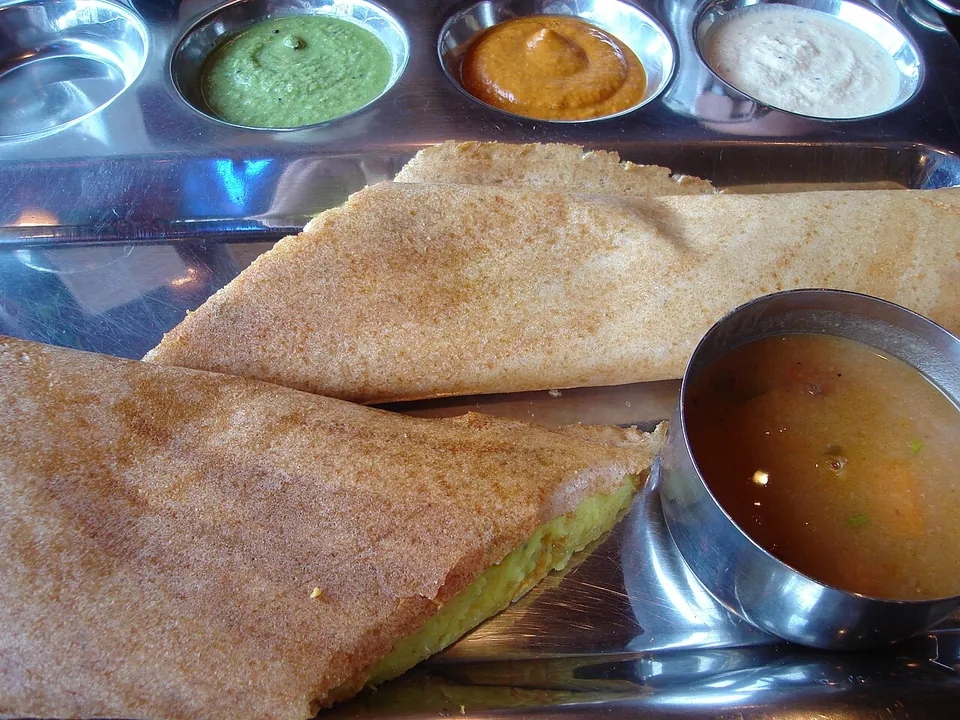
Dosa is a South Indian dish made by grinding rice and urad dal with water on a stone mill, letting the batter ferment overnight, and spreading it thin like a crepe on a hot griddle (tawa). Rice is the lead ingredient, with urad dal in a supporting role, giving the batter its lift and its faint sourness. Both are long-established crops of the South Indian soil. Dosa was cooked day after day in home and temple kitchens before it became the signature dish of the urban tiffin house.
The name appears in the medieval record. The food historian K. T. Achaya notes a reference to dosai in Tamil literature of the 8th century, with Kannada-language records following a little later. The encyclopedic Manasollasa (c. 1126 CE), compiled by the Chalukya king Someshvara III, gives a recipe for a dosaka: rice and Bengal gram spread thin on a heated griddle. With both name and method attested together, this 12th-century entry serves as one firm anchor. The word itself runs deep: tocai/dosai traces back to the Dravidian toy (to ferment, to soak), and the Kannada dose and Tulu dose share that root. The core of the dish, a fermented batter, is written into the language of the land.
The masala dosa, folded around a spiced filling, is a separate and much later dish. Its potato stuffing could only appear once the potato had crossed the ocean from South America and reached India.
How we know
Two invented stories have long clung to the dosa.
The first is that dosa is 'two thousand years old,' present since the Sangam era in the 1st century CE. But the earliest written record Achaya could point to was Tamil literature of the 8th century; tracing it back to the Sangam age was his own conjecture, not a documented fact. The first point at which a name is inscribed in the record is not the same as the moment a dish was actually born, and pushing the first attestation ever earlier manufactures an origin far older than the sources can bear.
The second ties the stuffed masala dosa to the 12th-century Chalukya court: a cook of Someshvara III is said to have wrapped leftover curry in a dosa. But the potato at the heart of the masala is a South American crop, unknown in India until the Portuguese brought it in the 16th century. A potato-stuffed dosa served at a 12th-century court is an impossibility. The real masala dosa is a modern offshoot, popularized in 1930s Madras by K. Krishna Rao of the Udupi restaurant tradition. The medieval thin dosa and the modern potato-filled masala dosa have to be told apart.
Clear away the folklore and one unresolved question remains: is the home of the dosa Tamil country or Karnataka (Udupi)? Achaya points to Tamil literature of the 8th century; the food historian P. Thankappan Nair reads the dosaka of the Manasollasa as evidence for Udupi. Each case rests on its own independent documentary record, and the two point to different regions, so they do not converge on a single answer. Rather than force one to be the true origin, the honest course here is to leave both accounts standing side by side.
The full set of origin theories and the detailed verification log — traceable all the way to their sources — are available on the Japanese edition.
See the full origin theories and verification log (Japanese) →
Related dishes
Cross-links Sister dishes & same-name dishes (separate lineage)
Shares the key ingredient
- BiryaniSouth Asia (Deccan / Mughal)C
- PaellaValencia, SpainC
- Risotto alla milaneseMilan (Lombardy, Italy)C
- Nasi gorengIndonesia (Java)C
- JambalayaNew Orleans (Louisiana, USA)C
- MujaddaraLevant (Syria, Lebanon, Palestine)B
- DoriaYokohama, JapanB
- MaqlubaPalestine / LevantC
- White mixed rice (hondonban / goldongban — Bibimbap precursor)Korean PeninsulaC
- MandiHadhramaut (Yemen)C
- Rice and native-grain upma layer (sada upma, pre-semolina)South IndiaC
- KiribathSri LankaD
- KabsaSaudi ArabiaC
- PlovUzbekistan (Samarkand / Fergana)C
- MachboosPersian Gulf (Bahrain / Kuwait)B
- Gallo pintoCosta Rica / NicaraguaC
- Dal bhatNepalB
- KoshariEgyptC
- PilauEast Africa (Swahili Coast)C
- Rice-and-lentil koshari base layer (pre-pasta, pre-tomato)EgyptC
- Bánh cuốnVietnamB
- MahshiEgyptB
- PolowIranC
- PulaoNorth IndiaC
- PilavAnatoliaC
- Kabuli palawAfghanistanC
- Pilaf (French)FranceC
- Pilaf (Japanese-style)JapanC
- TahdigIranC
- Arroz de mariscoAlgarve (Portugal)C
- CasadoCosta RicaC
- Nan gyi thokeMyanmarC
- Mont diMyanmarC
- AranciniSicily (Italy)C
- Mazbi (madhbi)Yemen (Hadhramaut)C