All dishes / 中東・北アフリカ
Mahshi Period BOrigin theory BVerified
Some fields (dish name, region and gates) are shown from the Japanese-edition data.
Mahshi, hollowed vegetables and grape leaves stuffed with rice and simmered slow, is sometimes told as a dish that goes back to ancient Egypt. But neither the ingredients that color today's mahshi nor its earliest text reach as far as the age of the pharaohs.
Verification highlight popular claim → verdict → evidence
A dolma-family stuffed dish: vegetables hollowed out or grape leaves wrapped around rice, then braised. Stuffed vegetables first appear in writing in a 13th-century Syrian cookbook, and the technique spread across the Middle East and Mediterranean under Ottoman rule (16th century onward), settling into Egypt around that same period. No specific date of invention or inventor survives.
The three gates
- Ingredient-supply gate
- Vegetables and grape leaves were locally available; the circulation of rice was central to the stuffing. The tomato version dates from after the New World crop's arrival.
- Cooking-technique gate
- Hollowing out vegetables or wrapping grape leaves, then braising -- a dolma-family technique.
- Venue gate
- A home dish and festive table staple.
Overview
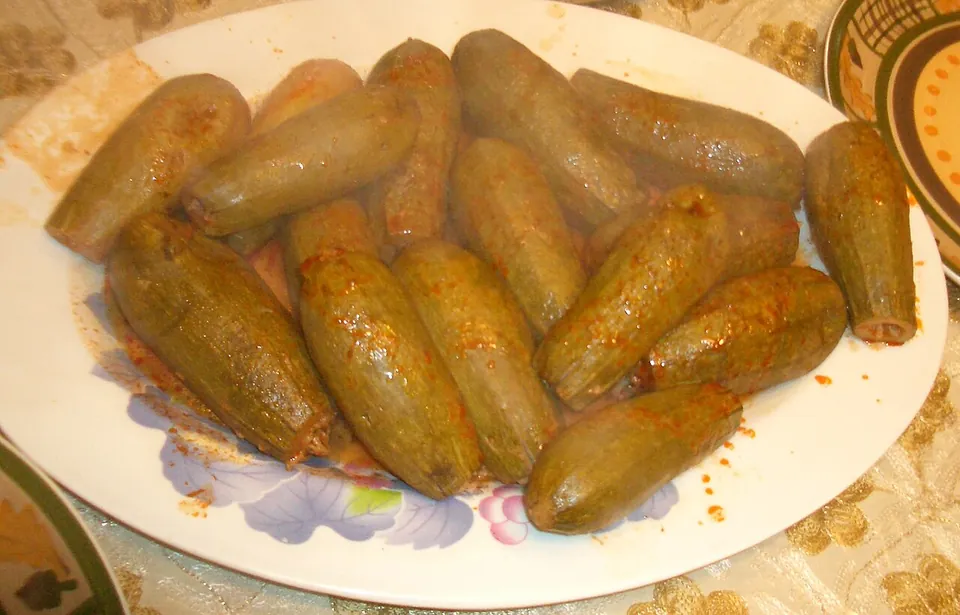
Mahshi is a dish of home and festival: zucchini or eggplant hollowed out, or grape leaves rolled up, filled with rice, minced meat, and herbs, and simmered slowly. The name runs back to the Arabic hashw, 'to stuff.'
The rice at the heart of the filling was a long-established ingredient in Egypt. It arrived around the time of the Arab conquest in the seventh century, and by the Ottoman era it was grown widely and was an everyday grain in the kitchen. The vegetables and grape leaves come from the local fields. The materials, in short, were all at hand on this land.
What makes mahshi mahshi lies rather in the handwork. Carefully hollowing out the vegetable, rolling the leaf without tearing it, simmering until the packed rice cooks through: this set of dolma-style techniques spread with the reach of the Ottoman Empire, from the Middle East to the Mediterranean, the Balkans, and the Caucasus. It was in this period, from the sixteenth century onward, that stuffed dishes took hold in Egypt.
The tomato-sauce version familiar in modern Egypt, it should be said, is a later dress, from after New World tomatoes reached the Middle East and North Africa in the nineteenth century. Even as a rice stuffing without tomato, mahshi holds together as mahshi.
How we know
Mahshi carries no founding story of who devised it, or when, in Egypt. Even so, one often meets online the telling that 'mahshi has been eaten since ancient Egypt, since the time of the pharaohs.' That antiquity, however, is not supported by the sources.
First, the ingredients do not fit. The tomatoes and peppers that mark modern Egyptian mahshi are New World crops, and they spread across North Africa and the Middle East only from the eighteenth century. They were nowhere on the pharaonic table. Next, the texts do not fit. The oldest record of a hollowed, stuffed vegetable dish is the thirteenth-century Syrian cookbook Kitab al-Wuslah ila l-habib, and even there it is limited to eggplant and snake cucumber, and it is not Egyptian. Further, contemporary records describe Ottoman governors introducing stuffed dishes to the nobility, placing Egypt on the receiving side rather than as a point of origin. The ancient-Egyptian claim thus clashes with the arrival dates of its ingredients, with the first appearance of the texts, and with the direction the records of the time describe.
To say instead that 'thirteenth-century Syria is the origin' would also overreach. The act of stuffing itself is far older. The tenth-century cookbook Kitab al-Tabikh of Ibn Sayyar al-Warraq has stuffed meat and sausage; ancient Greece had thrion, cheese wrapped in fig leaves (fifth century BCE); late-antique Apicius has a stuffed cucumber. The year a dish first appears in writing is not the year it was born.
What can be said with certainty reaches this far: the first written record of stuffed vegetables in the thirteenth century, and their taking hold in Egypt in the Ottoman era, an outline of dates and no more. No individual founding year, no inventor, no founding anecdote survives. Mahshi is best understood not as one person's invention but as a dish that took root across many places by word of mouth, within the wide current of stuffed cookery, which is the reading most faithful to the sources.
The full set of origin theories and the detailed verification log — traceable all the way to their sources — are available on the Japanese edition.
See the full origin theories and verification log (Japanese) →
Related dishes
Shares the key ingredient
- BiryaniSouth Asia (Deccan / Mughal)C
- DosaSouth India (Tamil Nadu / Karnataka)C
- PaellaValencia, SpainC
- Risotto alla milaneseMilan (Lombardy, Italy)C
- Nasi gorengIndonesia (Java)C
- JambalayaNew Orleans (Louisiana, USA)C
- MujaddaraLevant (Syria, Lebanon, Palestine)B
- DoriaYokohama, JapanB
- IdliSouth IndiaC
- MaqlubaPalestine / LevantC
- White mixed rice (hondonban / goldongban — Bibimbap precursor)Korean PeninsulaC
- MandiHadhramaut (Yemen)C
- Rice and native-grain upma layer (sada upma, pre-semolina)South IndiaC
- KiribathSri LankaD
- KabsaSaudi ArabiaC
- PlovUzbekistan (Samarkand / Fergana)C
- MachboosPersian Gulf (Bahrain / Kuwait)B
- Gallo pintoCosta Rica / NicaraguaC
- Dal bhatNepalB
- KoshariEgyptC
- PilauEast Africa (Swahili Coast)C
- Rice-and-lentil koshari base layer (pre-pasta, pre-tomato)EgyptC
- Bánh cuốnVietnamB
- PolowIranC
- PulaoNorth IndiaC
- PilavAnatoliaC
- Kabuli palawAfghanistanC
- Pilaf (French)FranceC
- Pilaf (Japanese-style)JapanC
- TahdigIranC
- Arroz de mariscoAlgarve (Portugal)C
- CasadoCosta RicaC
- Nan gyi thokeMyanmarC
- Mont diMyanmarC
- AranciniSicily (Italy)C
- Mazbi (madhbi)Yemen (Hadhramaut)C