All dishes / 南アジア
Jalebi Period BOrigin theory BVerified
Some fields (dish name, region and gates) are shown from the Japanese-edition data.
Often taken for an Indian spiral sweet, jalebi in fact traces back to zalabiya, a fried confection of the medieval Islamic world. It already appears in a tenth-century Arabic cookbook.
Verification highlight popular claim → verdict → evidence
Popular claims: jalebi is a native Indian invention (via the ancient kundalika/jalavallika sweets), or alternatively of Turkish origin. Verdict: both refuted -- linguistic and culinary evidence point to West Asia. The name derives from Arabic zulabiya / Persian zolbiya (Hobson-Jobson, 1903), and the earliest recorded version, zalabiya, appears in the 10th-century Baghdad cookbook Kitab al-Tabikh. It reached India by the 15th century, first attested in the Sanskrit-adjacent text Priyamkara-nrpa-katha (c.1450). Key sources: Kitab al-Tabikh (al-Warraq, 10th c.); Hobson-Jobson (1903).
The three gates
- Ingredient-supply gate
- Both wheat and sugar were native Old World crops, so the limiting ingredient was available early; this factor imposes no late date.
- Cooking-technique gate
- Batter is piped in spirals, deep-fried, then soaked in syrup.
- Venue gate
- Originally a sweet for festivals and religious occasions, later a popular street snack.
Overview
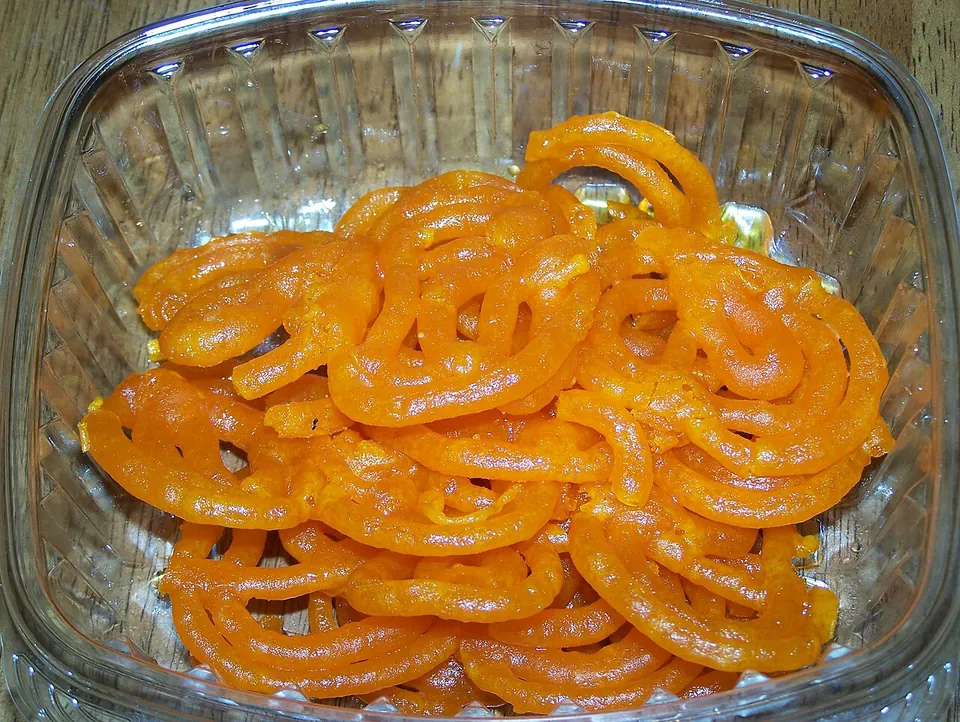
Jalebi is a sweet made by piping a wheat-flour batter into hot oil in a spiral, frying it, then steeping it straight in sugar syrup. Centered on North India, it has long been served at festivals and religious occasions and enjoyed as a street sweet. In the record, the confection settles into India in the medieval period — around the fifteenth century.
The ingredients themselves are old. Wheat and sugar are both long-established Old World foods, on hand early in the kitchens of North India. What binds these ingredients into a sweet is the sequence of piping the batter into a spiral, frying it, and steeping it in syrup.
That technique did not arise in India on its own; it was carried in from West Asia. The prototype was a fried sweet known in the medieval Islamic world as zalabiya or zolbiya, brought to the Indian subcontinent along with Persian culture. It took hold amid the cultural traffic from the Delhi Sultanate through the Mughal era, and the name jalebi itself derives from the Arabic zulabiya and the Persian zolbiya.
How we know
Jalebi's history comes into focus by following the oldest records. The fried, syrup-steeped sweet appears as zalabiya in the tenth-century Arabic cookbook Kitab al-Tabikh, compiled by Ibn Sayyar al-Warraq. This is the earliest known record of it.
After that the trail breaks off: through the thirteenth and fourteenth centuries, the link between tenth-century West Asia and fifteenth-century India has yet to turn up. A cookbook of the same title compiled in Baghdad in 1226, the Kitab al-Tabikh of al-Baghdadi, is often offered as the piece that closes the gap, but A. J. Arberry's complete translation of that book carries no entry for zalabiya. It is al-Warraq's tenth-century book that gives zalabiya in two forms, plain and latticed (zalabiya mushabbaka), and sets down the method of piping the batter through a coconut shell to shape it. The spiral motion of today's jalebi is already there in that oldest record.
The Indian testimony is not a single point either. The Priyamkara-nrpa-katha of around 1450, by Jinasura, carries one of the earliest mentions of jalebi, and the pre-sixteenth-century Sanskrit text Gunyagunabodhini sets down the same ingredients and method as present-day jalebi. Further, the glossary Hobson-Jobson (1903) records jalebi as deriving from the Arabic zulabiya and the Persian zolbiya. Cookbook, literary text, and dictionary — three different kinds of source all point to a West Asian origin.
That weight of evidence sets aside the rival claims. One holds jalebi to be a native Indian sweet, taking the ancient Indian spiral sweets kundalika or jalavallika as its forebears. But whatever the age of fried sweets as a genre, the etymology and the oldest sources of today's jalebi all point to West Asia, so a native sweet falls short as its direct ancestor. Another claim makes jalebi Turkish in origin, spread in recent years as the spoken remark of a diplomat; no contemporary record supports it. The oldest record lies in the tenth-century Arabic cookbook of Baghdad, and no independent source or material evidence predates it to show a Turkish origin. Turkey too belongs to the zalabiya diffusion sphere binding Persia and the Arab world, and there is no ground to set it up as a separate birthplace.
The full set of origin theories and the detailed verification log — traceable all the way to their sources — are available on the Japanese edition.
See the full origin theories and verification log (Japanese) →
Related dishes
Shares the key ingredient
- PierogiPolandC
- EmpanadaRío de la Plata (Argentina)C
- BliniRussiaB
- PirozhkiRussiaB
- CheburekiCrimea (Crimean Tatar)C
- BelyashiVolga-Ural (Tatar / Bashkir)C
- Fortune cookieCalifornia (USA)C
- StroopwafelGouda (Netherlands)C
- LamingtonQueensland (Australia)C
- ChimichangaTucson, Arizona (USA)C
- BuuzMongoliaB
- YantıkCrimea (Crimean Tatar)C
- VarenykyUkraineC
- MandaziEast Africa (Swahili Coast)C
- LángosHungaryC
- Daoxiaomian (knife-cut noodles)Shanxi (China)C
- KhuushuurMongoliaB
- Dobos torteHungaryB
- SambusaEast Africa (Swahili Coast)B
- SarburmaCrimea (Crimean Tatars)B
- ThenthukTibet / NepalB
- ShumaiGuangzhou (China)B
- Jiaozi (gyoza)ChinaC
- Hohhot shaomaiHohhot (China)B
- OliebollenNetherlandsC
- MarquesitaYucatán (Mexico)D
- Halwa puriLahore (Pakistan)D
- Roti prataSingaporeB
- SopaipillaNew Mexico (USA)C
- CoyotaSonora (Northern Mexico)C
- RunzaMidwestern United StatesB
- BanshMongoliaC
- Kashyk-ash (къашыкъ-аш, Crimean Tatar spoon-dumpling soup)Crimea (Crimean Tatar)C
- KulebyakaRussiaB
- Spring roll (Chinese)ChinaC
- ChuchvaraUzbekistan (Samarkand / Fergana)C
- DamperAustraliaC
- SamsaCentral AsiaC
- HalushkyUkraineC
- BanitsaBalkans (Bulgaria)C
- Har gowGuangzhou (China)C