All dishes / 南アジア
Pulao Period BOrigin theory CVerified
Some fields (dish name, region and gates) are shown from the Japanese-edition data.
Pulao was born in ancient India, so the story long went. Food history rejects it. The claim rests on a mix-up over an old word that merely shares the name, and in truth pulao is a rice dish in which a Persian method of cooking rice took root in South Asia by way of the medieval Mughal court.
Verification highlight popular claim → verdict → evidence
K.T. Achaya's claim that pulao appears in 3rd-6th century Sanskrit and Tamil texts does not hold up: food historian Charles Perry showed the terms Achaya cited meant raw meat or spoiled grain, not pilaf. Pulao instead derives from Persian pilaf, established in South Asia through the Mughal court. Main source: Abu'l-Fazl's Ain-i-Akbari (compiled 1589-1596), which records a mince pulao recipe.
The three gates
- Ingredient-supply gate
- Rice was native to South Asia; rice cultivation was already established on the subcontinent.
- Cooking-technique gate
- Rice sauteed in aromatic fat, then simmered in stock to absorb it (a milder seasoning than biryani).
- Venue gate
- From the Mughal court to a festive and household dish in North Indian cities.
Overview
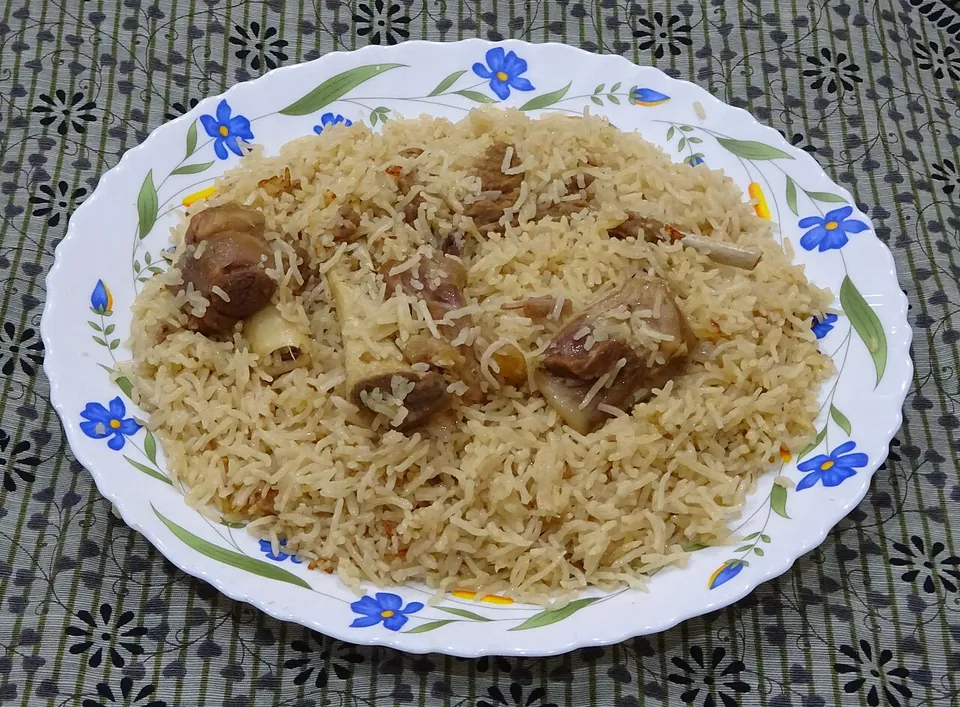
Pulao is a North Indian rice dish in which rice is lightly fried in ghee to lift its aroma, then cooked so it drinks up a seasoned stock. Where biryani leans on heavy, layered spicing, pulao is meant to be milder and mellow. It began at the courtly table yet became just as familiar as a home and festive dish.
The main ingredient, rice, is a long-established grain in South Asia, where paddy cultivation has been carried on for ages. That rice is fried in ghee, dressed with local spices such as onion, ginger, pepper, cumin, cardamom, and clove, and cooked in stock. Pulao is the meeting of a rice-cooking technique brought from Persia with the aromatic world of India.
Pulao belongs to the family of rice dishes descended from the Persian polow, and it is a sister to biryani, which branched from the same ancestral form within South Asia. The two are told apart by taste and by method: pulao a milder, simpler line, biryani a richer one in which rice and its garnish are layered and steamed slowly.
How we know
The origin of pulao was long told as reaching back to ancient India. The food historian K. T. Achaya argued for an indigenous origin, holding that words answering to pulao or pallao already appear in Sanskrit and Tamil texts of the third to sixth centuries (the Yajnavalkya Smriti among them). If the same name shows up in old writings, the reasoning ran, the dish itself must be that old, a plausible-sounding case.
But it was the food historian Charles Perry who called this a myth. The old words Achaya cited actually mean raw meat or fish, or withered, spoiled grain, and do not denote a pilaf-type rice dish. No trace of pulao is found in ancient India, Perry held, and Achaya had merely passed along, unchecked, a conclusion others had drawn from the primary sources. Colleen Taylor Sen and Ashis Nandy likewise find that the identically named word in ancient texts connects neither in meaning nor in history to today's pilaf, and conclude that pilaf appeared in India only after the medieval conquests out of Central Asia. It was a confusion of first attestation with origin, mistaking an old word of the same name for the source.
So what was the actual route? The Mughals were strongly drawn to Persian culture, and Humayun is said to have brought many Persian cooks with him in the 1530s. Through such courtly taste, Persian polow and pilaf-style rice cooking was carried in and fused with local spices. The Ain-i-Akbari (by Abul Fazl), a court record from Akbar's reign at the end of the sixteenth century, sets down a recipe for a minced-meat pulao in concrete terms, with rice, ghee, chickpeas, onion, ginger, pepper, cumin, cardamom, and clove, preserving a picture of the dish standardized at court. That the name and the ingredients survive together in a primary source is the foundation of the accepted account: Persian in origin, Mughal by way of arrival.
The full set of origin theories and the detailed verification log — traceable all the way to their sources — are available on the Japanese edition.
See the full origin theories and verification log (Japanese) →
Related dishes
Cross-links Sister dishes & same-name dishes (separate lineage)
Shares the key ingredient
- DosaSouth India (Tamil Nadu / Karnataka)C
- PaellaValencia, SpainC
- Risotto alla milaneseMilan (Lombardy, Italy)C
- Nasi gorengIndonesia (Java)C
- JambalayaNew Orleans (Louisiana, USA)C
- MujaddaraLevant (Syria, Lebanon, Palestine)B
- DoriaYokohama, JapanB
- IdliSouth IndiaC
- MaqlubaPalestine / LevantC
- White mixed rice (hondonban / goldongban — Bibimbap precursor)Korean PeninsulaC
- MandiHadhramaut (Yemen)C
- Rice and native-grain upma layer (sada upma, pre-semolina)South IndiaC
- KiribathSri LankaD
- KabsaSaudi ArabiaC
- PlovUzbekistan (Samarkand / Fergana)C
- MachboosPersian Gulf (Bahrain / Kuwait)B
- Gallo pintoCosta Rica / NicaraguaC
- Dal bhatNepalB
- KoshariEgyptC
- PilauEast Africa (Swahili Coast)C
- Rice-and-lentil koshari base layer (pre-pasta, pre-tomato)EgyptC
- Bánh cuốnVietnamB
- MahshiEgyptB
- PilavAnatoliaC
- Kabuli palawAfghanistanC
- Pilaf (French)FranceC
- Pilaf (Japanese-style)JapanC
- TahdigIranC
- Arroz de mariscoAlgarve (Portugal)C
- CasadoCosta RicaC
- Nan gyi thokeMyanmarC
- Mont diMyanmarC
- AranciniSicily (Italy)C
- Mazbi (madhbi)Yemen (Hadhramaut)C