All dishes / 北米
Jambalaya Period BOrigin theory CVerified
Some fields (dish name, region and gates) are shown from the Japanese-edition data.
The Louisiana rice dish jambalaya, the story often goes, arose as a stand-in for Spanish paella, its name a blend of jamón (ham) and paella. But that etymology finds no support in the record, and the origin is far from settled. A line running back to West African jollof rice now stands alongside it, this one with scholarly backing.
Verification highlight popular claim → verdict → evidence
The earliest known appearance of jambalaya in print is roughly 30 years earlier than long assumed: 1849 (American Agriculturist), not 1878. Its origin is contested: one line of scholarship, from historian Ibrahima Seck, traces it to West African Jolof-rice traditions, while another places it in a Spanish paella lineage. Etymologies tracing the name to Spanish jamon (ham) plus paella are rejected by the sources as folk etymology. Neither the origin nor the etymology is settled.
The three gates
- Ingredient-supply gate
- The key limiting factor is when rice cultivation took hold in Louisiana, established during the colonial period. Creole red jambalaya uses tomato, a New World crop, while the Cajun version omits it.
- Cooking-technique gate
- One-pot rice cookery, in a lineage linked to Spanish paella.
- Venue gate
- A home and community dish of Louisiana, with two branches: urban Creole and rural Cajun.
Overview
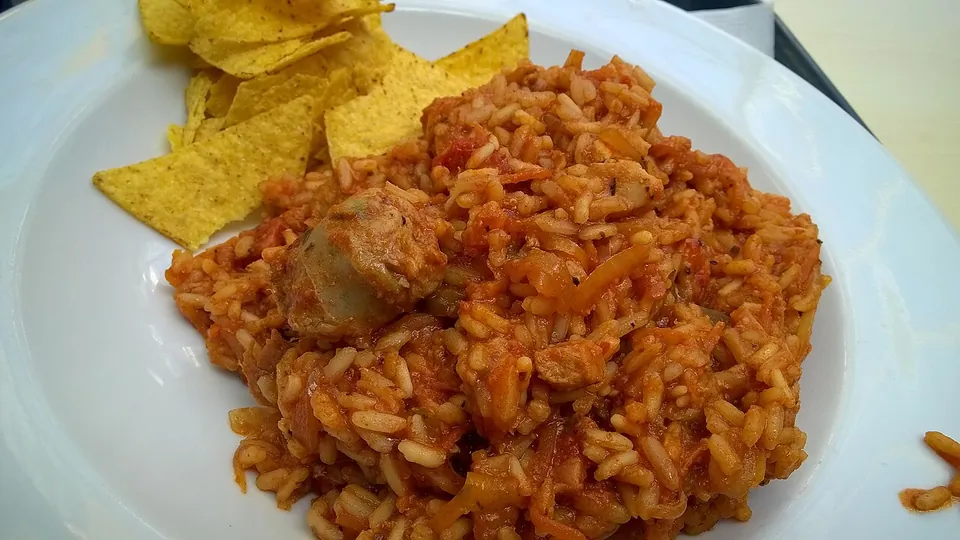
Jambalaya is a regional dish of Louisiana: rice cooked in a single pot with onion, bell pepper, and sausage or ham. The Creole "red" jambalaya adds tomato; the Cajun version leaves it out. Its makers span two regional cultures, the urban Creole world and the rural Cajun one.
Until rice took hold in Louisiana, this dish had no way of coming into being. Rice cultivation settled here from 1718 onward. The earliest record of the name in a printed recipe comes from May 1849, in the farm journal American Agriculturist: a recipe titled "Hopping Johnny (jambalaya)" sent in by Solon Robinson from Mobile, Alabama, cooking chicken, onion, rice, chile pepper, and parsley together. It runs about thirty years earlier than the 1878 cookbook long taken as the first attestation.
The earliest written record marks not the moment a dish was born but a point by which it certainly existed. Still, this 1849 recipe tells us that jambalaya in its present shape was on the table by then at the latest. Cooking rice down in a single pot came together as the people who gathered in Louisiana brought the food memories of their several homelands to the same fire.
How we know
Jambalaya's origin is often told as a single story. Spanish settlers set out to recreate paella and, short of saffron, reached for tomato instead. The name gets the same treatment: a coinage from Spanish jamón (ham) and paella, an explanation that has circulated widely.
But the ham-plus-paella account does not hold up. Line up the recipes written after 1849 and ham is not consistently present; it is not an essential ingredient. As word-building, it fails too: natural Spanish would run paella con jamón, and squeezing two words into jambalaya is a stretch. The alternative, French ham plus a West African word, fares no better, since the word said to mean rice does not appear with that sense in the major West African languages. The name jambalaya can be traced through the Louisiana record; its source remains unresolved.
On the origin itself, a second lineage has lately gained scholarly footing and taken its place beside the first. The historian Ibrahima Seck (Cheikh Anta Diop University in Dakar; director of research at the Whitney Plantation slavery museum) argued in his book Bouki Fait Gombo (2014) for a line running back to West African jollof rice. Many of the enslaved people brought to Louisiana came from Senegambia, carrying both a knowledge of rice growing and a tradition of cooking rice down in a single pot. That Louisiana's rice cultivation itself rested on their skills lends weight to this view.
So the European line by way of paella and the West African line by way of jollof each stand on independent evidence, facing each other without collapsing into one. What can be said with confidence reaches only this far: after rice cultivation took hold in Louisiana, the foods of several cultures met and this dish came together, and by 1849 at the latest it was on the table. Neither its origin nor its name has yet been drawn into a single thread.
The full set of origin theories and the detailed verification log — traceable all the way to their sources — are available on the Japanese edition.
See the full origin theories and verification log (Japanese) →
Related dishes
Shares the key ingredient
- BiryaniSouth Asia (Deccan / Mughal)C
- DosaSouth India (Tamil Nadu / Karnataka)C
- PaellaValencia, SpainC
- Risotto alla milaneseMilan (Lombardy, Italy)C
- Nasi gorengIndonesia (Java)C
- MujaddaraLevant (Syria, Lebanon, Palestine)B
- DoriaYokohama, JapanB
- IdliSouth IndiaC
- MaqlubaPalestine / LevantC
- White mixed rice (hondonban / goldongban — Bibimbap precursor)Korean PeninsulaC
- MandiHadhramaut (Yemen)C
- Rice and native-grain upma layer (sada upma, pre-semolina)South IndiaC
- KiribathSri LankaD
- KabsaSaudi ArabiaC
- PlovUzbekistan (Samarkand / Fergana)C
- MachboosPersian Gulf (Bahrain / Kuwait)B
- Gallo pintoCosta Rica / NicaraguaC
- Dal bhatNepalB
- KoshariEgyptC
- PilauEast Africa (Swahili Coast)C
- Rice-and-lentil koshari base layer (pre-pasta, pre-tomato)EgyptC
- Bánh cuốnVietnamB
- MahshiEgyptB
- PolowIranC
- PulaoNorth IndiaC
- PilavAnatoliaC
- Kabuli palawAfghanistanC
- Pilaf (French)FranceC
- Pilaf (Japanese-style)JapanC
- TahdigIranC
- Arroz de mariscoAlgarve (Portugal)C
- CasadoCosta RicaC
- Nan gyi thokeMyanmarC
- Mont diMyanmarC
- AranciniSicily (Italy)C
- Mazbi (madhbi)Yemen (Hadhramaut)C