All dishes / 東南アジア
Nasi goreng Period COrigin theory CVerified
Some fields (dish name, region and gates) are shown from the Japanese-edition data.
Some accounts trace nasi goreng, Indonesia's signature fried rice, to a 10th-century Javanese court. But the earliest form that can be followed in writing dates to 1814, and even that differs from the dish today. Its main ingredient, rice, is an old crop long rooted in the Javanese land, yet the fried rice as we now know it, built on sweet soy sauce and sambal, took shape far later.
Verification highlight popular claim → verdict → evidence
Neither when the dish took its current form nor its origin is settled. Rice offers no clue to dating since it is native, but the chili at the heart of sambal is a New World crop that arrived in the 16th century, setting the earliest possible date for the current form. The oldest known text, the 1814 Serat Centhini, describes a related but different dish without soy sauce; the modern form built around sweet soy sauce (kecap manis) and sambal seems to have settled only in the late Dutch colonial period (late 19th to early 20th century). Accounts differ on whether it derives from Chinese fried rice blended with a native habit of not wasting leftover rice, or from Middle Eastern pilaf; the question remains open.
The three gates
- Ingredient-supply gate
- Rice is native and not a limiting factor. The chili that gives the dish its signature heat, used in sambal, came from the New World, loosely setting a physical floor: it arrived in the 16th century.
- Cooking-technique gate
- Reheating leftover rice by stir-frying, using a wok or frying pan.
- Venue gate
- home kitchens and street stalls (warung). Social common people. everyday food. Java, and Indonesia more broadly.
Overview
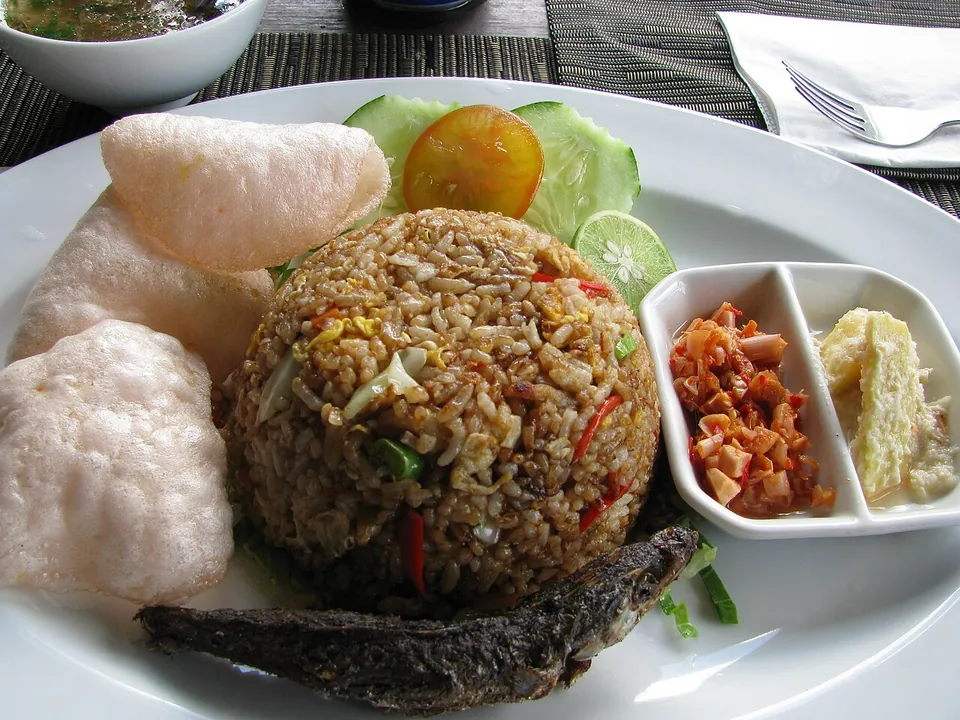
Nasi goreng is a Javanese everyday dish of Indonesia: leftover rice fried again and seasoned with kecap manis, a sweet soy sauce made with palm sugar, and with sambal, a chili condiment. Its main ingredient, rice, is an old crop long rooted in the Javanese land and on the daily table from early on. The chili at the heart of the heat, by contrast, is a New World crop that reached Indonesia in the 16th century, and the present seasoning of sambal and kecap manis dates from after the chili arrived.
At the base of the flavor is the cooking itself: leftover rice fried in a pan with a little oil. This frying technique is said to have been brought by Chinese merchants and migrants, arriving from the Majapahit era of the 15th century onward and spreading in the Dutch colonial period. Locally there was a household habit of not letting leftover rice go to waste, and the prevailing view is that nasi goreng arose when this frying technique joined that habit. It began as a way of using up household leftovers and later spread as a street-stall (warung) dish of ordinary people.
Kecap manis and sambal, the sweet soy sauce and the chili, are the distinctive core that sets nasi goreng apart from Chinese fried rice. This present form is thought to have settled into the cookbooks in the Dutch colonial period, from the late 19th into the early 20th century.
How we know
When nasi goreng came into being is a question with a wide spread of estimates, from the 10th century to the 19th. Some accounts describe it served as breakfast at a 10th-century Javanese court. But no contemporary record supports this court claim; trace it to its source and it ends in later popular books and blogs.
The earliest form that can be followed in writing is the fried rice that appears in the Javanese work Serat Centhini of 1814. A study of food habits in colonial Java confirms that this manuscript records sekul goreng. Yet its form differed from today's: it used no soy sauce and was not a single stand-alone dish. The year 1814 is only a limit meaning "it existed by at least this year," not proof that the dish was born then.
The line of origin, too, has not been narrowed to one. The main view holds that Chinese-style stir-frying merged with the local habit of using up leftover rice. Against this, the historian Fadly Rahman, in his major work Jejak Rasa Nusantara: Sejarah Makanan Indonesia (2016), argues that there is no historical evidence that nasi goreng is indigenous to Indonesia, and, alongside the Chinese influence, suggests it took its cue from the pilaf of the Middle East. On this view it is, like risotto and paella, a reworking of the pilaf that Arab trade brought in. The account was also reported in the English-language Jakarta Post in 2017.
The present style, with kecap manis and sambal, settled into the cookbooks in the Dutch colonial period, from the late 19th into the early 20th century. No source has yet been found to support the 10th-century court claim, and whether the origin lies in China or in the Middle East remains unsettled.
The full set of origin theories and the detailed verification log — traceable all the way to their sources — are available on the Japanese edition.
See the full origin theories and verification log (Japanese) →
Related dishes
Shares the key ingredient
- BiryaniSouth Asia (Deccan / Mughal)C
- DosaSouth India (Tamil Nadu / Karnataka)C
- PaellaValencia, SpainC
- Risotto alla milaneseMilan (Lombardy, Italy)C
- JambalayaNew Orleans (Louisiana, USA)C
- MujaddaraLevant (Syria, Lebanon, Palestine)B
- DoriaYokohama, JapanB
- IdliSouth IndiaC
- MaqlubaPalestine / LevantC
- White mixed rice (hondonban / goldongban — Bibimbap precursor)Korean PeninsulaC
- MandiHadhramaut (Yemen)C
- Rice and native-grain upma layer (sada upma, pre-semolina)South IndiaC
- KiribathSri LankaD
- KabsaSaudi ArabiaC
- PlovUzbekistan (Samarkand / Fergana)C
- MachboosPersian Gulf (Bahrain / Kuwait)B
- Gallo pintoCosta Rica / NicaraguaC
- Dal bhatNepalB
- KoshariEgyptC
- PilauEast Africa (Swahili Coast)C
- Rice-and-lentil koshari base layer (pre-pasta, pre-tomato)EgyptC
- Bánh cuốnVietnamB
- MahshiEgyptB
- PolowIranC
- PulaoNorth IndiaC
- PilavAnatoliaC
- Kabuli palawAfghanistanC
- Pilaf (French)FranceC
- Pilaf (Japanese-style)JapanC
- TahdigIranC
- Arroz de mariscoAlgarve (Portugal)C
- CasadoCosta RicaC
- Nan gyi thokeMyanmarC
- Mont diMyanmarC
- AranciniSicily (Italy)C
- Mazbi (madhbi)Yemen (Hadhramaut)C