All dishes / 南アジア
Rogan josh Period BOrigin theory CVerified
Some fields (dish name, region and gates) are shown from the Japanese-edition data.
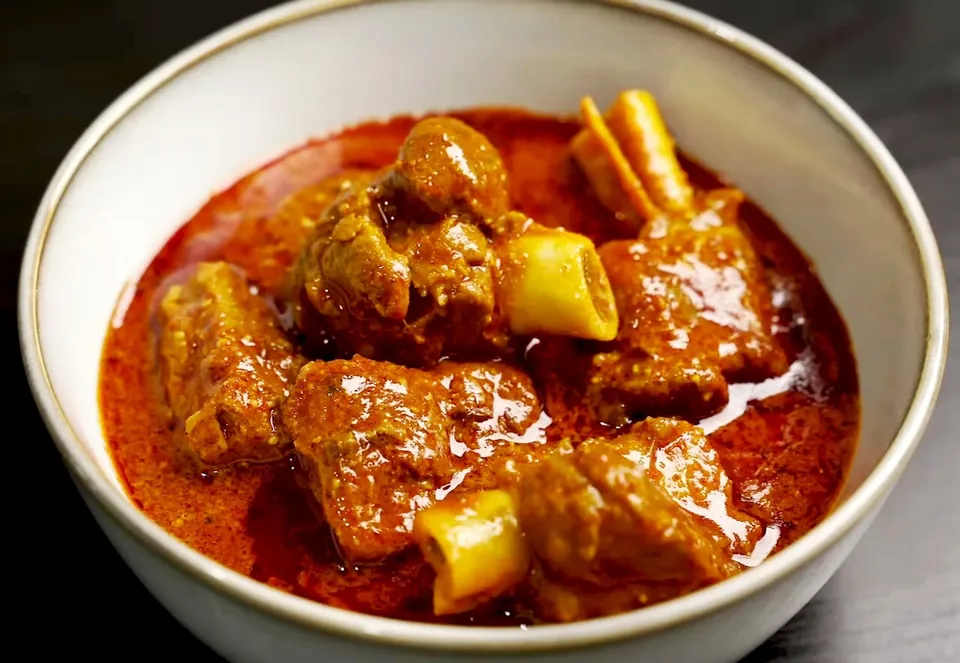
A Kashmiri mutton stew known for its vivid red. That red is often taken to come from chili, but the old form used no chili at all, coloured instead with a safflower-like root and cockscomb flowers.
Verification highlight popular claim → verdict → evidence
A claim that Rogan Josh appears in Abul Fazl's Ain-i-Akbari (c.1590) would push its earliest documented form back to the 16th century, but the imperial-kitchen section (about 30 dishes) lists biryani, qaliya, do-piyaza, musamman and kabab -- not rogan josh -- and the claim cites no primary source. The well-supported account: Rogan Josh is a Persian dish (cooking meat in hot oil/ghee) that Mughal rule carried into Kashmir in the 16th century, becoming a wazwan staple. Its name's etymology remains contested -- Persian roghan ('oil') plus josh ('boil/heat') versus Kashmiri/Urdu roghan ('red') plus gosht ('meat') -- and both the coloring source and the etymology remain unsettled.
The three gates
- Ingredient-supply gate
- The limiting ingredient, mutton, was a long-domesticated Old World animal available early. Red color came historically from natural dyes (alkanet root / cockscomb flower) and later also from Kashmiri chili (mild heat, deep color) once it reached South Asia c.1550; since chili is a secondary flavor/color element rather than the limiting ingredient, its arrival does not push back how early the dish could have formed.
- Cooking-technique gate
- Searing mutton in hot oil or ghee, then slow-simmering it with yogurt and spices -- a technique from Persian cuisine (roghan josh, 'cooked in oil/fat').
- Venue gate
- Brought to Kashmir as Mughal court cuisine of Persian origin in the 16th century, and established as a centerpiece of Kashmiri wazwan (multi-course feast) dining. This is the limiting gate.
Overview
From Persia to Kashmir
Rogan josh is a mutton stew that stands as the signature dish of the Kashmir region in northern India. Mutton is fried in hot oil or ghee, then combined with yoghurt and spices and simmered slowly. The technique itself has its source in Persian cooking.
The dish took root in Kashmir in the sixteenth century, in the age of the Mughal empire. According to the food historian Lizzie Collingham, the Mughal court, escaping the heat of central India, often stayed in the cool of Kashmir and brought its court cuisine along. The Persian-derived braise was thus carried into the land of Kashmir, where it took on local herbs and a character of its own. In time it became the main course of the many-dish banquet known as the wazwan, and grew into what one might call the face of the region's cooking.
How the red colour is produced has varied over time. The older form drew its colour from natural pigments, the root of a safflower-like plant (ratan jot, alkanet) and the cockscomb flower (maval), and added no heat. Later Kashmiri versions came to use a mild native chili (Kashmiri chili) as well, letting it carry both the colour and a gentle warmth. The main ingredient, mutton, is a long-established Old World meat, easy to come by in both court and market.
How we know
The very meaning of the name rogan josh has never settled into one reading. One reading takes it as Persian, oil (rogan) and simmering (josh), to cook in oil; another as Urdu or Kashmiri, red (rogan) and meat (gosht). The two stand side by side, and which is the original is undecided. The dish name first enters an English dictionary in 1934, and the Oxford English Dictionary lists both spellings, rogan josh and rogan gosht, evidence that both readings have long been alive.
Some pieces claim the dish left its name in the records much earlier. The assertion is that the Ain-i-Akbari (around 1590) of Abul Fazl, who served the emperor Akbar, records a dish called Rogan Josh. Were that true, the firm earliest mention of the present dish would reach back to the end of the sixteenth century. But the chapter of that source describing the imperial kitchen lists some thirty dishes, biryani, qaliya, do-piyaza, musamman, kabab and the rest, and the name rogan josh is nowhere among them (H. Blochmann's translation of the Ain-i-Akbari, Vol. 1, 1873). The claim rests on secondary and blog hearsay that cites no primary source, and looks to be a mistake, turning the broad influence of Persian cooking on the Mughals into the record of one particular dish name.
The assumption about the source of the red colour lies along the same line. Because modern Kashmiri versions colour the dish with a mild chili, it is easy to take that red for chili's own. But the classical preparation used no chili, dyeing the stew instead with a safflower-like root and cockscomb flowers. What is certain is the lineage: a dish that began in Persia and was carried, in the sixteenth century, into Kashmir along with the Mughal court. Lizzie Collingham's Curry: A Tale of Cooks and Conquerors (Oxford University Press, 2006) traces that line of transmission, and the origin itself is accepted as a stable account. Only the details, the etymology and the source of the colour, remain matters of several views.
The full set of origin theories and the detailed verification log — traceable all the way to their sources — are available on the Japanese edition.
See the full origin theories and verification log (Japanese) →