All dishes / 中東・北アフリカ
Machboos Period BOrigin theory BVerified
Some fields (dish name, region and gates) are shown from the Japanese-edition data.
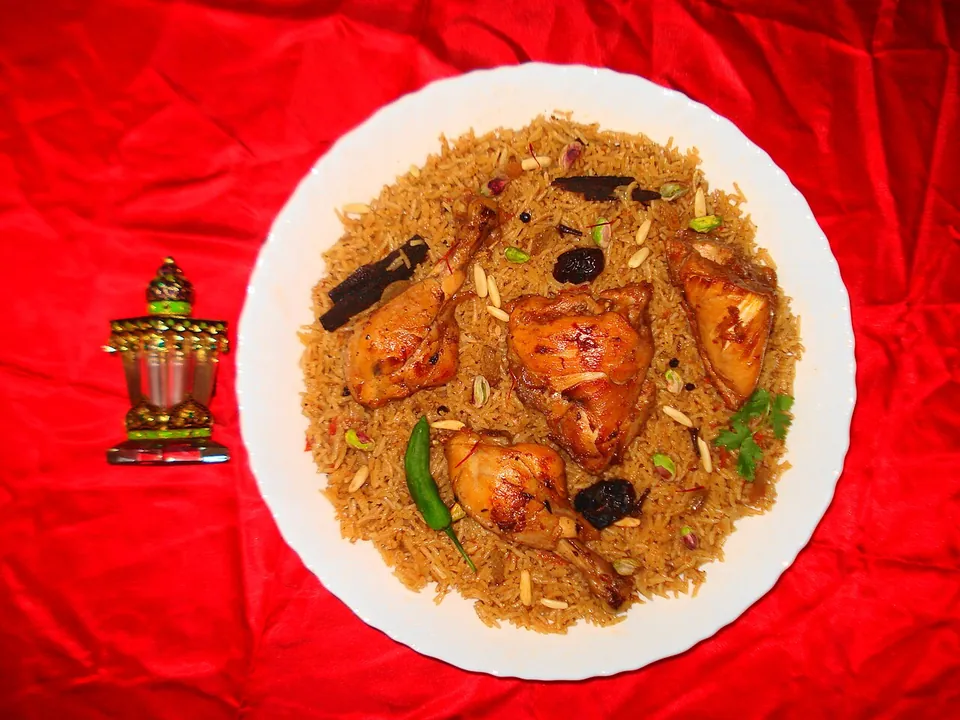
A one-pot rice dish that graces the tables of the Gulf. The name is different, but it is the same dish known as Kabsa in Saudi Arabia and Yemen.
Verification highlight popular claim → verdict → evidence
Myth: machboos is an ancient dish, brought to the Gulf by Indian and Persian traders in the distant past. Verdict: nothing dated supports that age. Rice, the heart of the dish, is not native to the Arabian Peninsula and reached the Gulf through Indian Ocean trade (roughly 800-1500). No recipe naming kabsa or machboos has yet been found in the oldest surviving Arabic cookbooks - al-Warraq's Kitab al-Tabikh (10th century), al-Baghdadi's manual of 1226, and the 13th-century Andalusian collection. A written mention, when one turns up, marks only the year by which a dish was already being eaten, not the year it was first made, and for machboos no such mention reaches back before the early modern period. The one-pot machboos eaten today took its shape in early modern to modern times; the much older habit of cooking rice together with meat or fish is not in question. Machboos is the Gulf's own name and regional variant of kabsa: it shares the Arabic root k-b-s ('to press'), not a separate root as sometimes claimed, with the passive participle makbūs shifting to mačbūs in Gulf dialect. Key sources: Wiktionary (machboos etymology); Kitab al-Tabikh (Wikipedia).
The three gates
- Ingredient-supply gate
- Rice is not native to the Arabian Peninsula; its supply via Indian Ocean trade sets the earliest possible date for the dish.
- Cooking-technique gate
- Rice is cooked together with fish or meat in a single pot.
- Venue gate
- A shared, hospitality-centered household dish.
Overview
Machboos is a large communal dish eaten across the Gulf—in Kuwait, Bahrain, Qatar, Oman and elsewhere—in which rice is cooked together with fish or meat in a single pot. It appears on family tables and at gatherings for guests.
The heart of its flavor is the rice. On the Arabian Peninsula, rice was never a native crop. Through the trade in spices and rice carried by Indian and Persian merchants, basmati rice along with cardamom, cinnamon and turmeric crossed the sea into the Gulf. The wealth built on pearl diving is said to have funded this spice trade. Until rice crossed the sea and reached the Gulf, this one-pot dish had no way of coming into being. There, the one-pot cooking developed by the desert Bedouin joined with it, and it settled into its present form over the early modern and modern periods. Influences from the Persian and Indian pilaf and biryani are noted as well.
What gives the Gulf version its character is the sourness of loomi, the dried black lime. Loomi is a preserved ingredient native to the Persian Gulf and Oman, long called the 'lemon of Basra' or the 'Omani lime.' This locally rooted sourness turns the flavor away from the Kabsa of Saudi Arabia and Yemen and lends it a Gulf character.
How we know
Machboos and Kabsa. They look like separate dishes, yet at heart they are the same one-pot rice dish. What differs is the name and the local seasoning.
About that name, one account was long told. Machboos, it was said, was a different word from Kabsa, deriving from the Arabic root j-b-s, 'to press in'—pointing to the way rice and meat are packed into a single pot and cooked. But from the side of linguistics, this is not the case. The name Machboos comes from exactly the same root as Kabsa, k-b-s (kabasa, 'to press in, to compress'). Its passive participle makbus went through the kaf-to-ch sound shift of Gulf dialect to become machbus (Wiktionary). In name too, then, the two were one and the same word. Machboos is simply the Gulf name for Kabsa.
The making of this dish trails several accounts. A Bedouin origin, an origin in Yemeni mandi, even a connection to Andalusian paella have been suggested (Wikipedia), and the origin cannot be pinned to a single source. What set the Gulf's own version apart played out on the ground: the basmati that Indian and Persian merchants unloaded at the pearling ports met the single-pot cooking the desert Bedouin had long practiced, and cooks folded in the sourness of loomi, the dried black lime cured around the Persian Gulf and Oman (Slow Food). Out of that meeting came Machboos—the Gulf version of Kabsa, marked by the tang of black lime.
The full set of origin theories and the detailed verification log — traceable all the way to their sources — are available on the Japanese edition.
See the full origin theories and verification log (Japanese) →
Related dishes
Cross-links Sister dishes & same-name dishes (separate lineage)
Shares the key ingredient
- BiryaniSouth Asia (Deccan / Mughal)C
- DosaSouth India (Tamil Nadu / Karnataka)C
- PaellaValencia, SpainC
- Risotto alla milaneseMilan (Lombardy, Italy)C
- Nasi gorengIndonesia (Java)C
- JambalayaNew Orleans (Louisiana, USA)C
- MujaddaraLevant (Syria, Lebanon, Palestine)B
- DoriaYokohama, JapanB
- IdliSouth IndiaC
- MaqlubaPalestine / LevantC
- White mixed rice (hondonban / goldongban — Bibimbap precursor)Korean PeninsulaC
- MandiHadhramaut (Yemen)C
- Rice and native-grain upma layer (sada upma, pre-semolina)South IndiaC
- KiribathSri LankaD
- PlovUzbekistan (Samarkand / Fergana)C
- Gallo pintoCosta Rica / NicaraguaC
- Dal bhatNepalB
- KoshariEgyptC
- PilauEast Africa (Swahili Coast)C
- Rice-and-lentil koshari base layer (pre-pasta, pre-tomato)EgyptC
- Bánh cuốnVietnamB
- MahshiEgyptB
- PolowIranC
- PulaoNorth IndiaC
- PilavAnatoliaC
- Kabuli palawAfghanistanC
- Pilaf (French)FranceC
- Pilaf (Japanese-style)JapanC
- TahdigIranC
- Arroz de mariscoAlgarve (Portugal)C
- CasadoCosta RicaC
- Nan gyi thokeMyanmarC
- Mont diMyanmarC
- AranciniSicily (Italy)C
- Mazbi (madhbi)Yemen (Hadhramaut)C