All dishes / 東南アジア
Bánh cuốn Period BOrigin theory BVerified
Some fields (dish name, region and gates) are shown from the Japanese-edition data.
The village of Thanh Tri near Hanoi gave birth to banh cuon; a prince taught the villagers the craft — so runs the familiar origin tale. But a poem in classical Chinese predates the village's own claimed "two hundred years of history" by more than five centuries, and that alone shows the story cannot stand as proof of where the dish began.
Verification highlight popular claim → verdict → evidence
Local tradition in Thanh Tri village near Hanoi holds that banh cuon originated there, taught by a prince of the eighteenth Hung King who showed villagers how to spread rice batter thin on cloth and steam it -- a two-hundred-year-old technique, and a story reaching back to Vietnam's legendary Hung King era. But this cherished village memory lacks contemporary documentation: no period source supports a Hung-era prince transmitting the technique, and the village's own "two hundred years" postdates the dish's appearance in writing by more than five centuries. The steamed thin rice-sheet technique instead took root in Vietnam as "spring rice cake," already celebrated in an 1291 poem by Tran Nhan Tong as an old Annamese custom, and recorded again around 1335 as a Cold Food festival gift; the earliest Han-Nom dictionary identifies that same dish with banh cuon. Thanh Tri remains a renowned place where the craft is kept alive today, but not the dish's birthplace.
The three gates
- Ingredient-supply gate
- Rice is a native staple; the defining constraint is less about ingredient availability than the cooking technique needed to steam thin rice-flour sheets.
- Cooking-technique gate
- Thin rice batter is poured and steamed on cloth stretched over boiling water.
- Venue gate
- A street-food breakfast snack.
Overview
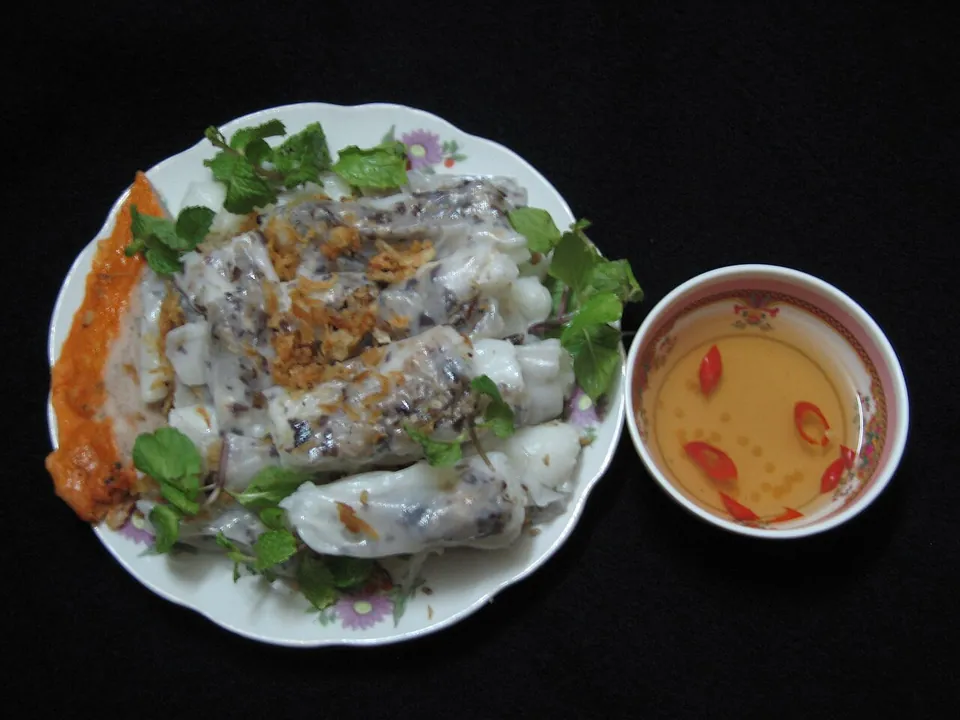
Bánh cuốn is made from rice that has been soaked, ground, and left to ferment into a batter, then spread thin over a cloth stretched across a steaming pot and cooked, covered, for a moment. The set sheet is lifted off in one stroke with a thin bamboo blade, filled with a core of stir-fried minced pork and wood-ear mushroom, and rolled. Fried shallots are scattered over the top, and a fish-sauce dip is served alongside. In northern Vietnam this has long been sold on the street as the light meal that starts the day.
Rice, pork, and wood-ear mushroom are all old ingredients rooted in this land, on hand from early on. The equipment amounts to little more than a pot, a single cloth stretched over it, and the slim blade that lifts the sheet. The heart of the dish is the handwork of spreading the batter into a thin film on the cloth and steaming it until it sets. Too thin and it tears; too thick and it turns heavy. Only when the cook's fingers have learned the heat, the amount to pour, and the moment to peel does a sheet emerge that is paper-thin and translucent. The fermented rice batter lends its faint sourness and softness, and steaming keeps it light, made without oil. That lightness — easy on a morning stomach — is part of why it took hold as a street-stall staple.
This cloth-steamed sheet traces back, at root, to the "spring cake" (bánh xuân thái) of the Chinese-character cultural sphere — a steamed spring pastry served at seasonal festivals. But the date at which it passed into Vietnam and became a local dish is older than one might expect. In a poem in classical Chinese composed in 1291 by the Trần emperor Trần Nhân Tông, the spring cake already appears as "a long-standing custom of An Nam." By the close of the thirteenth century, in other words, the thin rice sheet steamed over cloth was no exotic novelty but a custom soaked into the land. The breakfast bánh cuốn rolled at today's street stalls is what that long stretch of local rooting finally took on as the guise of a street snack.
How we know
The most commonly heard account of banh cuon's origin points to the village of Thanh Tri in northern Hanoi. This craft village along the Red River, where much of the population makes bánh cuốn, is a renowned producer and counts among the country's intangible cultural heritage. To it is attached a tradition that An Quốc, a prince of the eighteenth Hùng king, taught the villagers the art of cloth-steaming, and the village has prided itself on "two hundred years" of the craft.
Follow the contemporary records that would support this origin tale, however, and the dates do not line up at all. A poem in classical Chinese composed in 1291 by the Trần emperor Trần Nhân Tông contains the line "the spring cake heaped on the platter is a long-standing custom of An Nam" — the spring cake being the old name for bánh cuốn. Following it, Lê Tắc's Annam chí lược (around 1335) records people exchanging spring cakes at the Hàn thực festival, and the oldest surviving Hán-Nôm dictionary, the Chỉ nam ngọc âm giải nghĩa, identifies the spring cake with bánh cuốn. Three texts crossing to point at one fact: that by the end of the thirteenth century, at the latest, this steamed pastry already existed. Thanh Tri's "two hundred years" is younger than that by more than five centuries.
Thanh Tri, then, is not the village that gave birth to the dish but the village that later became known for producing it. The founding legend of the Hùng king's prince has no independent support, and local commentators too have criticized it as lacking any basis. What is instead placed on firm ground by those three texts is that a cloth-steaming technique of the spring-cake kind had passed over and, by the Trần dynasty, become a seasonal festival pastry soaked into Vietnamese soil. Whether it shares an ancestral form with Cantonese cheung fun, and where the two branched apart, remains a separate question — but that the thin sheet was already an old custom in thirteenth-century Vietnam is no longer in doubt.
The full set of origin theories and the detailed verification log — traceable all the way to their sources — are available on the Japanese edition.
See the full origin theories and verification log (Japanese) →
Related dishes
Shares the key ingredient
- BiryaniSouth Asia (Deccan / Mughal)C
- DosaSouth India (Tamil Nadu / Karnataka)C
- PaellaValencia, SpainC
- Risotto alla milaneseMilan (Lombardy, Italy)C
- Nasi gorengIndonesia (Java)C
- JambalayaNew Orleans (Louisiana, USA)C
- MujaddaraLevant (Syria, Lebanon, Palestine)B
- DoriaYokohama, JapanB
- IdliSouth IndiaC
- MaqlubaPalestine / LevantC
- White mixed rice (hondonban / goldongban — Bibimbap precursor)Korean PeninsulaC
- MandiHadhramaut (Yemen)C
- Rice and native-grain upma layer (sada upma, pre-semolina)South IndiaC
- KiribathSri LankaD
- KabsaSaudi ArabiaC
- PlovUzbekistan (Samarkand / Fergana)C
- MachboosPersian Gulf (Bahrain / Kuwait)B
- Gallo pintoCosta Rica / NicaraguaC
- Dal bhatNepalB
- KoshariEgyptC
- PilauEast Africa (Swahili Coast)C
- Rice-and-lentil koshari base layer (pre-pasta, pre-tomato)EgyptC
- MahshiEgyptB
- PolowIranC
- PulaoNorth IndiaC
- PilavAnatoliaC
- Kabuli palawAfghanistanC
- Pilaf (French)FranceC
- Pilaf (Japanese-style)JapanC
- TahdigIranC
- Arroz de mariscoAlgarve (Portugal)C
- CasadoCosta RicaC
- Nan gyi thokeMyanmarC
- Mont diMyanmarC
- AranciniSicily (Italy)C
- Mazbi (madhbi)Yemen (Hadhramaut)C