All dishes / 東アジア
Doria Period BOrigin theory BVerified
Some fields (dish name, region and gates) are shown from the Japanese-edition data.
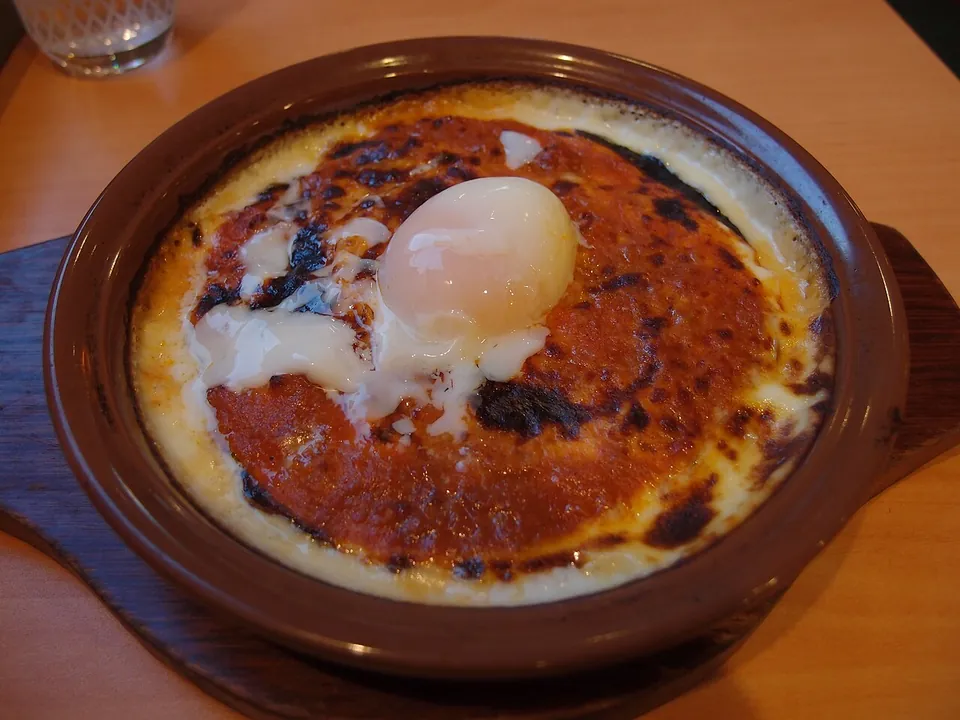
Doria looks like a European dish, yet Europe has no such thing. Rice layered with white sauce and baked until golden, it was born in a Western-style restaurant in Yokohama, a Japanese invention.
Verification highlight popular claim → verdict → evidence
Well established: Saly Weil, head chef at Yokohama Hotel New Grand, created this rice gratin around 1930, a dish invented in Japan. The name is genuinely tied to the Doria family, but the popular story that Weil coined it on the spot is rejected by the sources: the term a la Doria already existed in French cuisine (Escoffier, 1903, and documented in Japan by 1923), so Weil more likely adapted an existing culinary term rather than inventing it.
The three gates
- Ingredient-supply gate
- Rice is a native staple. The dish presupposes dairy products, butter, milk, cheese, and a white (bechamel) sauce.
- Cooking-technique gate
- Oven baking (gratin technique), built on a Western culinary foundation.
- Venue gate
- Originated in hotels and Western-style restaurants (yoshoku), later spreading into home kitchens.
Overview
Doria is a rice gratin: buttered rice topped with shrimp in cream and béchamel, finished with cheese and baked in the oven. It is said to have been devised around 1930 by Saly Weil, a Swiss chef and the first head chef of the Hotel New Grand in Yokohama.
The dish depends on several things being present at once: dairy, béchamel, and the Western technique of baking in an oven. Butter, milk, and cheese, the means to make a béchamel, and the Western kitchen itself all reached Yokohama across the sea after Japan opened to the world in the Meiji era. Milk shops appeared in Yokohama in the 1870s, and Western cooking slowly took hold there. Only once these tools and techniques had come together could a rice gratin take shape, and around 1930 falls after that groundwork was laid.
The rice at its center was a long-established local crop, on Japanese tables from early on. Onto that familiar staple came a technique from abroad and the setting of the hotel and the Western-style restaurant, and from there the dish worked its way down to the home kitchen. Doria is a modern dish, born in Yokohama where the local rice and an imported Western cuisine met.
How we know
Doria raises two questions. The first is where it was born. Rice topped with white sauce and baked has no counterpart in France, in Italy, or in Weil's native Switzerland. Following that thread, several food-history sources treat Doria as a Japanese Western-style invention. This is the settled view.
The second question is why it is called Doria. The hotel and the press tell it this way: a guest asked the name of the dish, and Weil, on the spot, named it after the noble Doria family of Genoa, the line of the admiral Andrea Doria. That the name traces to the Doria family is reasonable enough. But no contemporary record supports the part where Weil coined it in a flash of the moment. Classical French cooking already had a garnish called 'à la Doria', cucumber and lemon served with fish, recorded in Escoffier's Le Guide Culinaire (1903). And in Japanese too, the term appears before Weil: Tokuzo Akiyama, chef to the Imperial Household, describes 'à la Doria' in his Complete Book of French Cooking (1923) as a garnish that must include cucumber. Before Weil ever worked in Yokohama, this name honoring the Doria family was in use in France and among Japan's French-cooking circles alike. The natural reading is that Weil borrowed a term he already knew from his training and applied it to the naming in Yokohama.
There is a further wrinkle: the name 'à la Doria' itself may not come from the Doria family at all, but from a regular patron of the Café Anglais in 19th-century Paris, a claim that has not yet been settled. Even so, two things hold. The rice gratin was born in Japan, and its name was a borrowing from French cooking rather than a fresh invention. Separate the birthplace from the name, and what is left is not a dish conjured in a single stroke of genius, but one reassembled in Yokohama from a technique and a word acquired through training.
The full set of origin theories and the detailed verification log — traceable all the way to their sources — are available on the Japanese edition.
See the full origin theories and verification log (Japanese) →
Related dishes
Shares the key ingredient
- BiryaniSouth Asia (Deccan / Mughal)C
- DosaSouth India (Tamil Nadu / Karnataka)C
- PaellaValencia, SpainC
- Risotto alla milaneseMilan (Lombardy, Italy)C
- Nasi gorengIndonesia (Java)C
- JambalayaNew Orleans (Louisiana, USA)C
- MujaddaraLevant (Syria, Lebanon, Palestine)B
- IdliSouth IndiaC
- MaqlubaPalestine / LevantC
- White mixed rice (hondonban / goldongban — Bibimbap precursor)Korean PeninsulaC
- MandiHadhramaut (Yemen)C
- Rice and native-grain upma layer (sada upma, pre-semolina)South IndiaC
- KiribathSri LankaD
- KabsaSaudi ArabiaC
- PlovUzbekistan (Samarkand / Fergana)C
- MachboosPersian Gulf (Bahrain / Kuwait)B
- Gallo pintoCosta Rica / NicaraguaC
- Dal bhatNepalB
- KoshariEgyptC
- PilauEast Africa (Swahili Coast)C
- Rice-and-lentil koshari base layer (pre-pasta, pre-tomato)EgyptC
- Bánh cuốnVietnamB
- MahshiEgyptB
- PolowIranC
- PulaoNorth IndiaC
- PilavAnatoliaC
- Kabuli palawAfghanistanC
- Pilaf (French)FranceC
- Pilaf (Japanese-style)JapanC
- TahdigIranC
- Arroz de mariscoAlgarve (Portugal)C
- CasadoCosta RicaC
- Nan gyi thokeMyanmarC
- Mont diMyanmarC
- AranciniSicily (Italy)C
- Mazbi (madhbi)Yemen (Hadhramaut)C