All dishes / 東南アジア
Banh xeo Period COrigin theory CVerified
Some fields (dish name, region and gates) are shown from the Japanese-edition data.
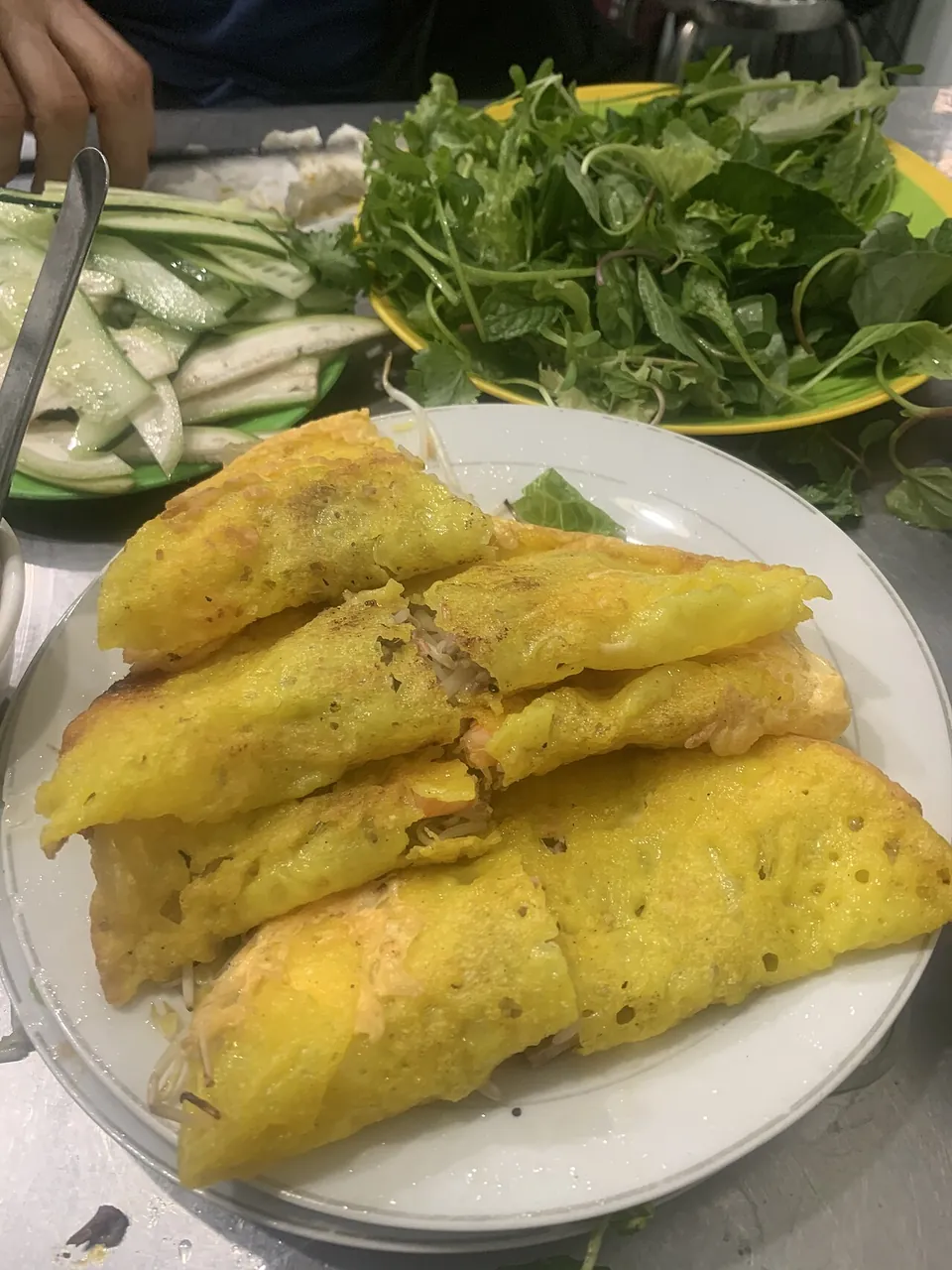
A rice-flour batter dyed golden with turmeric goes thin onto a hot pan and hisses "xèo"—and Vietnam's first monolingual dictionary, published in 1896, had already written down that the hiss is what gave the dish its name. Bánh xèo is a folded crepe born in the center of the country that grew large in the south.
Verification highlight popular claim → verdict → evidence
No single confirmed origin: a central Vietnamese origin (popularized under the Tay Son dynasty) and an external origin (via Cham or South Indian influence) are both treated as unproven, competing accounts. The firmest documentary anchor is an 1895-96 southern Vietnamese dictionary entry for "Xeo," which already records the onomatopoeic name and the method of pouring batter into a hot mold — but this is the earliest attestation, not proof of where or when the dish began.
The three gates
- Ingredient-supply gate
- Rice flour, turmeric, shrimp, pork, and bean sprouts/mung beans were all native to Vietnam or arrived early and were consistently available, so nothing held the dish back on the ingredient side.
- Cooking-technique gate
- Turmeric-tinted rice batter poured thin onto a hot iron pan, sizzling (xeo) into a crepe, then topped with shrimp, pork, bean sprouts, and mung beans and folded over.
- Venue gate
- Street stalls and home cooking of central and southern Vietnam; served in place of rice on the 16th day of the second lunar month under the Tay Son dynasty, and spread widely to Saigon in the 1980s as people from central Vietnam moved south.
Overview
When and where it began
Banh xeo is made from rice flour thinned with water and tinted yellow with turmeric, then poured thin onto a hot pan or cast-iron mold and fried. The "xeo" sound the batter makes the instant it hits the pan became the name. Shrimp, pork, bean sprouts, and mung beans go on top of the cooked skin, which is folded in half to enclose them. It is eaten wrapped with fresh greens and herbs, dipped in sauce.
Rice flour, turmeric, shrimp, pork, bean sprouts, and mung beans were all long-established, everyday ingredients in a Vietnamese kitchen, on the table from early on. With those to hand, a technique appeared: spreading thin rice batter over hot iron and frying it in one pass until the edges crisped up. The batter meets the pan, hisses "xeo," and sets into a thin golden skin—this frying craft took hold on the street, and the crepe called banh xeo appeared.
Where it was served was just as close to daily life. The street stalls and home kitchens of central and southern Vietnam were its setting, and in the era of the Tay Son it was so well liked that records tell of it being eaten in place of rice on the second and sixteenth of each lunar month.
Different in the center and the south
Even the same banh xeo takes a distinctly different shape from region to region. In the center, held to be its birthplace, it is fried small, in a cast-iron mold, colored deeply with fermented shrimp seasoning and kept light on filling. In the Mekong Delta of the south, by contrast, it is fried large, the size of a pizza, with coconut milk worked into the batter to brighten the turmeric yellow further, and it is generously filled. Coconut milk is native to that land, and it gives the southern version its richness.
In the 1980s, as people from the center moved south to settle, the dish took firm root in Saigon. The large southern version so widely known today became established in this way. The name, though, was in the south well before that. A Saigon dictionary that gathers southern vocabulary thickly had already entered banh xeo in 1896, as the worked example under its headword for the sound word xeo.
How we know
Several accounts stand side by side over when and where banh xeo began.
The leading view is that it originated in central Vietnam. By the time of the Tay Son dynasty in the eighteenth century, it was well enough liked to be eaten in place of rice on set days each month. A further suggestion holds that it grew out of banh khoai, a Hue griddle cake. Several independent sources, the Michelin Guide among them, line up on this thread: central origin, spreading during the Tay Son era as a stand-in for rice.
Those same sources, however, are unanimous that it is unclear when the dish came into being. The Tay Son telling rests on oral transmission and later writing. It conveys a dish already widely eaten; it does not mark the moment the dish first entered writing.
The oldest record that carries a firm date sits inside a dictionary. Vietnam's first monolingual Vietnamese dictionary, the Đại Nam Quấc Âm Tự Vị compiled by Huình-Tịnh Paulus Của and printed in Saigon between 1895 and 1896, has it in volume 2, page 579. What stands as the headword there is not the name of a dish but the sound word xèo—glossed as the noise fat makes when it suddenly crackles, the noise of frying with oil poured in. Banh xeo comes in underneath as the worked example: a kind of bánh fried in fat, which makes a sound the moment it is poured into the mold, and takes its name from that sound. The entry runs on to the phrase đúc bánh xèo, to cast that bánh in the mold. The etymology and the method of pouring into a mold and frying in oil are both already there, in one short entry. By 1896 at the latest, the dish and its name were fixed in the Vietnamese lexicon—and since this is a dictionary that gathers southern vocabulary thickly, the name was current in the south by the end of the nineteenth century too.
The year a dish is written down, though, is not the year it was born. The entry establishes that banh xeo existed by 1896. It says nothing about whether the dish arose in the center, or whether a method arrived from outside and was worked into local ingredients.
That second possibility has had a long life of its own. Some see a technique learned from the Cham over centuries; others trace it to the rice-flour crepes of southern India before the eleventh century, the fermented batter of dishes like dosa. There is a telling that a method carried by Indian traders was adapted through the Cham using native ingredients, and voices that place the origin in the cultural mixing of the French colonial period. Yet the evidence behind all of these is scant, and none rises above hypothesis. The thin-fried rice-flour skin itself is best regarded as belonging to a local lineage of technique.
Since none of the accounts is decisive, the origin can be traced back to the center, but beyond that its lineage remains open. What holds firm is the line set down in a dictionary compiled in Saigon at the end of the nineteenth century—it sounds when you pour it into the mold, and the sound is the name—and the journey: a small crepe born in the center changed into a large one in the Mekong Delta as people moved south, and became a dish that represents Vietnam.
The full set of origin theories and the detailed verification log — traceable all the way to their sources — are available on the Japanese edition.
See the full origin theories and verification log (Japanese) →