All dishes / 東南アジア
Banh mi Period BOrigin theory CVerified
Some fields (dish name, region and gates) are shown from the Japanese-edition data.
Vietnam's bánh mì is a sandwich that reworked the baguette left by French colonial rule into a portable food packed with local fillings. A well-known story explains the name 'bánh mì' as a corruption of the French pain de mie, but that account does not survive a look at the history of the words.
Verification highlight popular claim → verdict → evidence
Popular claim: 'banh mi' derives from French 'pain de mie' (soft white bread). Verdict: refuted linguistically -- 'banh' comes from the Chinese character for cake/bread and appears in Vietnamese texts from the 12th-13th centuries, centuries before French contact, while 'mi' is a native word for wheat; the compound simply means 'wheat bread,' not a French borrowing. The modern sandwich form is French-linked (baguette introduced in the 1860s, sandwich form popularized from the 1950s), but no single inventor is confirmed -- the widely told 1958 Hoa Ma (Saigon) origin story remains only one of several claims. Key sources: Dictionarium Anamitico-Latinum (Taberd, 1838); Wikipedia (Banh mi).
The three gates
- Ingredient-supply gate
- Wheat baguette (of French origin)
- Cooking-technique gate
- Colonial-era introduction of French bread-baking
- Venue gate
- Saigon street stalls
Overview
The present-day sandwich form of bánh mì came together in Saigon around the middle of the twentieth century, broadly in the 1950s.
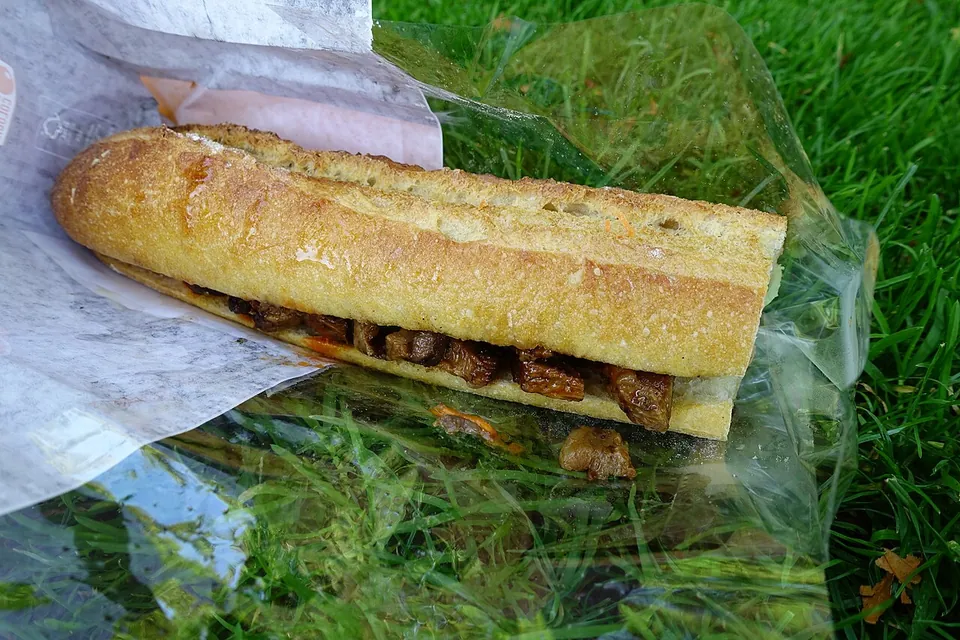
The baguette it rests on was not something Vietnam had of its own. Until wheat bread crossed the sea and took root in this land, a dish built on bread had no way of coming into being. Under French colonial rule, baking arrived and fresh baguettes began to line the streets, and only then were the conditions in place. Once the baguette had entered the Vietnamese table, people began to pack local fillings into it, tucking in pickled vegetables, herbs, meat and pâté so that the whole could be eaten in one hand, a French loaf and Vietnamese fillings settling into a single sandwich. That is bánh mì.
The stage for its making was the Saigon street stall. As a cheap, quick street food eaten standing at the roadside, this portable sandwich spread through the postwar city. Onto the bread form left by France rode the everyday food of ordinary Vietnamese, and at the stall it set into a dish of its own, the offspring of a colonial legacy and local life.
How we know
Alongside the origin of the dish, bánh mì carries a well-known way of talking about its name. The 'mì' of 'bánh mì,' it is often said, is a corruption of the French pain de mie, the white sandwich loaf. Since the dish comes from France, so the reasoning runs, the name must come from French too, which sounds plausible enough.
Trace the history of the words, though, and the account falls apart. 'Bánh' is an old word derived from the Chinese character for cake or bread, and it already appears in Vietnamese texts of the twelfth and thirteenth centuries, in works such as Tran Nhan Tong's Cư trần lạc đạo phú of around 1300, centuries before contact with France began in the nineteenth century. 'Mì,' for its part, is a native word meaning wheat. Put together, bánh mì means simply 'wheat bread,' not a transcription of the sound of pain de mie. That the dish itself descends from the French baguette is certain, but running the name back to French as well is an association that overreaches.
The word itself is recorded early. The Vietnamese 'bánh mì' (bread) is listed in the 1838 Dictionarium Anamitico-Latinum compiled by Taberd, taken as the earliest surviving use in writing. But the bánh mì there is simply 'bread,' not the filled sandwich of today. The first appearance of the word and the birth of the dish are separate matters. For the present sandwich form to appear, the arrival of the baguette (introduced in the later nineteenth century) had to be followed by the postwar work of packing fillings into it to make a portable food.
About the 'very first shop' there is another account. A couple, Lê Minh Ngọc and Nguyễn Thị Tịnh, came south from the north in 1954 and in 1958 opened a Saigon stall called Hòa Mã, which is said to be the shop that first packed fillings into a baguette to make it portable. The story is widely known, yet the evidence does not add up to a claim that it was truly the first, and calling Hòa Mã the birthplace outruns the sources. Vietnamese-language newspapers and surveys, too, go no further than treating Hòa Mã carefully as one of the early shops.
The full set of origin theories and the detailed verification log — traceable all the way to their sources — are available on the Japanese edition.
See the full origin theories and verification log (Japanese) →