All dishes / 東南アジア
Chả giò (Vietnamese fried spring roll) Period COrigin theory CVerified
Some fields (dish name, region and gates) are shown from the Japanese-edition data.
The Vietnamese fried spring roll is often traced to Emperor Quang Trung, the Tây Sơn hero said to have invented rice paper itself. But both the wrapper and the roll-and-fry technique are far older than his lifetime, and no independent record supports crediting the dish to a single inventor.
Verification highlight popular claim → verdict → evidence
A 1914 Saigon cookbook is the earliest print record found for the dish, confirming rice-paper wrapping as the distinctly Vietnamese twist on a Chinese spring-roll concept.
The three gates
- Ingredient-supply gate
- Rice paper, pork, and glass noodles were all available within Southeast Asia and the wider Old World; no limiting imported ingredient (provisional).
- Cooking-technique gate
- Wrapping the filling in rice paper and deep-frying.
- Venue gate
- Widespread as a fried dish for home cooking and festive occasions.
Overview
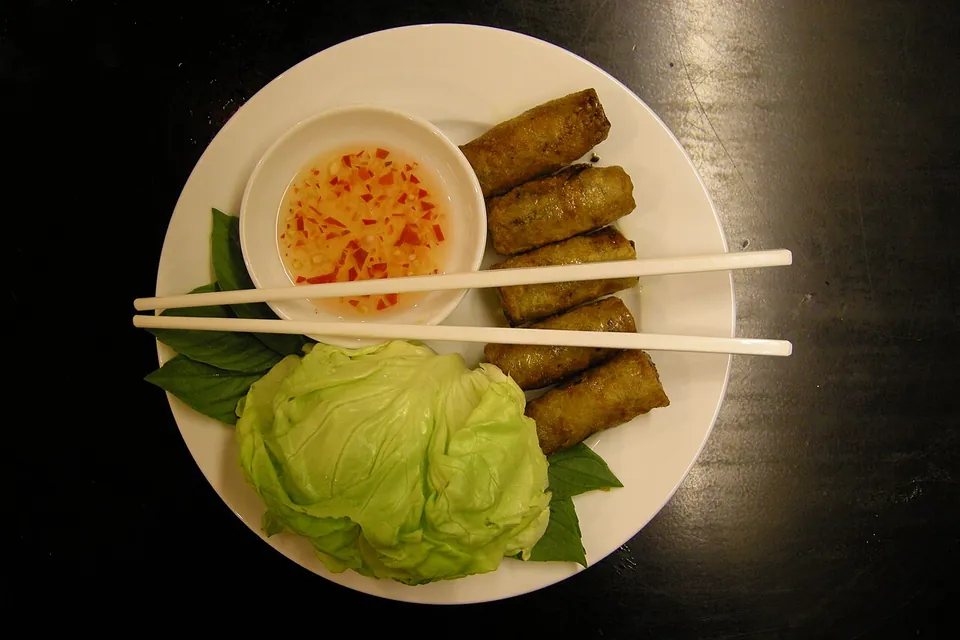
Chả giò is a fried roll built on rice paper (bánh tráng) that has been softened in water, then filled with seasoned ground pork, cellophane noodles, and finely shredded wood-ear mushroom and fried until golden. Its appeal lies in the contrast between the crisp, light shell and the moist filling within; it is eaten wrapped in herbs and lettuce and dipped in a fish-sauce-based sauce. A fixture at Vietnamese tables both festive and everyday, it goes by different names by region: cha gio in the south, nem rán in the north, chả ram in the center.
The wrapper, bánh tráng, is an old local staple: a batter of ground rice is steamed thin over cloth and dried in the sun. It is a specialty of Bình Định province in central Vietnam, said to have spread outward as people moved south. The pork, cellophane noodles, and wood-ear that fill it were long at hand as well. What makes the dish distinctly Vietnamese, then, is not any rare ingredient but the craft of wrapping in dried rice paper and frying. Wrapped in rice paper rather than a wheat skin, the shell blisters into its own fine bubbles and crisps as it fries. That texture is what sets the Vietnamese fried roll apart from other rolled-and-fried foods.
The idea of a rolled, fried parcel belongs to a wider lineage. Food historians and cooks broadly agree that chả giò descends from the Chinese spring roll — the thin-wrapped spring greens eaten at the start of spring, the chunpan that became the chunjuan — one branch of a family found across East and Southeast Asia. That cooking concept reached Vietnam, and by swapping the wheat skin for a rice-flour wrapper it settled into a form of its own. Yet no early record directly shows when this form first appeared in Vietnam, and the timing of its arrival remains unclear. The earliest firm textual trace of the dish is a 1914 Saigon cookbook, Sách dạy nấu ăn theo phép An Nam by Madame Lê Hữu Công, which names chả giò heo among 124 Vietnamese dishes.
How we know
The most widely told origin of chả giò credits Emperor Quang Trung — Nguyễn Huệ (1753–1792), the Tây Sơn hero — with inventing the Vietnamese rice-paper roll. When the man who saved the nation is also said to have invented the very wrapper now central to the table, the story sits well.
But the invention tale does not hold. The rice paper it rests on was made and eaten across a wide region long before the emperor was born. The very habit of wrapping fillings in a thin skin reaches back to the Chinese spring roll — the spring parcels of the Jin era, a Tang poet's line, an entry in a Yuan-dynasty text all speak to its age. For a single hero in a single year to have started it, this dish's lineage is far too old and far too broad. No independent early record supports tying the invention to the emperor's name, and it reads as a later story that hands the credit to a hero. The 1914 cookbook that gives the dish its earliest firm textual date carries no such attribution — the absence of any contemporary source for the emperor's feat is itself telling.
Setting the invention tale aside takes nothing from the dish. Its originality lies in receiving an old idea — the Chinese rolled-and-fried parcel — and rewrapping it in the local rice paper instead of wheat. No one person made it at a stroke; a cooking concept that arrived from outside and a rice paper rooted in the land blended over a long time into the dish as it stands. More than whether the hero's anecdote is true, that blending is what its making really looks like.
The full set of origin theories and the detailed verification log — traceable all the way to their sources — are available on the Japanese edition.
See the full origin theories and verification log (Japanese) →
Related dishes
Cross-links Sister dishes & same-name dishes (separate lineage)
- Diffusion prototypeSpring roll (Chinese)ChinaC
- Sister dish (shared ancestor)Gỏi cuốn (Vietnamese fresh rolls)VietnamC