All dishes / 東欧
Pirozhki Period BOrigin theory BVerified
Some fields (dish name, region and gates) are shown from the Japanese-edition data.
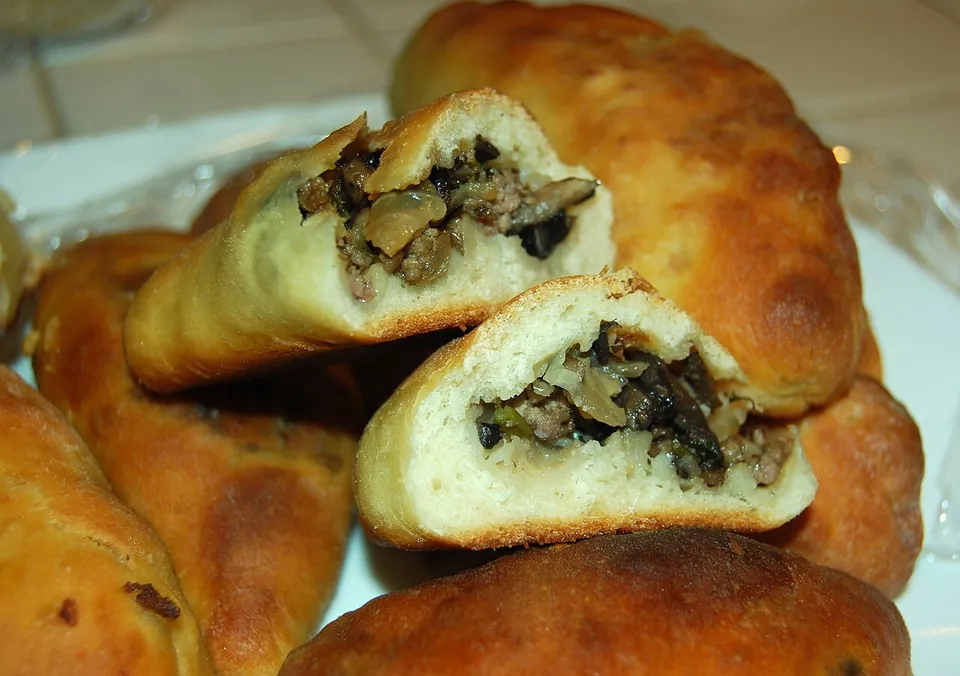
Russian pirozhki are small stuffed pies, filled with meat, cabbage, or fish and either baked or fried. The name goes back to an old Slavic word for 'feast', and the pies have run in an unbroken line through festive tables since the Middle Ages. The idea that the name was borrowed from Turkic has been set aside by etymological scholarship.
Verification highlight popular claim → verdict → evidence
Pirozhki take their name from the Old East Slavic word for a feast, and the earliest firm record of the stuffed-pastry genre is the 16th-century household manual Domostroi -- centuries before the now-familiar potato filling, which only became possible after the potato reached Ukraine around 1840.
The three gates
- Ingredient-supply gate
- Limiting factor: wheat or rye dough. Both grains were long established in Eastern Europe and Russia (wheat by the 5th c. BCE, rye by the 11th-12th c.), so there is no physical constraint. What actually sets the dish genre's lower bound is its first documentary attestation (the 16th-century Domostroi), not an ingredient. The potato filling (arriving in Ukraine c. 1840) is a modern variant filling, not the limiting factor.
- Cooking-technique gate
- Oven baking or deep-frying. Both were established techniques well before modern times, with no technical bottleneck.
- Venue gate
- home and festive occasions / Social all classes / indigenous / East Slavic
Overview
Pirozhki are small pies of dough wrapped around a filling and shaped by hand, then baked in the oven or fried in oil. The large form is called a pirog; pirozhki are its smaller kin. The fillings run wide: meat, cabbage, fish, buckwheat.
The wheat and rye at the heart of them are old grains in Eastern Europe and Russia. Wheat was rooted here by around the 5th century BCE, rye by the 11th or 12th. The raw materials were on hand early, and the dough was at first usually made from rye. In time a wheat dough spread and the pie moved toward the form we know today.
Baking in the oven and frying in oil were both everyday skills in pre-modern Russia. Baked in home kitchens, set on festive tables, present from the peasant house to the court, the pie appears across every part of daily life. It was not the food of any one class or faith but a pie woven into the very life of the East Slavs, with a long history behind it.
How we know
Two assumptions cling to pirozhki.
The first concerns the name. The claim runs that pirog (пирог) was borrowed from the Turkic böräk (a meat pie), or else that it came from the Old Slavic пира (a bag) and meant 'bread for the road.' Plausible as they sound, Max Vasmer's Russian Etymological Dictionary rejects both as 'unlikely' (Невероятно). Had the word been borrowed from böräk, cognates should show up in the South Slavic languages, and they do not. The пира account rests on a Greek borrowing with a limited range. The word was formed inside Slavic: пиръ, meaning 'feast', with the suffix -огъ, built the same way as творог (curd cheese), and it originally meant 'bread for a feast.' The name is recorded at the medieval feasts of Kyiv, and by the 16th century the household manual Domostroi lists stuffed pies of meat, cabbage, fish, and buckwheat.
The second is the modern reflex that pirozhki means potato-filled. But the New World potato only spread to the tables of Russia and Ukraine in the 19th century. It reached Ukraine around 1840, and after the failed harvests of 1838 and 1839 and the peasant unrest of the 1840s, it became a staple only in the latter half of the century. The potato pirozhok came after all of this, a newer dish. The old fillings were meat, cabbage, fish, and buckwheat; the potato joined them later. Not mistaking the age of the genre for the age of one particular filling is the key to reading this dish's history.
The full set of origin theories and the detailed verification log — traceable all the way to their sources — are available on the Japanese edition.
See the full origin theories and verification log (Japanese) →
Related dishes
Shares the key ingredient
- PierogiPolandC
- EmpanadaRío de la Plata (Argentina)C
- BliniRussiaB
- CheburekiCrimea (Crimean Tatar)C
- BelyashiVolga-Ural (Tatar / Bashkir)C
- JalebiNorthern IndiaB
- Fortune cookieCalifornia (USA)C
- StroopwafelGouda (Netherlands)C
- LamingtonQueensland (Australia)C
- ChimichangaTucson, Arizona (USA)C
- BuuzMongoliaB
- YantıkCrimea (Crimean Tatar)C
- VarenykyUkraineC
- MandaziEast Africa (Swahili Coast)C
- LángosHungaryC
- Daoxiaomian (knife-cut noodles)Shanxi (China)C
- KhuushuurMongoliaB
- Dobos torteHungaryB
- SambusaEast Africa (Swahili Coast)B
- SarburmaCrimea (Crimean Tatars)B
- ThenthukTibet / NepalB
- ShumaiGuangzhou (China)B
- Jiaozi (gyoza)ChinaC
- Hohhot shaomaiHohhot (China)B
- OliebollenNetherlandsC
- MarquesitaYucatán (Mexico)D
- Halwa puriLahore (Pakistan)D
- Roti prataSingaporeB
- SopaipillaNew Mexico (USA)C
- CoyotaSonora (Northern Mexico)C
- RunzaMidwestern United StatesB
- BanshMongoliaC
- Kashyk-ash (къашыкъ-аш, Crimean Tatar spoon-dumpling soup)Crimea (Crimean Tatar)C
- KulebyakaRussiaB
- Spring roll (Chinese)ChinaC
- ChuchvaraUzbekistan (Samarkand / Fergana)C
- DamperAustraliaC
- SamsaCentral AsiaC
- HalushkyUkraineC
- BanitsaBalkans (Bulgaria)C
- Har gowGuangzhou (China)C