All dishes / 南アジア
Haleem Period COrigin theory CVerified
Some fields (dish name, region and gates) are shown from the Japanese-edition data.
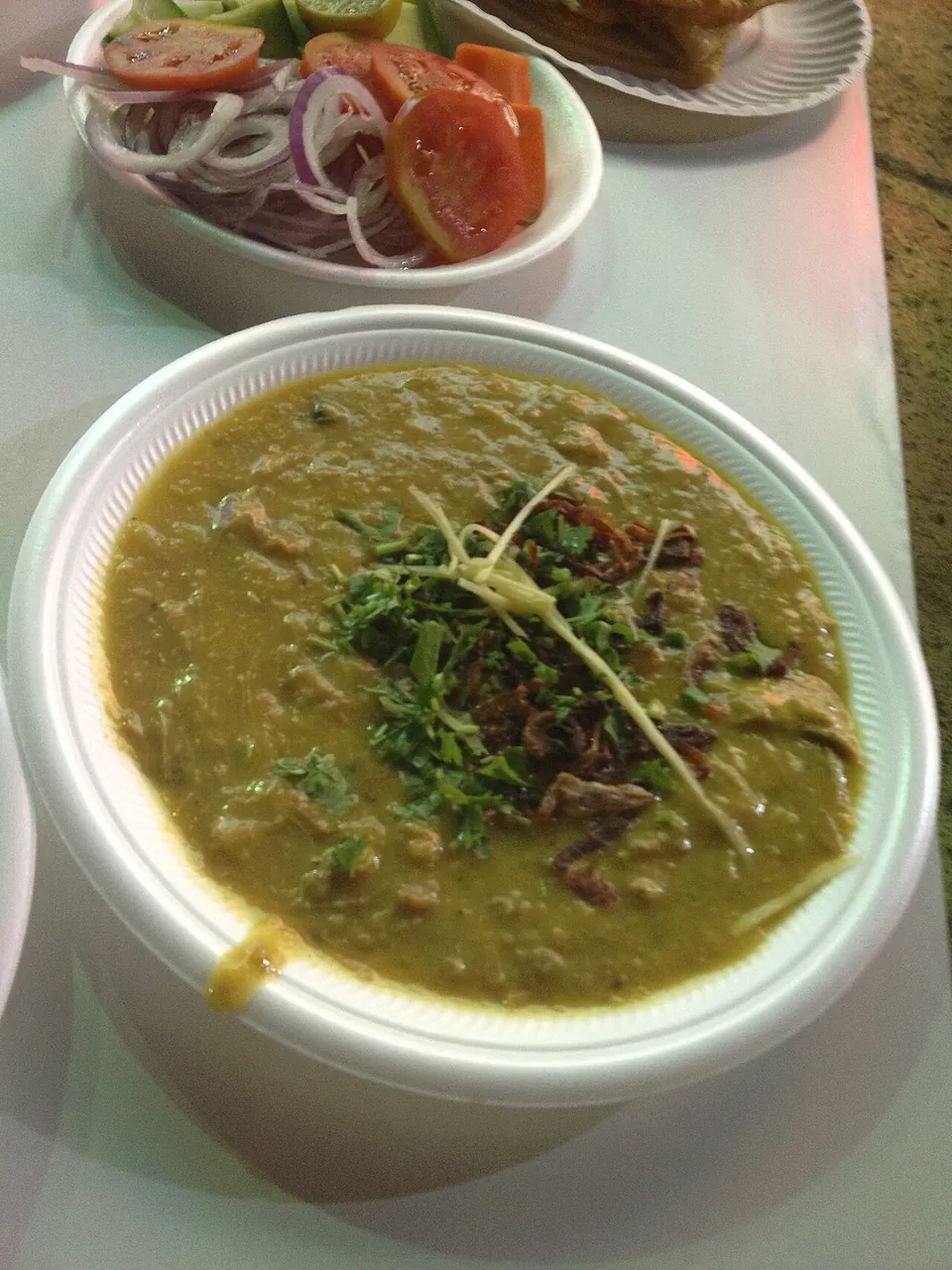
A dense Ramadan stew from Hyderabad in which wheat and meat are simmered and pounded until they melt into one another. The dish is often traced to a seventh-century caliph, but the oldest form we can actually follow in writing belongs to the tenth-century Arab world.
Verification highlight popular claim → verdict → evidence
The dish descends from the medieval Arab harees (recorded in 10th-century Baghdad's Kitab al-Tabikh, the oldest surviving Arabic cookbook), most likely brought to Hyderabad by Yemeni-descended Chaush soldiers and traders under the 6th Nizam and then localized with regional spices and ghee. A separate account credits its consolidation and popularization to the 7th Nizam's court; the two accounts differ on which period should be considered decisive, and the matter remains unresolved. It received Indian Geographical Indication status in 2010.
The three gates
- Ingredient-supply gate
- Wheat, mutton, and lentils are all locally available, so no single ingredient's arrival sets the limiting constraint.
- Cooking-technique gate
- Long, slow simmering and vigorous stirring to break meat and wheat down into a thick porridge.
- Venue gate
- Began as a court dish under the Nizams, later spread as a popular Ramadan street food.
Overview
When and where it took shape
Haleem is cracked wheat, mutton and lentils cooked for hours and stirred until the ingredients lose their edges and collapse into a thick, porridge-like mass. It is a signature dish of Hyderabad, on the Deccan plateau, and it is eaten above all to break the daily fast during Ramadan.
Wheat, mutton and pulses were all long-established staples of this land, on everyday tables from early on. What defines haleem is not any single ingredient but the labor of making it. The meat and grain are simmered for hours and stirred without pause, so that the contours of each dissolve and everything binds into a single sticky whole. This patient cooking is what separates haleem from an ordinary meat-and-wheat stew.
The settings in which it was served also mark its standing. What began as a dish of the court of the Nizams, the rulers of Hyderabad, spread outward until it was sold on the streets during Ramadan. The path down from the palace kitchen to the roadside pot is what raised it into a regional emblem. In 2010 Hyderabadi haleem was registered as a Geographical Indication of India, and its recognized method was set down in public terms: goat meat, a meat-to-grain ratio of ten to four, and long hours of cooking in a copper pot over a wood fire.
How we know
Haleem's origin is often told with a grand backstory. Its ancestor, harees, was already established in the seventh century as a dish favored by the Umayyad caliph Mu'awiya; that, at least, is the tale. The anecdote comes from a story preserved in the version of the Kitab al-Tabikh attributed to Ibn al-Karim.
But that seventh-century date cannot serve as proof of the dish's origin. The anecdote itself was written down some three centuries after Mu'awiya's lifetime, an attribution added long afterward rather than a contemporary record showing the dish existed in the 600s.
The oldest harees we can actually follow in a text sits in tenth-century Baghdad. The Kitab al-Tabikh compiled by Ibn Sayyar al-Warraq is the earliest surviving Arabic cookbook, and it records harisa as a dish of cracked grain and meat cooked long and pounded together. That places the dish in existence by the tenth century at the latest. This is the earliest point at which it appears in writing, not the year it was born.
How did this old Arab stew take root in Hyderabad, far away on the Deccan? The key lies with people from the Hadhramaut region of southern Yemen. Under the sixth Nizam, Mahbub Ali Khan (1869 to 1911), Yemeni soldiers and traders known as the Chaush came to Hyderabad and brought the harees of their homeland. Their dish was in time joined with local cumin, coriander, turmeric and garam masala, and with ghee, and grew into a distinct haleem unlike the Arab harees.
Haleem is said to have taken its recognized Hyderabadi form, and become widely known, under the seventh Nizam, Mir Osman Ali Khan. A nobleman from Mukalla in Yemen, Sultan Saif Nawaz Jung Bahadur, is remembered as having served it at banquets and spread it, and in 2010 Hyderabadi haleem was registered as a Geographical Indication of India, the first non-vegetarian food to receive the status. The specification even fixes the method: goat meat, meat and grain combined at a ratio of ten to four, and twelve hours of cooking in a copper pot over a wood fire. It took many generations, and much coming and going of people, for an old Arab stew to be written into law as a Deccan specialty.
The full set of origin theories and the detailed verification log — traceable all the way to their sources — are available on the Japanese edition.
See the full origin theories and verification log (Japanese) →
Related dishes
Cross-links Sister dishes & same-name dishes (separate lineage)
Shares the key ingredient
- SamosaIndian subcontinent (Delhi Sultanate)B
- KhachapuriGeorgia (Caucasus)C
- PelmeniSiberia (Russia)C
- Hot dogNew York, United StatesB
- KobeteCrimea (Crimean Tatar)C
- BrikTunisiaC
- BoortsogMongoliaC
- Mission burritoSan Francisco, California (USA)C