All dishes / 東アジア
Boortsog Period COrigin theory CVerified
Some fields (dish name, region and gates) are shown from the Japanese-edition data.
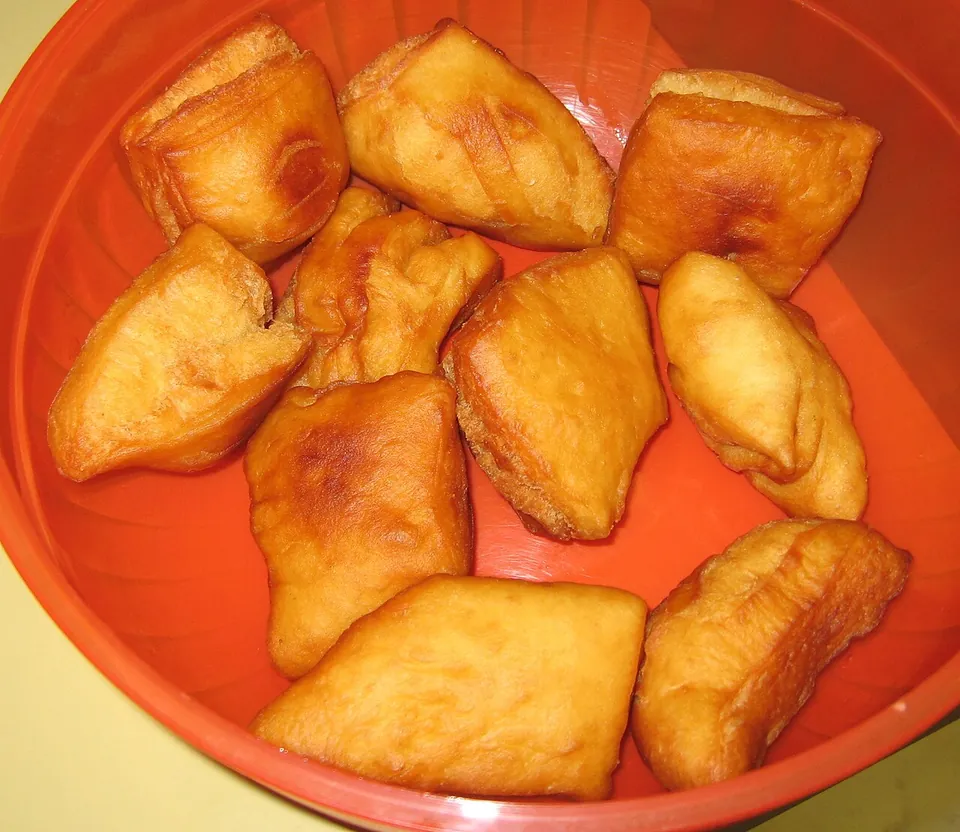
A simple fried dough cooked in mutton fat, boortsog is indispensable to the Mongolian new year. It is sometimes told as a confection the ancient Mongol nomads devised for themselves, yet its name reaches back into Turkic speech, kin to the Kazakh baursak and the Kyrgyz boorsok, and it is a shared possession of the whole Central Asian steppe.
Verification highlight popular claim → verdict → evidence
The story of Mongols inventing boortsog as a nation-unique sweet does not hold up: etymology and cognates point to a pan-Central Asian, Turkic-rooted tradition of fried dough with no single attributable inventor, of which Mongolia is one branch. Main source: Proto-Turkic etymology (Wiktionary) corroborated by 19th-century Russian travel accounts.
The three gates
- Ingredient-supply gate
- Wheat was obtained through trade and local supply; mutton fat was a native staple of nomadic herding.
- Cooking-technique gate
- Kneaded dough fried in animal fat.
- Venue gate
- An offering at nomadic festivals, especially the Lunar New Year (Tsagaan Sar).
Overview
Boortsog is a plain confection of wheat-flour dough fried in mutton fat. At Tsagaan Sar, the Mongolian new year, the sight of these stacked high as an offering is essential.
The ingredients all come from the nomadic day. Wheat was had through trade and through cultivation on the margins of the steppe, and mutton fat had long been at hand for a people who live alongside their flocks. Kneaded dough is dropped into hot animal fat and fried. Portable and keeping well, this is a food that took its shape not at a settled hearth but in a moving way of life.
This kind of cooking—frying dough in fat—is not Mongolia's alone. The Kazakhs, the Kyrgyz, the Uzbeks, the Tatars, and even the Eastern Yugur of western China: the Turkic and Mongolic peoples each have a closely similar fried dough, and call it by a closely similar name. It is a dish of a wide cultural sphere, shared out across a life of crossing the steppe.
The cauldron cooking beneath it reaches back further than one might expect. From late Bronze Age metal cauldrons of Mongolia, around 2,700 years old, Wilkin and colleagues reported in 2024 residues of blood and milk protein, showing that the people of the steppe have boiled and cooked in large cauldrons for that long. The gesture of heating fat and frying dough sits on the far end of that old cauldron culture.
For that reason, when boortsog became established as the Tsagaan Sar offering cannot be fixed to a year in any firm source. That it has long been handed down together with the steppe new year is about as far as one can say, and in that lies the antiquity of this confection.
How we know
On the origin of boortsog, blogs and the like sometimes tell of "a confection the ancient Mongol nomads invented, native to their own country." But this telling does not sit well with the traces the words themselves leave behind.
The name boortsog (боорцог) goes back to Proto-Turkic *bagïrsuk. This is a word meaning "intestine," thought to come from the twisted shape of the early dough. From the same root branch the Kazakh baursak, the Kyrgyz boorsok, the names in Uzbek and Tatar, and even the term in the Eastern Yugur of western China. The Mongolian boortsog stands among them as a borrowing from, or a cognate of, this Turkic word. Given how widely the name overlaps across these languages, it cannot be credited to a single people or a single date as its inventor. Fried dough is a shared possession the steppe nomads have long held in common, and Mongolia is one branch that made it its own as the Tsagaan Sar offering of the new year.
Seen this way, the place of the "Mongolia's own invention" telling comes into view too. It was not invented but inherited and rooted here—that is the picture the etymology and the spread of cognates point to.
That no firm inventor and no firm year of invention can be identified does not diminish this confection. If anything it shows that boortsog belongs not to a particular court or year but to the roving nomadic life of the steppe itself.
The full set of origin theories and the detailed verification log — traceable all the way to their sources — are available on the Japanese edition.
See the full origin theories and verification log (Japanese) →
Related dishes
Shares the key ingredient
- SamosaIndian subcontinent (Delhi Sultanate)B
- KhachapuriGeorgia (Caucasus)C
- PelmeniSiberia (Russia)C
- Hot dogNew York, United StatesB
- HaleemHyderabad (Deccan)C
- KobeteCrimea (Crimean Tatar)C
- BrikTunisiaC
- Mission burritoSan Francisco, California (USA)C