All dishes / 東欧
Khachapuri Period COrigin theory CVerified
Some fields (dish name, region and gates) are shown from the Japanese-edition data.
Khachapuri, the cheese bread of Georgia, is built from wheat and cheese, long-established staples of the land, and its origins reach deep into the medieval period. The tale that the boat-shaped Adjaruli was modelled by Black Sea sailors on the sea, a ship, and the sun, however, has only been handed down by word of mouth; the sources point instead to a modern origin.
Verification highlight popular claim → verdict → evidence
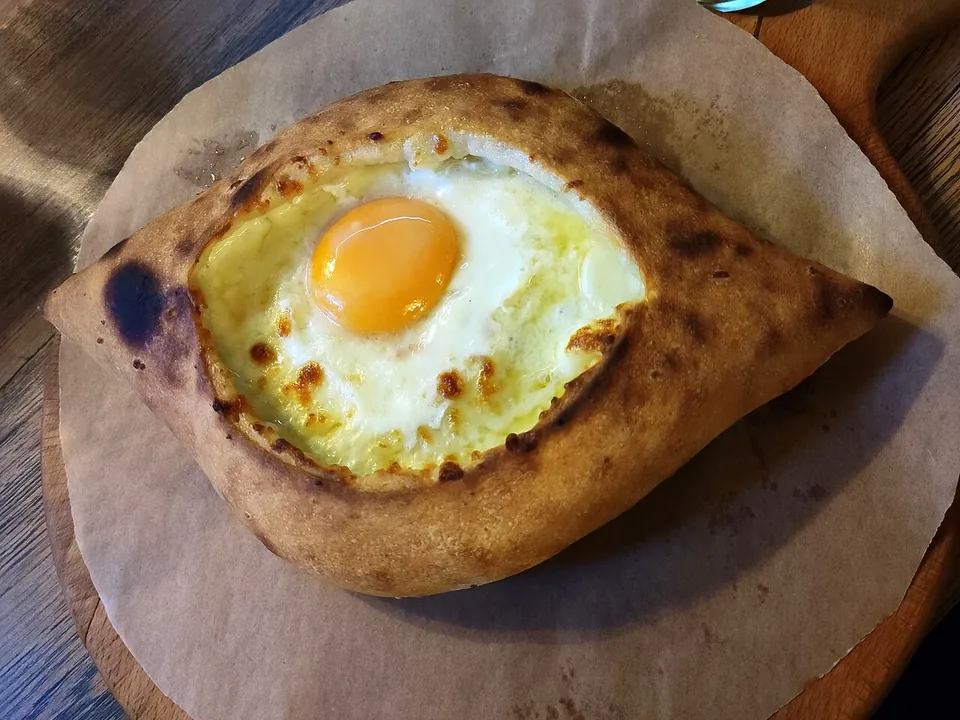
Popular story: the boat shape of Adjarian khachapuri, with an egg yolk at its center, symbolizes the sea, a boat, and the sun as imagined by Laz sailors. Verdict: refuted -- the dish's round predecessor, 'penerli' (from Turkish peynirli), arrived under Ottoman rule in the 15th-16th century, and only took its boat shape in the 19th-20th century and its current name in the 1950s; a food historian quoted in the press calls the sea/boat/sun story an explicit legend, not history. Key sources: Adjarian Khachapuri, Advantour; Adjaruli Khachapuri: The Cheesy Bread, Going.com.
The three gates
- Ingredient-supply gate
- Wheat, cheese, and eggs were all long-established in the region — the Caucasus is one of the old centres of wheat growing. Nothing among the ingredients sets an earliest possible date for the dish; it rests on staples already at hand in the land.
- Cooking-technique gate
- Wheat is milled to flour and the dough leavened, then baked in an oven or on a flat pan, while the filling calls for the separate craft of cheesemaking.
- Venue gate
- Baked at home, it was everyday food for ordinary people, and it belonged to every province of Georgia alike.
Overview
A bread born of Caucasian wheat and cheese
Khachapuri is a Georgian cheese bread: leavened wheat dough wrapped around cheese and baked, using local cheeses such as Sulguni and Imeruli and, at times, egg. Both the wheat and the cheese are long-established local ingredients. This part of the Caucasus is one of the old centres of wheat growing, where grain farming and dairying were woven into daily life from early on. A dish that stands on the produce of the land alone, khachapuri reaches back into a deep past.
Baking the bread calls for its own crafts: grinding the wheat, leavening the dough, and baking it brown in an oven or on a flat pan. Making the cheese calls for another. These skills grew over a long time in a region where grain farming and dairying were bound tightly together.
Khachapuri began as a food of the rural home and later branched into regional styles. Imeruli seals the cheese inside the dough; Megruli lays Sulguni on top as well; Adjaruli is shaped like a boat and finished with an egg yolk and butter. These are the three best-known styles. Yet records showing when each took form are scarce, and even the order of which came first is unclear.
The word khachapuri itself appears plainly in writing in 1725, in a record from the time of the lexicographer Sulkhan-Saba Orbeliani. The first appearance of the name, though, is a separate matter from the beginning of the dish. In western Georgia (Colchis), a Greek writer as early as the fifth century BC already mentions a dish much like khachapuri. The cheese-bread genre itself was in this land long before its name was set down in writing.
How we know
Khachapuri holds together two different things: an antiquity that inquiry has firmed up, and an origin tale that inquiry has taken apart.
First, the antiquity. Khachapuri as a genre, the cheese bread itself, goes back to the medieval period, and this is the part whose standing has been raised toward a firmer consensus. The food historian Darra Goldstein places khachapuri as far back as the twelfth century, Georgia's golden age. The view that this bread, resting on local wheat and cheese, had taken shape by the medieval period in the wheat-and-dairy country of western Georgia stands firm.
Next, the timing of the regional styles, which remains unsettled. Imeruli, Megruli, and Adjaruli each arose as a variant suited to a region's own cheese and terrain, but records showing when each style took form are scarce, and the order of which is older cannot be fixed.
And the most colourful story turns out to be the most recent. The boat shape of Adjaruli, with an egg yolk set in the middle, is said to have been modelled by sailors of the Black Sea coast on the sea, a ship, and the sun. The tale circulates widely in cookbooks and travel pieces, but the sources tell the reverse. The forerunner of Adjaruli was a round bread known around Batumi as penerli, a name from the Turkish peynirli, meaning with cheese, that came in with the lineage of Turkish pide under Ottoman rule in the fifteenth and sixteenth centuries. The name penerli lingered until around the 1950s, and the present boat shape finished with an egg took form only in the nineteenth and twentieth centuries. The symbolism of sea, ship, and sun was thus a story added later to a form standardized in modern times; the food historian Lali Papashvily calls it a poetic fable. It is a lovely explanation, but the sources do not support it.
The full set of origin theories and the detailed verification log — traceable all the way to their sources — are available on the Japanese edition.
See the full origin theories and verification log (Japanese) →
Related dishes
Shares the key ingredient
- SamosaIndian subcontinent (Delhi Sultanate)B
- PelmeniSiberia (Russia)C
- Hot dogNew York, United StatesB
- HaleemHyderabad (Deccan)C
- KobeteCrimea (Crimean Tatar)C
- BrikTunisiaC
- BoortsogMongoliaC
- Mission burritoSan Francisco, California (USA)C